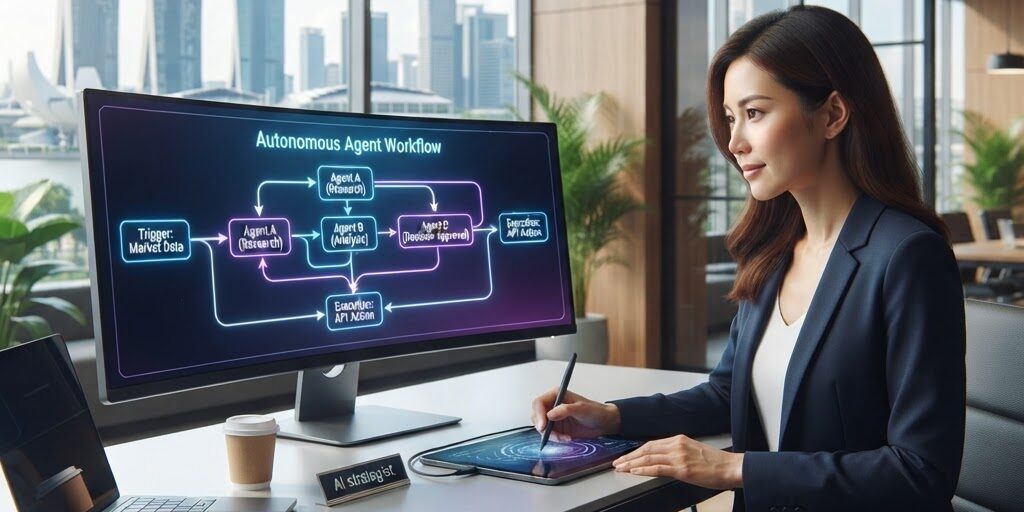
Mastering Agentic AI Workflows: A Guide for Singapore Professionals in 2026
As the digital landscape of Singapore continues to evolve, the shift toward autonomous technologies has redefined productivity standards. By 2026, the primary focus for industry leaders has moved away from basic prompt engineering toward the sophisticated implementation of agentic AI workflows. Unlike static chatbots that respond to individual inputs, agentic systems operate as dynamic loops, capable of reasoning, planning, and executing multi-step business objectives without constant human intervention. For Singaporean professionals aiming to remain competitive in an increasingly automated global economy, mastering these workflows is no longer optional. This guide explores the architecture of autonomous agents, the strategic benefits of integrating them into business operations, and the core competencies required to design effective AI systems. By understanding how to bridge the gap between simple automation and true agency, professionals can unlock new levels of efficiency, innovation, and strategic value. Whether you are leading a team or refining your individual contributions, embracing this transformation is critical for professional relevance and operational excellence in our interconnected, high-tech landscape.
Table of Contents
The Evolution of Agentic AI
The transition from generative AI to agentic AI marks the most significant milestone in the history of business automation. While generative models are excellent at summarizing text or creating images, agentic AI workflows represent a paradigm shift where software moves from being a passive tool to an active participant in professional processes. In 2026, Singaporean businesses are increasingly reliant on agents that can navigate complex software environments, integrate disparate databases, and solve problems through iterative feedback loops. The fundamental difference lies in the agent’s ability to plan. Instead of relying on a single prompt to generate a static answer, an agentic system analyzes a task, decomposes it into smaller logical sub-tasks, and executes each one while adjusting its approach based on real-time data. This capability allows professionals to focus on high-level strategy rather than mundane execution. Industry experts have noted that the core of this evolution is the integration of reasoning models with external tools. By granting an AI access to internet search, coding environments, or internal corporate APIs, organizations can automate entire departments’ worth of manual labor. The shift requires a fundamental change in how we perceive software interaction. We are no longer just instructing computers; we are managing automated agents that act as digital employees. This necessitates a deep understanding of control loops, error handling, and security protocols to ensure that these autonomous systems operate within company guidelines while maximizing efficiency. As we look at the trajectory of these tools, it is clear that the ability to orchestrate multi-agent systems will be the defining skill for digital transformation specialists throughout the Asia-Pacific region. This new methodology requires a blend of technical literacy and creative problem-solving skills that allow users to design workflows that are robust, resilient, and highly adaptable to changing market conditions.
Designing Effective Autonomous Systems
Building a successful agentic AI workflow begins with careful design principles. The process starts by identifying a specific business process that requires multiple steps, such as lead qualification or automated financial reporting. Unlike traditional automation which follows a linear script, agentic workflows require a framework that handles uncertainty. Designers must map out the objectives, constraints, and the tools the AI will have at its disposal. A robust design includes clear definitions of the agent’s persona, its operational boundaries, and the specific validation steps that human oversight will trigger. Industry standard practices for designing these systems include iterative testing where the agent is forced to justify its actions before finalizing a task. This creates a feedback loop that improves the reliability of the system over time. Furthermore, the selection of the underlying large language model is crucial, as the agent needs significant reasoning capability to avoid hallucinations and maintain task alignment. Professionals should consider the environment in which the agent operates; a secure, isolated sandbox is often the best choice for handling sensitive proprietary information. The following table illustrates the key components required for a functional agentic framework when designing these workflows for modern business applications.
| Component | Function | Importance |
|---|---|---|
| Reasoning Core | The LLM engine that plans tasks | High – Determines intelligence |
| Tool Integration | Connecting to external software/APIs | High – Enables execution |
| Memory Layer | Storing context across sessions | Medium – Adds continuity |
| Safety Guardrails | Constraint enforcement mechanisms | Critical – Prevents errors |
By focusing on these components, designers can ensure that their autonomous systems are not just functional but also scalable and secure. Designing for agency means moving away from the “if-this-then-that” mentality of traditional automation. Instead, it involves providing the agent with a goal and the necessary resources to achieve that goal in a dynamic environment, ensuring that the architecture can accommodate unexpected variables while maintaining the integrity of the business outcome.
Business Impact and Scalability
The impact of implementing agentic AI workflows on business performance in Singapore has been profound. By automating repetitive, multi-step tasks, organizations can achieve a level of operational throughput that was previously impossible. This is particularly relevant in sectors such as fintech, logistics, and legal services, where accuracy and speed are paramount. When agents manage the flow of information between departments, the chance of human error is significantly reduced, and the speed at which decisions can be made increases exponentially. Scalability is perhaps the most significant advantage. Once an agentic workflow is perfected for a single process, it can be replicated across hundreds of similar operations with minimal adjustment. This allows growing companies to scale their output without necessarily scaling their headcount in a linear fashion. From a strategic perspective, this frees up human capital to focus on innovation, client relationship management, and complex decision-making processes that still require the nuance and empathy that current AI cannot replicate. Furthermore, these workflows provide a level of data consistency that is difficult to achieve manually. By documenting every step of the decision-making process, agents create a transparent trail of how conclusions were reached, which is invaluable for auditing and compliance in strict regulatory environments like those seen in Singapore. Organizations that successfully adopt this technology report significant reductions in operational costs and improvements in employee satisfaction, as the burden of monotonous, manual data-shuffling is removed from the workforce. The strategic integration of agentic systems is essentially about building a digital infrastructure that works alongside human talent, creating a symbiotic ecosystem where technology manages the operational heavy lifting while people define the vision and provide the necessary final approvals.
Future-Proofing Your Career
For the modern Singaporean professional, the rise of agentic AI represents an opportunity rather than a threat, provided one is willing to adapt. Future-proofing one’s career involves moving up the value chain. As AI takes over the execution of complex tasks, the value of the human worker shifts toward systems architecture, ethical oversight, and strategic project management. Professionals who learn how to orchestrate AI agents will become the most sought-after individuals in the workforce. This involves gaining proficiency in high-level prompting, basic Python for API management, and a deep understanding of the business logic behind AI processes. It is essential to stay updated with industry developments, as the tools for building these agents change rapidly. Networking with other AI professionals and participating in collaborative learning environments can provide insights into emerging trends and best practices. Furthermore, developing a strong ethical framework is critical. As autonomous systems become more integrated, ensuring their behavior aligns with human values and organizational standards will be a key responsibility of management. Cultivating soft skills—such as critical thinking, creativity, and the ability to interpret complex data outputs—will become even more valuable as the technical implementation of these workflows becomes standardized. By positioning oneself as an expert in managing and auditing autonomous systems, a professional ensures their relevance in a market that prioritizes technical agility. The transition is not just about learning how to use new software; it is about changing your mindset to view AI as an extension of your own capabilities. Those who treat agents as collaborative partners will find themselves leading in this new era of productivity. Continuous learning and a commitment to understanding the mechanics behind the automation will serve as the foundation for a long, successful career in the evolving landscape of 2026 and beyond.
In conclusion, the mastery of agentic AI workflows is an essential milestone for any forward-thinking professional. By understanding the transition from simple chatbots to autonomous reasoning systems, and by focusing on the core design principles of these workflows, you can position yourself at the forefront of the digital revolution. While the technology continues to advance at a rapid pace, the principles of strategic design, ethical oversight, and human-centric orchestration remain constant. Embracing these tools allows you to scale your impact, improve operational efficiency, and focus on the work that truly drives innovation within your organization. As you continue your journey, remember that the most successful professionals will be those who balance technical expertise with human wisdom, leveraging AI to enhance, rather than replace, their unique contributions to the industry.
Frequently Asked Questions
What is an agentic AI workflow? An agentic AI workflow is a process where an AI system is given a goal and the autonomy to plan and execute multiple steps to achieve that goal, often using external tools.
Why is agentic AI important for Singapore professionals? It enables higher productivity, better operational scalability, and the ability to manage complex business processes that traditional automation cannot handle effectively.
Do I need to be a programmer to build these workflows? While coding knowledge is beneficial, many low-code and no-code platforms are now available, allowing professionals to design agents without deep software engineering expertise.
How can I ensure my AI agents are safe? Security is maintained by implementing strict guardrails, operating agents in isolated environments, and ensuring human-in-the-loop validation for critical decisions.
What are the first steps to learning this skill? Start by identifying a manual, multi-step process in your job, research agentic frameworks like LangChain or AutoGen, and begin experimenting with small, contained tasks.