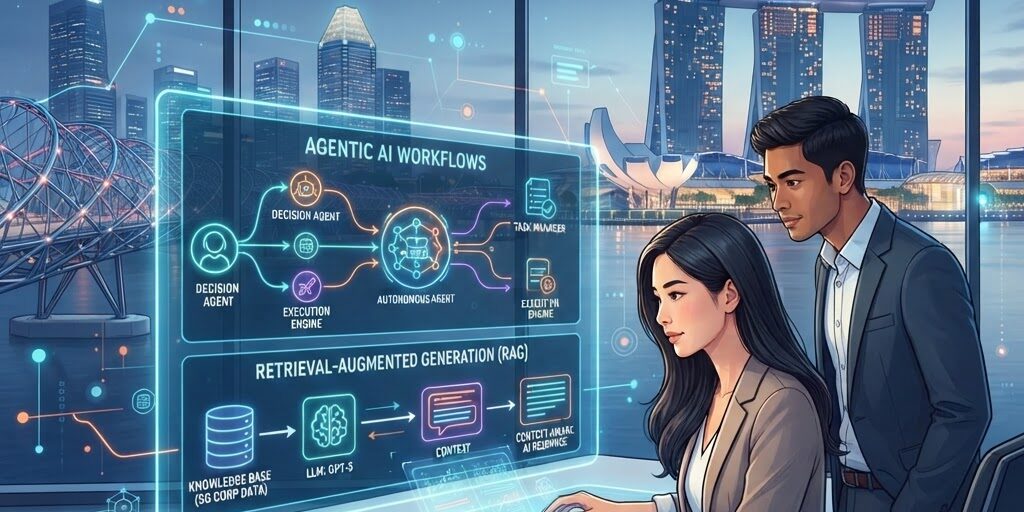
Mastering Agentic AI and RAG: Essential Skills for the 2026 Singapore Workforce
As Singapore moves toward becoming a world-class smart nation, the rapid integration of advanced technologies has shifted the professional landscape. By 2026, proficiency in Agentic AI and RAG training has become the gold standard for high-performing teams across the city-state. These technologies are not merely trends; they are the fundamental building blocks for creating autonomous, data-driven systems that can handle complex enterprise workflows without constant human supervision. As industries ranging from finance to healthcare demand more sophisticated automation, the ability to architect intelligent agents that utilize Retrieval-Augmented Generation (RAG) is proving to be a critical competitive advantage. This article explores how these skills bridge the gap between simple chatbots and true autonomous problem-solving. By mastering these tools, professionals can ensure they remain highly employable in an increasingly automated economy, positioning themselves at the forefront of the technological evolution currently defining Singapore. Whether you are a software developer, a business analyst, or a corporate strategist, understanding the synergy between agentic logic and accurate data retrieval is the most valuable investment you can make in your career path today.
Table of Contents
Understanding the Rise of Agentic AI
Agentic AI represents a massive leap forward from standard generative models that merely provide responses to static prompts. Unlike traditional AI tools, agentic systems possess a level of autonomy that allows them to perform multi-step reasoning, plan tasks, and execute actions across external applications. In the context of the Singaporean workforce, this shift is revolutionary. Employees are no longer just using AI to generate text; they are designing agents that can navigate complex software environments, audit data, and manage administrative cycles independently. This evolution requires a deep understanding of how to define agent goals, set constraints, and monitor execution cycles effectively. Industry experts emphasize that the core value of an agent lies in its decision-making capability. By focusing on Agentic AI and RAG training, professionals gain the technical literacy needed to create systems that can effectively troubleshoot issues in real-time. This is particularly relevant for sectors like fintech and logistics, where speed and precision are paramount. Agents operate by breaking down complex user goals into manageable sub-tasks. They continuously monitor their environment, evaluate if a task has been completed successfully, and pivot their strategy if the initial approach fails. This dynamic nature means that an agent acts as a digital worker rather than a passive assistant. As these systems become more prevalent, the demand for individuals capable of designing, fine-tuning, and maintaining these agents will skyrocket. The workforce must move away from manual input towards supervising AI-driven workflows. By adopting a mindset centered on agent orchestration, professionals can drastically reduce repetitive manual tasks, thereby freeing up time for high-value strategic decision-making that AI cannot easily replicate, ensuring that the local industry remains globally competitive and future-proofed against rapid technological shifts.
The Power of RAG in Data-Driven Workflows
Retrieval-Augmented Generation, or RAG, is the bridge between the vast knowledge contained within large language models and the specific, proprietary data unique to a business. In Singapore, where data privacy and accuracy are top priorities for enterprises, RAG is indispensable. It works by allowing the AI to query a verified knowledge base before it generates a response, significantly reducing hallucinations and ensuring the output is grounded in factual, company-specific documentation. Mastering RAG involves understanding how to structure vector databases, perform semantic searches, and integrate these retrievals into prompt-engineering pipelines. When an AI agent performs a task, it needs the latest context to make an informed decision. Without RAG, the model is limited to its training data, which becomes stale almost instantly in the fast-moving Singaporean business environment. By implementing RAG, you ensure that your agents always work with the most current data, whether that involves legal contracts, internal financial reports, or real-time supply chain updates. The following table highlights why RAG is superior to standard model training methods:
| Feature | Standard LLM | RAG-Enabled System |
|---|---|---|
| Data Source | Static Training Set | Real-time Internal Knowledge |
| Hallucinations | Common | Minimal (Evidence-based) |
| Maintenance | Requires Re-training | Low (Document update only) |
| Transparency | Black Box | Citations Included |
Professionals who undergo comprehensive Agentic AI and RAG training learn how to maintain these knowledge bases. This involves data cleaning, chunking strategies for better search accuracy, and embedding selection. These technical skills are the bedrock of reliable AI applications. Because Singaporean enterprises handle vast amounts of sensitive data, the ability to build a secure RAG pipeline that enforces strict access controls is a highly sought-after professional competence. As organizations look to automate customer support, technical documentation, and market research, the RAG-enabled agent becomes the central nervous system of the organization, providing accurate insights at the speed of thought.
Integrating Agents with RAG Architecture
The true power of modern AI is unlocked when Agentic AI and RAG are integrated into a single cohesive architecture. While an agent provides the engine for action, RAG provides the intelligence and grounding required to act accurately. For example, an agent tasked with drafting a compliance report does not merely guess the regulatory requirements; it uses a RAG pipeline to pull the latest updates from the official legal databases, validates the information against company policy, and then proceeds to draft the document. This combination allows for a level of precision that was impossible to achieve only a few years ago. Our team often sees that the biggest challenge for organizations is not the lack of AI capability, but the lack of integration skills among their staff. Integrating these technologies requires an understanding of orchestration frameworks that manage the communication between the agent, the retrieval database, and the external software tools. This involves mapping out workflows to ensure that the AI can handle edge cases without human intervention. Training in this area focuses on technical implementation, testing, and system optimization. Professionals learn how to create “memory” for agents, allowing them to recall previous interactions and refine their performance based on accumulated context. This is essentially the development of a long-term strategy for digital transformation. By linking RAG with agents, you transform the AI from a simple search tool into a proactive problem-solver that can interact with APIs, databases, and third-party platforms. This technical proficiency is the key to creating sustainable enterprise value in a digital economy that demands nothing less than total efficiency and complete reliability in its automated processes.
Building Career Resilience Through Skills
As we head toward 2026, the Singaporean job market is undergoing a significant transition. The shift toward AI-first operations means that technical fluency is no longer reserved for software engineers; it is becoming a requirement for managers, marketers, and operations staff alike. Those who invest in Agentic AI and RAG training are future-proofing their careers by gaining the ability to control and direct the technologies that are reshaping their industries. Resilience in the age of AI does not mean fighting against the tide of automation; it means mastering the tools that drive it. This educational path encourages a deep understanding of AI ethics, system monitoring, and the continuous improvement of workflows. Professionals who learn to build and supervise agents develop a high-level perspective on how businesses operate, identifying bottlenecks and finding ways to resolve them through intelligent automation. Furthermore, the collaborative aspect of AI development means that cross-departmental communication is more important than ever. Being able to explain how an AI agent uses RAG to fetch data, or how it makes decisions based on specific constraints, allows you to lead teams effectively through the transition process. As digital infrastructure continues to evolve, the ability to rapidly adapt these systems to new business challenges will be the most valuable trait an employee can possess. This journey of lifelong learning is supported by the rapid growth of training ecosystems available across the country. Whether through workshops, professional certifications, or on-the-job projects, prioritizing these specific skill sets ensures that you remain an essential asset. By staying curious and technically proficient, you turn the uncertainty of the future into a landscape of endless professional opportunity and personal development.
In conclusion, the intersection of Agentic AI and RAG is set to define the next era of workplace innovation in Singapore. By developing the skills to build autonomous, data-grounded systems, professionals can transition from being task-executors to being AI-architects. This shift not only enhances personal productivity but also drives meaningful efficiency for the organizations they serve. As we move closer to 2026, the urgency to adopt these skills becomes clearer. Whether you are aiming for a career transition or looking to sharpen your current profile, focusing your education on these core areas is a strategic decision that promises long-term dividends. Embrace the complexity of the AI landscape today to lead the innovative workforce of tomorrow with confidence and technical authority.
Frequently Asked Questions
1. Why is Agentic AI and RAG training important for Singapore professionals? It is essential because it allows workers to design and supervise autonomous systems that improve decision-making and efficiency across various sectors.
2. Does RAG help reduce AI errors? Yes, RAG ensures the AI retrieves real-time, verified data, which significantly minimizes hallucinations compared to standard models.
3. Can non-programmers learn these skills? While there is a technical component, many low-code tools now allow professionals with basic logic and data-handling skills to build agents effectively.
4. How does Agentic AI differ from regular chatbots? Standard chatbots react to prompts, whereas Agentic AI plans tasks, uses tools, and takes action autonomously to reach a specific goal.
5. Will these skills remain relevant after 2026? Given the trajectory of AI development, these foundational skills in automation and data integration will remain critical for long-term career growth.