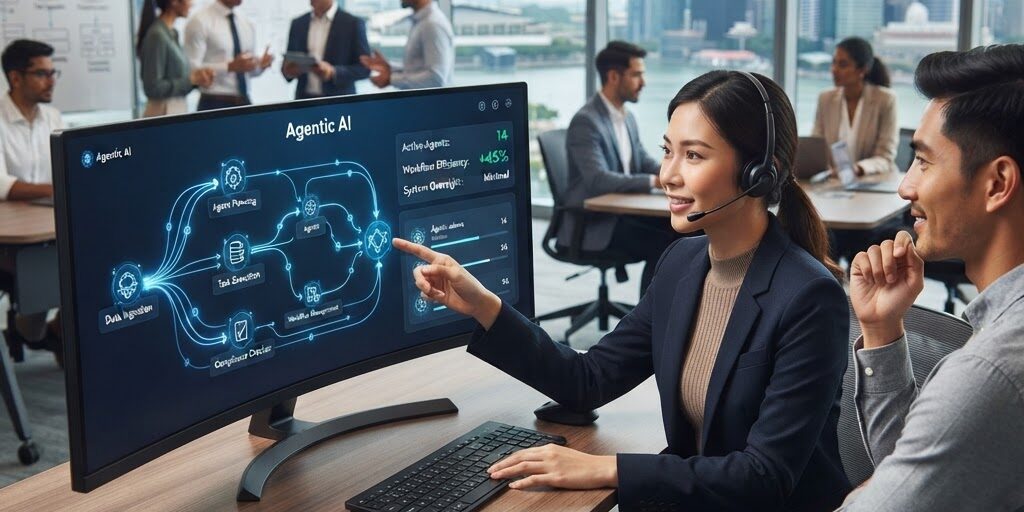
Mastering Agentic AI: The Future of Professional Workflow Automation in Singapore
As we navigate the sophisticated landscape of 2026, the technological frontier has evolved far beyond basic generative models. Professionals across Singapore are increasingly turning their attention toward Agentic AI training to remain competitive in a rapidly digitizing economy. Unlike traditional tools that rely on constant human prompting for every minor interaction, Agentic AI represents a paradigm shift where software systems act as autonomous agents. These systems possess the capability to plan, execute multi-step processes, and manage complex operational workflows with minimal human oversight. By understanding how to architect these autonomous agents, employees can effectively delegate repetitive tasks, allowing them to focus on high-level strategic initiatives. This comprehensive guide explores the essential components of building and managing agentic workflows, ensuring that your organization remains at the forefront of digital transformation. Whether you are an IT lead, an operations manager, or a business owner, mastering the nuances of autonomous task execution is no longer optional but a fundamental requirement for operational efficiency. Let us delve into the architecture of tomorrow today.
Table of Contents
Core Concepts of Agentic Systems
The fundamental shift from generative AI to Agentic AI requires a deep understanding of autonomous goal-setting. While generative models are designed to produce text or images based on input, agentic systems are designed to accomplish objectives. The difference lies in the feedback loop. When you enroll in high-quality agentic AI training, you learn how to configure these systems to interpret high-level instructions, break them down into smaller manageable sub-tasks, and iterate based on the environment’s state. These agents utilize reasoning capabilities to verify their own outputs, a process often referred to as self-correction. In a professional environment, this means an agent can be tasked with performing a market analysis, cross-referencing public data sets, identifying potential gaps in competitors’ strategies, and formatting the results into a presentation document. To achieve this level of sophistication, the underlying architecture must support long-term memory, enabling the system to learn from past task completions. Industry experts suggest that the most successful implementations are those that pair strong reasoning models with external tool access, such as APIs, databases, and collaboration software. This allows the agent to function not just as an information synthesizer but as an active participant in your company ecosystem. The transition requires a move away from linear workflow thinking toward recursive problem solving, where the agent constantly assesses whether it is nearing its goal and what corrective actions might be necessary if it encounters an unforeseen roadblock. By mastering these core mechanisms, practitioners can build resilient systems that operate autonomously during business hours, effectively scaling team capabilities without the direct need to increase headcount, thus providing a sustainable path toward organizational growth within a resource-constrained market environment.
Strategic Implementation in Singapore
Implementing autonomous agents within a Singapore-based business requires a nuanced understanding of both local regulatory frameworks and global technical standards. As businesses seek to integrate these tools, the primary challenge often lies in the selection of a robust infrastructure that complies with data privacy regulations. Agentic AI training provides the foundation for this selection, teaching professionals how to evaluate model benchmarks, latency, and cost-efficiency. A key strategy for success is starting with pilot projects that focus on internal data processing tasks rather than customer-facing roles. By automating repetitive administrative functions like procurement coordination, invoice reconciliation, or lead qualification, organizations can build trust in these systems before deploying them in more sensitive areas. Table 1 outlines the comparative evolution of AI roles in the modern workplace to highlight the transition from simple generative models to complex agents.
| Feature | Generative AI | Agentic AI |
|---|---|---|
| Task Scope | Single-turn request | Multi-step autonomous workflows |
| Intervention | Frequent human prompting | Minimal periodic oversight |
| Planning | None | Self-managed execution |
| Tool Use | Restricted | Integrated API ecosystem |
The integration process involves establishing clear guardrails to ensure that agents perform within defined organizational parameters. Experts emphasize that the key to successful implementation is the concept of human-in-the-loop monitoring. Even with advanced autonomous systems, periodic auditing is essential to ensure the agent remains aligned with company objectives and ethical standards. Professionals trained in this field are tasked with monitoring logs, verifying task success rates, and fine-tuning prompts to improve execution quality. Furthermore, businesses in Singapore must consider how these agents interface with existing legacy software. Using middleware and robust integration platforms can bridge the gap between legacy databases and modern language models, creating a unified digital fabric. As you move forward with implementation, focus on scalability; a well-designed agentic flow is one that can be easily replicated across different departments. This strategic approach ensures that the technological investment translates into tangible productivity gains, reducing the time spent on manual oversight and allowing talent to flourish in roles that require empathy, critical thinking, and nuanced human-to-human interaction, which are still beyond the reach of any machine.
Advanced Workflow Integration Techniques
Advanced integration involves creating a multi-agent environment where individual specialized agents communicate to solve complex problems. In this paradigm, one agent might be responsible for data collection, another for analysis, and a third for quality assurance. This orchestration of specialized agents is the pinnacle of modern AI training. Professionals are learning how to define the roles of these agents, ensuring they collaborate seamlessly rather than creating bottlenecks. For instance, in a supply chain context, an agent designed to monitor inventory levels can alert a purchasing agent when stocks are low, which in turn triggers a procurement agent to draft purchase orders for review. This level of automated coordination reduces the friction usually associated with cross-departmental operations. The beauty of this approach is its ability to handle dynamic inputs; if a shipment is delayed due to weather, the agents can automatically communicate this change to the logistics team, update the project management software, and adjust expectations with the client. Learning to build these feedback loops is essential for modern workflow architects. You must master the art of prompt engineering combined with structured data output, such as JSON, to ensure that one agent’s output is perfectly formatted for the next agent’s consumption. By standardizing these interactions, companies can build a modular system that is easy to update as new models are released. Furthermore, the use of vector databases allows these agents to maintain long-term context, ensuring they do not repeat past mistakes. This creates an institutional memory that persists across sessions, which is vital for maintaining high performance in fast-moving industries like finance or technology. Developing this infrastructure requires a deep understanding of software design principles, emphasizing that effective AI integration is less about the model itself and more about the architectural logic connecting various system components.
Future Readiness and Ethical Oversight
As the adoption of autonomous agents continues to accelerate, future readiness depends on our ability to govern these systems effectively. Ethical oversight is a cornerstone of advanced agentic AI training. Professionals must understand the implications of bias, data leakage, and system failure modes. Because agents act on behalf of the company, ensuring they do not hallucinate actions or violate data privacy standards is paramount. This necessitates a culture of continuous learning and rigorous documentation. As we move toward 2027 and beyond, the expectation is that these agents will become more ubiquitous, perhaps even interacting with one another across different corporate ecosystems. This inter-agent communication raises new questions about cybersecurity and the need for standardized communication protocols to prevent malicious exploitation. To prepare for this future, organizations should invest in staff training that covers not just technical proficiency but also risk assessment and ethical strategy. By fostering a workforce that is comfortable with both the potential and the limitations of autonomous systems, you build an organizational resilience that is rare. Furthermore, consider the environmental impact of your AI choices. Selecting energy-efficient models and optimizing workflows to minimize unnecessary compute cycles is not only fiscally responsible but also aligns with global sustainability trends. As you refine your strategies, stay informed through industry journals and professional development courses that focus on the evolving landscape of AI ethics. Being a leader in this space requires constant vigilance and an unwavering commitment to transparency, ensuring that as we delegate tasks to machines, we do so with a clear understanding of the risks, rewards, and the profound impact these tools have on the future of work. Your success depends on your ability to harness this power responsibly, creating a future where technology amplifies human potential rather than replacing the core values that define professional integrity and creative excellence in our global marketplace.
In conclusion, mastering Agentic AI is a journey of continuous improvement, strategic oversight, and technical architectural planning. As the professional landscape in Singapore shifts, the ability to build and maintain autonomous workflows will distinguish high-performing organizations from their peers. By investing in comprehensive AI training, you empower your team to transition from being manual operators to high-level system architects. Remember that the ultimate goal is not to eliminate human contribution, but to elevate it by removing the burden of repetitive, low-value tasks. As you integrate these systems, prioritize security, ethics, and modularity to ensure long-term sustainability. The future of workflow automation is here, and by adopting these agentic principles today, you are securing a competitive edge that will define your organization’s success in the coming years of the digital age.
Frequently Asked Questions
1. What is the main difference between generative and agentic AI? Generative AI creates content, while Agentic AI takes actions and completes entire workflows autonomously.
2. Why is agentic AI training critical for Singaporean professionals? It enables workers to scale their productivity, allowing them to manage complex systems with minimal oversight in a competitive market.
3. Can agentic AI be integrated with current legacy software? Yes, through the use of APIs and specialized middleware, agents can interact with existing databases and tools effectively.
4. How can businesses ensure ethical standards with autonomous agents? By implementing human-in-the-loop monitoring, rigorous auditing of logs, and clear operational guardrails during the setup phase.
5. Is extensive coding experience required for agentic AI training? While technical knowledge helps, many modern frameworks are designed to be accessible, focusing more on architectural logic and prompt design than traditional programming.