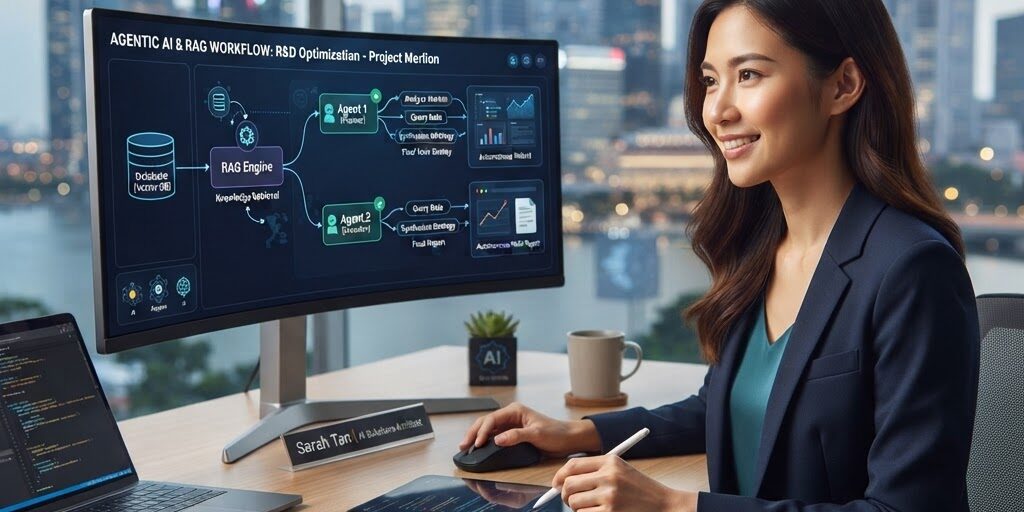
Mastering Agentic AI and RAG: Essential Skills for Singapore Professionals in 2026
As the digital landscape of 2026 continues to evolve rapidly, the demand for sophisticated technical competencies has reached an unprecedented peak. For those seeking career advancement, Agentic AI training Singapore has become the premier gateway to staying competitive. Moving far beyond the limitations of basic prompting, modern AI integration requires an intimate understanding of autonomous workflows and intelligent data retrieval. This shift marks a transition from static chatbots to dynamic agents capable of reasoning, planning, and executing multi-step tasks independently. In Singapore’s fast-paced innovation ecosystem, professionals must learn to synthesize complex information using Retrieval-Augmented Generation (RAG) to ensure accuracy and contextual relevance. By mastering these advanced frameworks, workers in the city-state can automate mundane processes, unlock deeper analytical insights, and lead their respective industries. This guide explores the critical components of Agentic AI and RAG, offering a roadmap for skill acquisition in a transformative professional environment. Embracing these advanced methodologies is no longer a luxury but a fundamental necessity for every forward-thinking career professional today.
Table of Contents
The Rise of Autonomous Agents
The transition toward agentic systems represents the most significant shift in artificial intelligence development over the last decade. Unlike traditional models that function primarily through linear request-response cycles, agentic AI operates with a degree of autonomy that allows for iterative problem-solving. In the context of Agentic AI training Singapore, experts emphasize that an agent’s true value lies in its ability to break down complex goals into actionable sub-tasks. By utilizing advanced reasoning models, these agents can navigate digital environments, interact with external tools, and verify their own output quality before presenting a final solution to the user. This level of autonomy is particularly vital for financial services, supply chain management, and regulatory sectors where precision is non-negotiable. Professionals who undergo rigorous training in this domain learn how to design systems that handle ambiguity, perform self-reflection, and manage multi-step processes with minimal human intervention. As organizations scale their operations, they are increasingly relying on autonomous agents to manage heavy workloads that would typically require large teams to execute. Understanding the underlying logic of these agents requires more than basic technical knowledge; it demands a strategic mindset focused on systems architecture, process optimization, and the ethical deployment of automated decision-making. By integrating these workflows into existing corporate frameworks, businesses can achieve higher efficiency while simultaneously reducing operational friction. Furthermore, the ability to orchestrate agents through defined instructions allows for a higher level of personalization in client interactions. As we progress further into 2026, the competitive advantage will belong to those who can successfully bridge the gap between human intent and machine-led execution, ensuring that autonomous tools remain aligned with broader organizational goals and strict compliance standards established within the local technology landscape.
The Power of RAG in Modern Workflows
Retrieval-Augmented Generation, commonly referred to as RAG, stands as the backbone of modern enterprise AI solutions. While Large Language Models are inherently powerful due to their vast training data, they often suffer from hallucinations and data obsolescence. RAG solves these challenges by dynamically fetching up-to-date, verified information from proprietary databases before generating a response. For professionals engaged in Agentic AI training Singapore, understanding RAG implementation is essential for creating reliable, fact-based AI systems. When an agent is combined with a robust RAG architecture, it can access private documentation, legal records, or internal company wikis in real-time. This ensures that the generated outputs are not only relevant but also grounded in specific, verifiable sources. The synergy between autonomous agents and RAG creates a closed-loop system where an agent identifies a gap in information, retrieves the necessary data, analyzes it, and generates a precise recommendation. This capability is revolutionary for sectors like law, medicine, and corporate strategy where precision is absolutely paramount. Industry experts frequently observe that organizations failing to implement RAG workflows often find their AI tools disconnected from the actual reality of their operational requirements. Consequently, training programs now place a heavy emphasis on vector database management, indexing strategies, and semantic search optimization. These technical components are vital because they determine the speed and accuracy with which an agent can access internal data silos. As firms in Singapore aim for greater digital maturity, the mastery of RAG allows them to build personalized assistants that understand unique corporate nuances. By leveraging these architectures, professionals can confidently deploy AI solutions that support high-stakes decision-making while maintaining the integrity and security of sensitive company information throughout the entire generation process.
| Feature | Basic Prompting | Agentic AI with RAG |
|---|---|---|
| Accuracy | Moderate | Very High |
| Autonomy | Low | High |
| Data Source | Static Training | Dynamic/Real-Time |
| Use Case | Creative Drafting | Complex Decision-Making |
Implementing Agentic Architectures
Building an effective agentic architecture requires a deep understanding of modular design and API orchestration. When participating in Agentic AI training Singapore, learners are introduced to the concept of AI orchestration frameworks that allow multiple agents to collaborate on a single task. This modular approach allows professionals to assign specific responsibilities to specialized agents, such as one focused on data analysis, another on report drafting, and a third on compliance monitoring. The success of this architecture depends heavily on the definition of clear hand-off points and the consistency of the data passed between agents. Effective implementation also necessitates a focus on monitoring and evaluation tools, which allow teams to trace the decision-making path of an agent and adjust its logic as needed. This iterative development cycle is the secret to building resilient AI systems that can handle real-world fluctuations and changing requirements. Because many enterprise environments in Singapore operate on legacy systems, the ability to connect agents to existing APIs and databases via RAG is a highly sought-after professional skill. Trainers focus on teaching how to handle authentication, manage data privacy protocols, and ensure that AI agents adhere to strict governance frameworks. Moreover, security becomes a critical design principle in these architectures, as agents are given access to sensitive environments. Developers must implement robust guardrails that prevent unauthorized actions and ensure that every step of the AI workflow is logged for future audit trails. By adopting a structured approach to architectural design, professionals can create scalable AI ecosystems that evolve alongside business needs. As these technologies mature, the ability to effectively debug and refine agent behaviors will differentiate top-tier talent from those who only possess a surface-level understanding of AI orchestration and integration processes.
Future-Proofing Career Pathways
The career outlook for professionals who invest in advanced AI training is exceptionally bright as we look toward the later part of the decade. By prioritizing Agentic AI training Singapore today, individuals are positioning themselves at the forefront of a significant industrial transition. Companies across the region are actively seeking talent that can not only build these complex systems but also manage their ethical and operational implications. Future-proofing a career involves staying agile, maintaining a commitment to continuous learning, and understanding that AI tools will eventually become deeply embedded in every business process. The skills required for success—such as prompt engineering, data pipeline construction, and autonomous agent orchestration—are foundational to the new digital economy. Furthermore, developing a strategic understanding of how to balance human intuition with machine precision is essential for leadership roles in the AI era. Professionals who successfully master these skills will find themselves in roles ranging from AI solutions architects to business process optimization specialists, all of which offer substantial growth opportunities. Industry experts predict that the most successful career paths in 2026 will be those defined by the ability to orchestrate complex human-machine partnerships. As the labor market shifts, the value of traditional manual processes will diminish, while the capacity to design and oversee intelligent systems will become the primary driver of value. By focusing on practical application, participating in hands-on workshops, and staying updated on emerging RAG research, professionals can ensure their expertise remains relevant. The key is to view these technologies not as replacements for human expertise, but as powerful force multipliers that allow for greater creativity, higher productivity, and more impactful decision-making across all sectors of the modern, globally connected Singaporean economy.
Conclusion
Mastering Agentic AI and RAG is a transformative journey that empowers professionals to redefine their roles in an increasingly automated world. By moving beyond static models and embracing the autonomy of agentic systems, you gain the ability to tackle complex, multi-layered challenges with unparalleled efficiency. The skills acquired through dedicated Agentic AI training Singapore will form the cornerstone of your competitive advantage as the business landscape continues to modernize. As you integrate these advanced tools into your daily workflow, remember that your critical thinking, ethical judgment, and strategic oversight remain the most vital human contributions to any technological project. Start your journey today to ensure you are fully prepared for the challenges and opportunities that lie ahead in 2026 and beyond.
Frequently Asked Questions
1. What is the primary difference between standard AI and Agentic AI? Standard AI follows a fixed response pattern, while Agentic AI uses reasoning to plan and execute multi-step tasks autonomously.
2. Why is RAG critical for enterprise AI applications? RAG prevents hallucinations by connecting AI models to verified, private, and real-time data sources for accurate information retrieval.
3. Who should consider Agentic AI training in Singapore? It is ideal for software developers, business analysts, data scientists, and managers aiming to optimize workflows through AI integration.
4. How long does it take to become proficient in these technologies? Proficiency depends on your technical background, but consistent practice with orchestration frameworks typically leads to competence within several months.
5. Is programming knowledge required for this training? While basic programming skills are highly beneficial for building custom agent flows, many low-code tools are emerging to assist those without deep coding backgrounds.