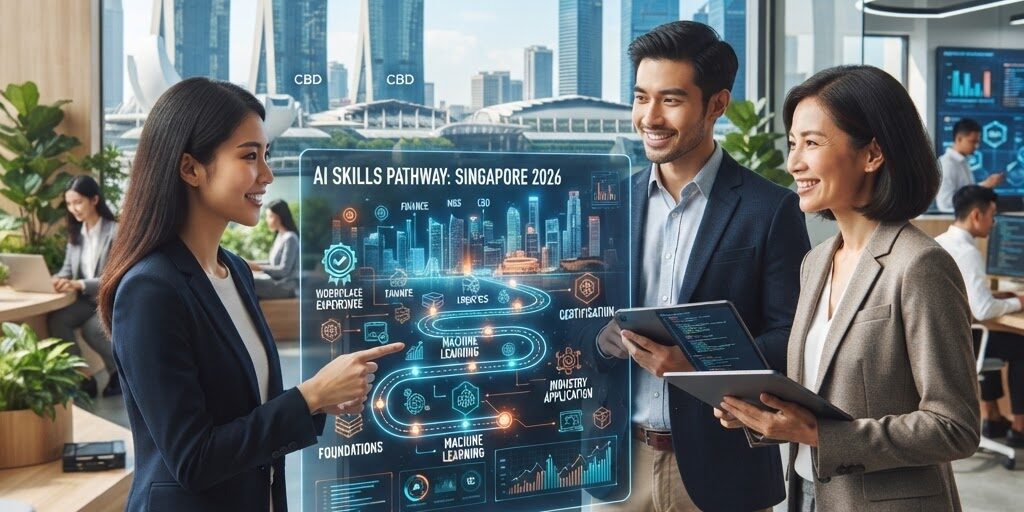
Navigating the New AI Skills Pathway: A Professional’s Guide to Singapore’s 2026 Roadmap
In an era where technology redefines the boundaries of industrial capability, Singapore has taken a monumental step forward by launching its comprehensive AI skills pathway Singapore initiative. As the national economy pivots toward an innovation-led future, the urgent demand for AI-fluent talent has become the primary driver for workforce transformation. This strategic roadmap is designed to bridge the widening gap between traditional professional experience and the sophisticated requirements of modern artificial intelligence implementation. By integrating formal certification programs with practical, on-the-job training, this pathway ensures that employees across various sectors can remain competitive in an increasingly automated landscape. Whether you are an entry-level worker or a seasoned executive, understanding the core components of this national framework is essential for long-term career growth. The roadmap not only emphasizes technical proficiency but also places a significant focus on ethical AI governance, human-centric design, and strategic data management. As we look toward 2026, those who actively participate in this skill development ecosystem will be the architects of tomorrow’s productivity, ensuring that Singapore remains a leading global hub for technological advancement and professional excellence.
Table of Contents
Understanding the Strategic Framework
The strategic framework underpinning the AI skills pathway Singapore serves as a blueprint for long-term national growth and human capital development. Recognizing that artificial intelligence is no longer a niche technological capability but a foundational economic tool, industry experts have collaborated to create a structure that accommodates diverse learning paths. This framework is anchored in three distinct pillars: foundational awareness, technical application, and strategic leadership. By segmenting the learning process, the government ensures that all individuals, regardless of their current technological background, can find a starting point that matches their professional trajectory. The foundational level focuses on demystifying artificial intelligence, removing the stigma surrounding complex algorithms, and fostering a culture of curiosity and continuous improvement. As professionals progress, the framework introduces more specialized modules that address specific domain requirements, such as AI-driven logistics, financial modeling, or healthcare diagnostics. This multi-layered approach is critical because it prevents the dilution of talent while allowing for specialization in high-growth sectors. The governance of this roadmap relies on consistent feedback from academic institutions, corporate partners, and regulatory bodies, ensuring that the content remains relevant in the face of rapid technological disruption. Furthermore, the framework emphasizes the necessity of data literacy, which remains the single most important prerequisite for successful integration into any AI-centric workflow. By aligning individual learning objectives with national economic targets, the roadmap transforms the workforce from a group of passive technological consumers into active, informed participants in the creation of value-added AI services. This systematic approach is designed to reduce the risk of systemic unemployment by proactively equipping workers with skills that have longevity, adaptability, and cross-functional utility in a highly interconnected global digital marketplace.
Core Competencies and Certification
Attaining mastery within the AI skills pathway Singapore involves a rigorous journey through a set of defined core competencies that are validated by standardized professional certifications. These competencies are categorized to ensure that learners understand not only how to deploy AI models but also how to maintain them ethically and securely. The certification process is intentionally modular, allowing professionals to earn micro-credentials that stack into more comprehensive diplomas or specialized certificates. Key competencies include predictive analytics, natural language processing, machine learning operationalization, and prompt engineering, all of which are essential for navigating the current labor market. To maintain high standards, the curriculum incorporates both theoretical examinations and practical capstone projects that require participants to apply their knowledge to real-world datasets. This ensures that the certification is not merely a reflection of memorized information but a testament to functional ability. Industry experts suggest that the most successful candidates are those who view these certifications as a starting point rather than a final destination. In addition to technical skills, the pathway mandates training in ethical considerations and algorithmic bias, which are crucial for ensuring that AI solutions are developed responsibly. Below is a breakdown of the typical competency progression for professionals engaging with this roadmap to ensure they meet the 2026 requirements.
| Competency Tier | Focus Area | Expected Outcome |
|---|---|---|
| Foundational | Data Literacy | Basic data interpretation skills |
| Intermediate | Model Deployment | Functional AI application usage |
| Advanced | AI Governance | Ethical and strategic leadership |
By achieving these certifications, professionals gain a recognized seal of quality that signals to employers that they possess the precise, standardized skill sets required to navigate modern AI workflows, thereby enhancing their employability and professional status across all competitive sectors.
Industry Integration and Workplace Application
The true success of the AI skills pathway Singapore lies in its seamless integration into the daily operations of local enterprises. Industry experts highlight that the most significant challenge for any organization is not the adoption of the technology itself, but the transformation of organizational culture to embrace AI-human collaboration. The pathway addresses this by providing companies with specific frameworks for internal mentorship and peer-to-peer learning. By embedding the AI curriculum into workplace training programs, firms can ensure that the theoretical knowledge acquired by staff is immediately put to the test in a practical setting. This minimizes the learning curve and allows businesses to see a direct return on their investment in human capital. Application strategies often involve the formation of departmental “AI squads” that serve as internal consultants, helping their colleagues automate redundant tasks and optimize data-heavy processes. This collaborative model is highly effective because it fosters a sense of collective ownership over technological adoption. Furthermore, the government provides various incentives for companies that formalize these training pathways, making it easier for small and medium-sized enterprises to participate alongside larger corporations. The goal is to create a unified ecosystem where knowledge flows freely between tech companies and traditional businesses, ensuring that the benefits of artificial intelligence are distributed equitably across the economy. As employees move through the pathway, they are encouraged to document their experiences and successes, which contributes to an ever-evolving repository of best practices. This iterative approach to learning ensures that the skills being taught are constantly refined based on the realities of the modern workplace, keeping the workforce nimble and capable of responding to the next generation of technological shifts with confidence and efficiency.
Future-Proofing Your Professional Career
In the landscape leading up to 2026 and beyond, the most valuable professional asset will be the ability to adapt to a continuously changing digital environment. Engaging with the AI skills pathway Singapore is the primary method for individuals to ensure their career longevity and relevance. Future-proofing your career requires a shift in mindset: moving away from viewing yourself as a holder of static job titles toward identifying as a continuous learner. The roadmap offers a clear, structured way to demonstrate this agility to current and future employers. By proactively participating in these training modules, you are signaling a commitment to growth and an ability to navigate the complexities of AI-enabled systems. As the workforce evolves, professionals who have mastered the foundational and advanced modules of this pathway will find themselves in a unique position to lead transitions within their organizations, moving from individual contributors to strategic managers who oversee the intersection of human talent and artificial intelligence. The roadmap also emphasizes networking and collaborative problem-solving, creating a community of professionals who can support each other as they navigate new challenges. This peer network is an invaluable resource for sharing insights, troubleshooting common technical issues, and discovering new opportunities for career advancement. As the economic environment becomes increasingly dominated by intelligent systems, your ability to provide human-centric oversight, creative strategy, and nuanced decision-making will become your most significant competitive advantage. By committing to this professional journey now, you are not just keeping pace with technological change; you are actively defining the role you will play in the digital economy of the future. The path is well-defined, the support is available, and the potential for long-term career growth is substantial for those ready to embrace the challenge.
As we conclude this overview, it is evident that the AI skills pathway Singapore represents a critical turning point for the nation’s workforce. By aligning educational standards with the actual needs of the digital economy, professionals are better equipped than ever to navigate the intricacies of artificial intelligence. Embracing this roadmap is more than a professional development exercise; it is an essential step toward securing one’s role in a future where human expertise and intelligent systems operate in tandem. We encourage every professional to take the first step, engage with the available resources, and commit to the ongoing journey of learning. By staying informed and actively participating in the established framework, you are ensuring a prosperous and resilient career that will thrive in the landscape of 2026 and far beyond.
Frequently Asked Questions
1. Who is eligible to participate in the AI skills pathway Singapore? Any professional working within the local industry, regardless of their sector or previous technical background, can join the pathway programs.
2. Are these certifications recognized by international employers? Yes, the certifications are designed to align with global standards, making them highly portable and recognized by organizations worldwide.
3. How does the program support small businesses? The government provides specific incentives and modular training structures tailored to the resource constraints of small and medium-sized enterprises.
4. Can I balance these courses with my full-time job? The pathway is specifically designed with flexible, self-paced, and modular components to accommodate the schedules of working professionals.
5. Will the curriculum be updated as technology changes? Yes, the framework is reviewed periodically by industry experts and academic partners to ensure all content remains cutting-edge and relevant to the evolving AI landscape.