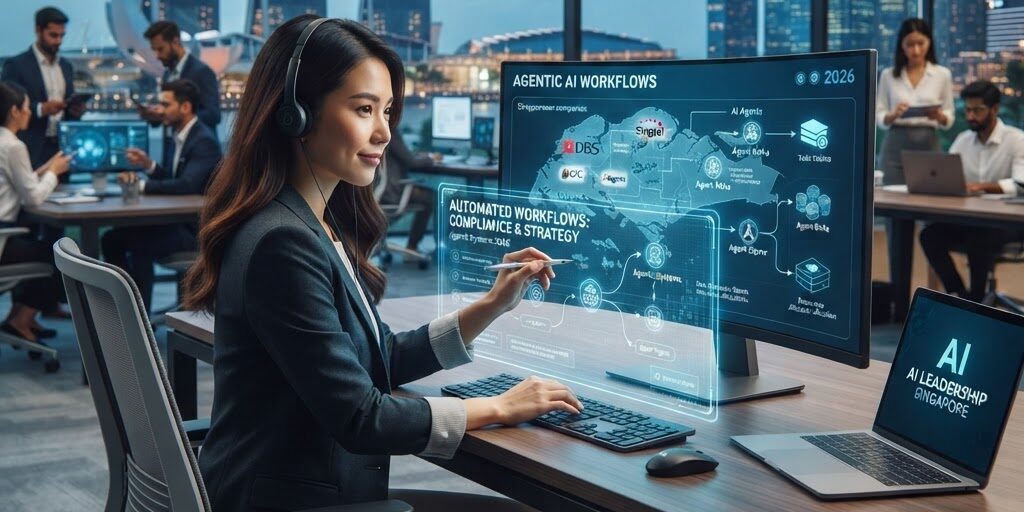
Mastering Agentic AI: The Essential Skill for Singapore Professionals in 2026
As Singapore cements its position as a global innovation hub, the professional landscape is undergoing a profound transformation. By 2026, the reliance on basic generative AI prompting has evolved into a sophisticated demand for autonomous systems. Today, the core of workplace efficiency lies in mastering agentic AI workflows. Unlike static chatbots that require constant human oversight for every minor task, agentic AI systems are designed to perceive, reason, and execute complex business processes independently. For professionals across the Lion City, from the bustling financial district to the tech-focused corridors of one-north, understanding how to design and manage these autonomous agents is no longer optional—it is a critical career accelerator. This article explores how these advanced systems are redefining productivity, helping teams navigate multi-step operations without the manual bottleneck of traditional digital assistance. By integrating these tools, organizations are not merely automating repetitive labor; they are architecting dynamic ecosystems where machines handle execution while humans focus on strategic oversight and creative problem-solving in an increasingly fast-paced and competitive digital economy.
Table of Contents
The Evolution of Agentic AI Workflows
The transition from passive AI to agentic AI workflows represents a fundamental shift in how we interact with technology. Historically, employees interacted with software by providing explicit, step-by-step instructions. This manual intervention often limited the potential of the underlying models. However, agentic AI changes the paradigm by utilizing goal-oriented architecture. These systems understand the objective provided by the professional and autonomously break it down into manageable sub-tasks. By continuously assessing their own progress, these agents can adjust their approach if they encounter obstacles, ensuring that the final output aligns with the desired outcome. For Singaporean enterprises, this means shifting focus from merely generating content to managing high-level workflows that span across multiple software platforms. Industry experts emphasize that the primary differentiator in the modern workspace is the ability to orchestrate these agents. When an agent is empowered to handle research, data synthesis, and report generation in one cohesive flow, the human employee gains the bandwidth to focus on high-stakes decision-making. This capability is rapidly becoming the gold standard for operational efficiency, pushing companies to modernize their digital infrastructure to accommodate agentic capabilities. The efficiency gains are not just marginal; they represent a leap in institutional productivity that allows smaller teams to compete with much larger, traditional organizations. By mastering these workflows, individuals ensure their technical skills remain relevant in a market that prioritizes velocity and precision. The ability to define clear goals for an autonomous agent, oversee its performance, and iterate on its logic flow will define the next generation of leadership in the corporate sector. As we continue to integrate these systems, the role of the professional moves closer to that of a digital architect or systems manager, orchestrating a fleet of autonomous digital workers to achieve complex objectives that would have previously taken weeks to complete.
Designing and Implementing Autonomous Systems
Implementing agentic AI workflows requires a structured approach to systems design. It begins with identifying repetitive yet complex tasks that involve multiple digital touchpoints. In a typical office environment, this might include invoice processing, lead qualification, or complex supply chain data reconciliation. The first step for any professional is to map out the entire lifecycle of a task, noting where human intervention is currently needed. By replacing these specific nodes with autonomous agents, the team can create a seamless flow of operations. Our experience in training programs highlights the importance of modularity. Rather than building one massive, complex agent, it is far more effective to design a swarm of specialized agents, each tasked with a specific competency—one for data retrieval, one for analytical synthesis, and another for communication output. This modular architecture allows for easier troubleshooting and optimization. Furthermore, the implementation phase must include robust feedback loops. Autonomous systems are powerful but can drift if not monitored correctly. Setting up clear validation checkpoints where a human reviews the output before the final action is executed provides a necessary layer of safety. This human-in-the-loop approach is particularly vital in highly regulated sectors like banking and healthcare, where precision and compliance are non-negotiable. As professionals gain experience with these tools, they often find that the design phase becomes the most rewarding part of their workday. They transition from being operators of software to designers of digital logic. The table below illustrates the core functional differences between standard AI and agentic workflows to help teams distinguish their current trajectory against the ideal future state of operations.
| Feature | Standard Generative AI | Agentic AI Workflows |
|---|---|---|
| Task Scope | Single-turn request | Multi-step goal execution |
| Interaction Style | Reactive prompting | Proactive, self-directed |
| Output Nature | Static content generation | Dynamic operational action |
| Monitoring | Direct user observation | Continuous audit logging |
| Error Handling | Manual correction by user | Autonomous refinement and retries |
As illustrated, the shift towards agentic models requires a change in mindset from giving prompts to defining parameters and monitoring outcomes, ensuring that the system remains aligned with specific business KPIs.
Navigating Ethical and Security Landscapes
With great power comes the significant responsibility of ensuring that agentic AI workflows remain secure, ethical, and transparent. As these systems are granted greater access to internal data and external software, the potential attack surface grows. Therefore, professional training in 2026 must prioritize digital hygiene and ethical AI governance. Singapore, with its focus on trust and data protection, is uniquely positioned to lead in this area. Professionals must understand the importance of sandboxing—running autonomous agents in controlled, isolated environments before deploying them to live production systems. This practice minimizes the risk of unintended consequences, such as an agent inadvertently leaking sensitive client data or making unauthorized external requests. Another critical consideration is algorithmic transparency. When an agent makes a decision, it should be possible to trace the logic steps it took to arrive at that conclusion. If an agent manages customer interactions or financial workflows, the system should generate detailed logs of its rationale. This not only aids in auditing and compliance but also serves as a vital diagnostic tool for the human professional to optimize the agent’s behavior. Furthermore, managing bias is essential. Since agents rely on the data and models provided, they can mirror the biases present in their training inputs. Our team advocates for a diverse set of inputs and regular bias testing to ensure that the autonomous outputs remain equitable and professional. Privacy concerns are equally paramount; professional guidelines must explicitly forbid agents from accessing PII (Personally Identifiable Information) unless strictly necessary and encrypted. Ultimately, the successful deployment of agentic technology relies on a culture of shared responsibility. Every employee, from individual contributors to executive managers, must be well-versed in the ethical frameworks that govern autonomous action, ensuring that as efficiency grows, so does the integrity and safety of the corporate brand. This commitment to rigorous standards will be the hallmark of successful firms in the coming years.
The Future of Singapore Professionalism
The future of the Singaporean workforce is inextricably linked to our ability to harness agentic AI workflows as a core productivity driver. As we look ahead, we anticipate that the most successful professionals will be those who view autonomous systems not as competitors, but as highly capable junior partners. This collaborative model will allow teams to scale their output exponentially while maintaining a lean operational profile. The shift will change the nature of many traditional roles, moving them toward a more high-level, supervisory capacity. For instance, instead of spending hours extracting data from spreadsheets and formatting reports, a marketing professional will instead manage a suite of agents that handle data aggregation, sentiment analysis, and initial drafting, leaving them free to develop the strategic narrative and creative direction that truly moves the needle for the client. This evolution is vital for Singapore, as our economy relies on maximizing the output of our human capital. By embracing this technology, we effectively augment our labor force, enabling local businesses to expand their reach and complexity without facing the traditional scaling issues that plague small-to-medium enterprises. Additionally, the development of specialized agentic systems for local industry niches—such as maritime logistics, specialized finance, or educational technology—will create new competitive advantages that are difficult to replicate abroad. Ongoing education is key. We suggest that professionals dedicate time each week to experimenting with new frameworks and monitoring the latest developments in agentic capability. Networking with peers to share best practices in agent design will create a feedback loop that benefits the entire ecosystem. As we refine these systems, the boundary between human intent and machine execution will continue to blur, resulting in a workspace that is significantly more fluid, intelligent, and capable of solving the complex problems of tomorrow.
Conclusion
Mastering agentic AI workflows is the defining competency for Singaporean professionals in 2026. By moving beyond simple prompting, you gain the ability to orchestrate autonomous systems that turn complex, multi-step goals into consistent, high-quality outcomes. This shift requires a focus on systematic design, continuous oversight, and an unwavering commitment to ethical data practices. As we continue to integrate these tools into our daily operations, the benefits become clear: reduced manual effort, higher operational velocity, and a professional landscape that empowers human creativity through the support of advanced digital agents. Start by auditing your current repetitive workflows, experiment with modular agent designs, and always prioritize security in your implementations. Embracing this evolution today ensures your career remains at the forefront of the technological wave that is fundamentally reshaping the global economy and the unique, high-performance environment of Singapore.
Frequently Asked Questions
What exactly is an agentic AI workflow?
An agentic AI workflow uses autonomous agents that can plan, execute, and adapt to reach a defined goal without constant manual prompting for every individual step.
How is this different from regular AI usage?
While standard AI responds to prompts, agentic AI actively manages the process, breaking down tasks, using tools, and troubleshooting errors on its own to achieve the objective.
Do I need to be a programmer to use these agents?
No, many modern platforms offer low-code or no-code interfaces that allow non-technical professionals to design and implement effective agentic workflows for their daily tasks.
How can I ensure the safety of my company data?
Always utilize secure, private instances of AI platforms, follow strict data handling protocols, and run agents in sandboxed environments to prevent unintended external access.
What is the first step for a beginner?
Begin by mapping out a multi-step routine task you perform daily and identify which segments can be automated by a logical agentic sequence.