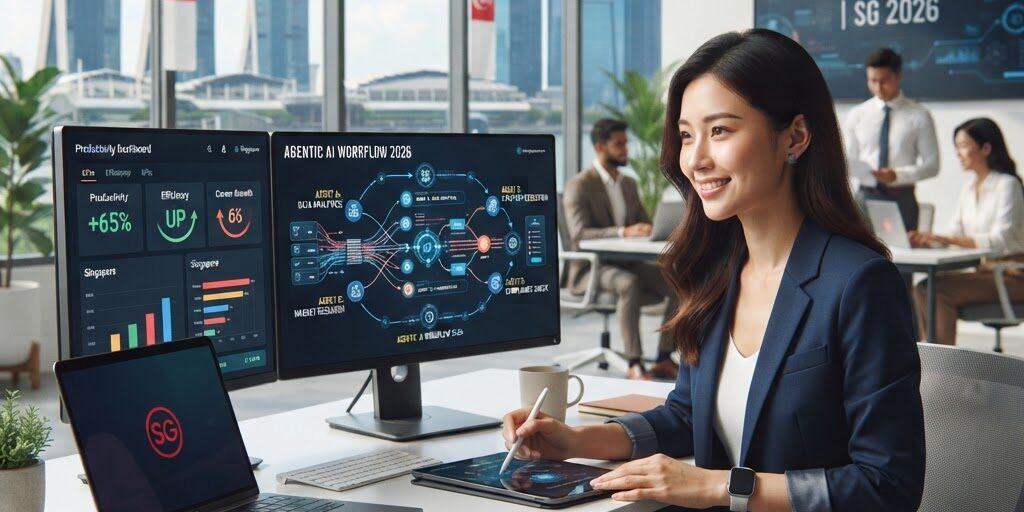
Mastering Agentic AI Workflows: The Essential Skill for Singapore Professionals in 2026
In the rapidly evolving landscape of 2026, Singaporean professionals face a pivotal transition. Moving beyond simple AI literacy, the focus has firmly shifted toward mastering Agentic AI workflows. This evolution marks the move from tools that simply react to prompts, to autonomous systems that can execute multi-step tasks independently. In a competitive market like Singapore, where efficiency and high-level strategic output define career growth, understanding how to deploy these agents is no longer optional. These workflows empower employees to delegate complex, iterative processes to intelligent software agents that can reason, plan, and operate across various software ecosystems. By integrating these autonomous agents into daily routines, professionals can significantly reduce operational overhead, reclaim time for high-value decision-making, and position themselves as indispensable assets within their organizations. As digital transformation reaches a new zenith, the ability to architect, monitor, and refine these systems serves as the ultimate differentiator for the modern workforce. Mastering this domain requires a blend of technical insight and strategic foresight, ensuring that the technology aligns perfectly with organizational objectives and productivity goals for the long-term success of every professional in the nation.
Table of Contents
Understanding Agentic AI Workflows
Agentic AI workflows represent a fundamental departure from standard generative AI applications. While a typical chatbot requires constant human guidance to complete a single task, an agentic system acts as a proactive collaborator. It functions by analyzing a complex objective and breaking it down into a sequence of actionable steps. For instance, in a corporate finance setting, an agent would not just summarize a report but would instead retrieve data from multiple ERP systems, reconcile variances against ledger entries, draft an initial analysis, and flag specific anomalies for management review. This transition toward autonomous execution is enabled by advanced reasoning engines that can handle ambiguity and self-correct during the execution phase. The core components of these systems include memory modules for context retention, search capabilities for real-time information retrieval, and tool-use interfaces that allow the AI to interact with external business applications like email clients, CRMs, and data visualization platforms. By leveraging these workflows, teams in Singapore can bridge the gap between initial ideation and final deployment with minimal friction. The architecture of these agents is designed to mimic the analytical prowess of human professionals, ensuring that complex multi-layered workflows are handled with precision, speed, and consistency. As these systems become more integrated, industry experts emphasize that the human role shifts from performing the task to supervising the agentic architecture. This paradigm shift requires professionals to cultivate a deeper understanding of how to define, refine, and troubleshoot these automated loops. By mastering the fundamental logic behind these systems, one can transform standard operational hurdles into streamlined, self-correcting pathways that maximize output while minimizing human error across every department in the modern digital enterprise today.
The Strategic Value of Autonomy
The strategic value of autonomy in the workplace cannot be overstated as we look toward the later half of the decade. In Singapore, where human capital is the most precious resource, the primary goal of adopting agentic AI is the optimization of high-value human talent. By offloading routine cognitive tasks—such as administrative processing, data entry, or repetitive communication drafting—to autonomous agents, professionals can refocus their efforts on innovation, relationship building, and high-level strategy. This creates a powerful force multiplier effect. Imagine a scenario where a marketing team in a high-paced digital agency uses agents to monitor campaign performance metrics across twenty different platforms simultaneously, automatically adjusting bids based on pre-set parameters and generating high-level summary reports. This frees the team to spend their time on creative strategy, brand positioning, and client acquisition, rather than manual data reconciliation. This is the essence of professional leverage in 2026. Furthermore, these autonomous systems provide unparalleled data consistency. Unlike humans, agents do not suffer from fatigue, boredom, or context switching costs, which often lead to errors in long-running processes. The following table illustrates the productivity shift between traditional workflows and agentic workflows in a typical corporate task. By understanding these metrics, professionals can better advocate for the integration of agentic tools within their own organizations. The shift is not merely about speed; it is about precision and the ability to operate at a scale that was previously impossible for human teams alone. As autonomy becomes a standard feature of modern software, those who can orchestrate these agents will become the architects of the new digital economy, leading their sectors in efficiency, responsiveness, and consistent delivery of high-quality professional outcomes.
| Metric | Traditional Workflow | Agentic AI Workflow |
|---|---|---|
| Task Execution Time | 4 Hours (Human Manual) | 15 Minutes (Agent + Human Audit) |
| Error Rate | Medium (Human Fatigue) | Extremely Low (Systematic) |
| Scalability | Limited to Headcount | Unlimited (Parallel Processing) |
| Resource Cost | High Per Unit | Low After Implementation |
Implementing Agents in Singapore Enterprises
Implementing agentic AI workflows within Singaporean enterprises requires a structured, multi-phased approach that balances technological ambition with practical risk management. Industry experts recommend beginning with small, high-impact pilot programs that focus on internal bottlenecks rather than external client-facing processes. This allows internal teams to test the stability and output quality of agents within a controlled, safe environment. The key to successful implementation lies in the design of the agent instructions—often referred to as ‘system prompts’ or ‘agent persona tuning’—which define the scope, authority, and behavioral boundaries of the AI. As the technology matures, these agents can be scaled to encompass more complex, interconnected business functions such as supply chain management, customer support ticket resolution, and predictive maintenance scheduling. One significant consideration for local organizations is compliance and data security. With Singapore’s rigorous standards for digital governance, professionals tasked with deploying these workflows must ensure that the agents operate within strict ethical and security frameworks. This means implementing robust auditing logs and ‘human-in-the-loop’ checkpoints at critical decision nodes. This hybrid approach ensures that while the agent does the heavy lifting, accountability remains clearly with human supervisors. As organizations scale, the focus shifts toward interoperability—ensuring that agents deployed across different departments can communicate effectively. Building a unified ecosystem where data flows seamlessly between agents enables a higher level of intelligence, where insights from a sales agent can inform the forecasting models used by the supply chain agent. This holistic approach to automation is what separates top-tier organizations from the rest of the market. By fostering a culture of experimentation and continuous improvement, local firms can create a competitive moat, utilizing their agentic workforce to outperform rivals in speed, reliability, and innovative depth as we progress further through 2026.
Future-Proofing Your Career
Future-proofing your career in 2026 demands that you evolve into a manager of machines. The most successful professionals will be those who can conceptualize complex workflows, define the logical steps required for completion, and orchestrate various agents to execute those steps effectively. This skill set is rooted in systems thinking, where you treat the enterprise as a complex web of inputs and outputs that can be optimized through strategic automation. To remain relevant, individuals should prioritize learning how to interact with agentic frameworks, understanding the underlying principles of prompt engineering, and mastering the basic integration of APIs that allow agents to talk to one another. Furthermore, soft skills have become more critical than ever; as the technical work is increasingly handled by AI, the human ability to curate the output, apply ethical judgment, and manage client expectations becomes the primary value proposition. You must also cultivate a proactive attitude toward staying informed on the rapid developments in model capabilities and agent architectures. Many industry organizations in Singapore now offer specialized workshops that provide hands-on experience in building these workflows, which can be an excellent way to validate your skills. The goal is to move from being a user of tools to becoming a director of agents, effectively supervising an entire department’s worth of digital capacity. This transition ensures that as industries continue to digitize, your professional value is tied not to the manual labor you perform, but to the strategic impact you generate. By embracing this technology, you are not just keeping pace with change, but you are actively shaping the future of work within your industry, ensuring that you remain a vital part of the workforce for years to come.
Ultimately, the era of Agentic AI is here, and it is reshaping the core of business operations in Singapore. By focusing on the strategic implementation of these technologies, professionals can secure their position at the forefront of this digital revolution. The journey is continuous, requiring a mindset of lifelong learning and a commitment to refining these systems for optimal performance. Success in the year 2026 and beyond depends on how effectively you can harness these autonomous capabilities, turning technical complexity into a source of competitive advantage for your organization and your career. Stay curious, stay informed, and begin integrating agentic frameworks into your daily workflow today to guarantee your long-term success.
Frequently Asked Questions
- What are agentic AI workflows? Agentic AI workflows are autonomous processes where AI systems are programmed to set their own sub-goals and execute multi-step tasks to achieve a desired objective without constant manual intervention.
- How can Singaporean professionals start learning this? Start by identifying repetitive tasks in your current role, research low-code agent platforms, and enroll in certified industry workshops that focus on AI orchestration and systems thinking.
- Are these systems secure for business use? Yes, when implemented with proper security protocols, audit trails, and strict data governance policies, agentic AI can be a secure and highly reliable tool for enterprise operations.
- Will AI agents replace jobs? Rather than replacing jobs, agents are intended to augment human capability, allowing professionals to delegate mundane tasks and focus on higher-value creative and strategic decision-making roles.
- What is the difference between standard AI and agentic AI? Standard AI provides a response based on a direct prompt, while agentic AI independently plans, executes, and revisits tasks to achieve a complex goal based on broader instructions.