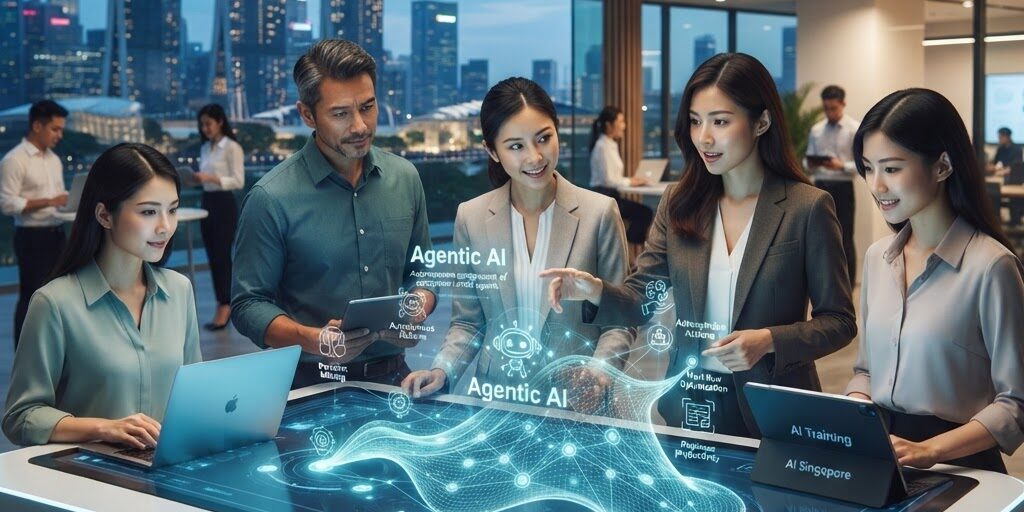
Mastering Agentic AI: The Essential Skill for Singapore’s Workforce in 2026
As the digital landscape evolves, Singaporean professionals are witnessing a paradigm shift from basic artificial intelligence literacy to the nuanced art of deploying Agentic AI workflows. In the competitive environment of 2026, proficiency in these autonomous systems is no longer a luxury but a fundamental necessity for maintaining business productivity and regional dominance. Agentic AI represents the next frontier, where software agents are empowered to act with autonomy, making real-time decisions to complete complex, multi-step tasks without constant human intervention. This transformative capability allows individuals and organizations to streamline operations, reduce cognitive load, and unlock new levels of innovation across every industry sector. To thrive in the modern Singaporean workplace, workers must move beyond simple prompt engineering and embrace the architectural logic of agent-based systems. By mastering these workflows, you align yourself with the future of work, ensuring your skill set remains relevant as the nation accelerates its Smart Nation initiative. This guide explores the essential competencies required to navigate this changing technological landscape, providing actionable insights into how you can harness the power of autonomous agents to transform your professional output and drive meaningful business results in an increasingly automated world.
Table of Contents
The Evolution of AI: From Assistants to Agents
The progression of artificial intelligence over the past few years has been nothing short of revolutionary. We have transitioned from the era of static chatbots, which provided simple responses to basic queries, toward the sophisticated era of Agentic AI. While traditional generative tools relied entirely on human-initiated prompts for every single action, Agentic AI workflows introduce the concept of autonomy within specific constraints. These agents can interpret complex goals, break them down into actionable sub-tasks, utilize external tools, and iterate on their own processes based on the feedback loop they receive from the environment. For Singaporean professionals, this evolution signifies that the value of human labor is shifting from task execution to high-level orchestration and system oversight. Instead of manually inputting data or drafting reports, workers are now required to design the pathways that these autonomous systems follow to achieve business objectives. This shift is profound because it necessitates a deep understanding of logical structures and system integrations rather than just familiarity with linguistic models. Industry experts suggest that the most successful professionals in 2026 will be those who view agents as collaborative team members rather than simple software features. By delegating iterative or tedious data synthesis to agents, professionals can reclaim their time for creative problem-solving and strategic planning. The ability to manage these agents effectively requires a new type of digital literacy focused on task decomposition, error handling, and logical sequencing. As we look ahead, it is clear that the integration of these autonomous systems will redefine every job description in the local market, making it essential to adapt rapidly to this new reality of automated workflow architecture and continuous agent optimization.
Designing Effective Agentic AI Workflows
Designing effective Agentic AI workflows requires a rigorous approach to system architecture and a solid grasp of how data flows between different software environments. Unlike basic AI usage, creating an autonomous workflow requires the developer to anticipate failure points and implement robust validation mechanisms. Professionals must begin by defining the primary objective clearly and then identifying the individual steps required to reach that goal. This involves a process known as task decomposition, where complex projects are broken down into granular units that an agent can execute independently. Once these tasks are isolated, the professional must select the right tools and APIs to bridge the gap between the agent and the required data sources. Furthermore, context management is paramount. In a workflow, an agent must be able to retain information from previous steps to inform its subsequent actions, ensuring continuity and logic. Many organizations in Singapore are now adopting structured frameworks to ensure these workflows are scalable and secure. When designing these systems, one must account for security protocols and data privacy, particularly when dealing with sensitive information in a corporate environment. Implementing these workflows is not just about technical implementation; it is about building a system that acts as a force multiplier for human intent. Industry experts highlight that the most resilient workflows are those that incorporate human-in-the-loop validation, where the agent presents results at critical milestones for review before proceeding to final execution. This balance between autonomy and control ensures that the productivity gains are realized without compromising on quality, accuracy, or organizational safety. As practitioners gain confidence, they can increase the complexity of these workflows, leading to fully autonomous loops that operate continuously to support various business operations, from supply chain management to dynamic customer relationship tracking.
Skill Requirements for the Modern Workforce
The transition toward widespread adoption of Agentic AI workflows demands a specific set of skills that go beyond traditional IT knowledge. First and foremost, professionals need to develop a fundamental understanding of systems thinking. This involves seeing business processes as interconnected loops rather than linear tasks, which is the foundational mindset needed to build autonomous agents effectively. Additionally, logical reasoning has become a high-demand skill in the age of 2026, as individuals must be able to build conditional structures that guide an agent through various decision-making scenarios. Troubleshooting has also evolved; instead of fixing lines of code, modern professionals must debug the logical failures of an agent’s reasoning. This requires a diagnostic mindset, where one analyzes why an agent chose a specific path and how the constraints might be adjusted to prevent future errors. Beyond logic, understanding API integrations is crucial, as agents are only as powerful as the tools they are connected to. Being able to bridge the gap between various business software and AI models will separate top performers from the rest. The table below illustrates the critical competencies required for mastering this technology.
| Competency | Description | Professional Impact |
|---|---|---|
| Task Decomposition | Breaking complex goals into logic-based sub-steps. | Increases efficiency in project management. |
| API Orchestration | Connecting AI to external software databases. | Enables autonomous data synchronization. |
| Prompt Engineering | Designing clear, goal-oriented system instructions. | Improves agent accuracy and performance. |
| Logical Debugging | Identifying reasoning errors in agent workflows. | Reduces downtime and manual overrides. |
Training programs are increasingly focusing on these areas to ensure that the Singaporean workforce remains competitive. Mastery of these skills allows professionals to move from performing tasks to directing processes, which is a major shift in the value proposition of human capital. By investing time in learning how to integrate these intelligent agents into daily routines, you are essentially upskilling to meet the demands of an AI-first economy. This shift in capability not only improves individual output but also creates a more agile organization capable of responding to market changes in real time. The focus must remain on practical application, where learners test their workflows in sandbox environments before deploying them into critical business systems, ensuring that every implementation is both functional and reliable under varied conditions.
Scaling Productivity with Agentic Systems
Scaling productivity with Agentic AI workflows requires a strategic transition from isolated pilot projects to enterprise-wide integration. In 2026, the real advantage lies in the ability to create multi-agent systems where different agents collaborate, each handling a specific domain of the business. For instance, a data-gathering agent can work in tandem with an analytical agent and a reporting agent, creating a seamless chain of value that operates across different time zones. This degree of automation allows businesses to operate with a speed and consistency that was previously unattainable. However, scaling also introduces new challenges, particularly regarding system governance and maintenance. As an organization relies more on these autonomous systems, it must establish clear frameworks for monitoring performance and ensuring that the output remains aligned with corporate strategy. Professional architects must implement centralized dashboards where the performance of various agents can be tracked, and exceptions can be managed as they arise. Scaling effectively means ensuring that every autonomous system has a clear kill-switch or manual override mechanism, maintaining the safety of the company’s digital infrastructure. Industry experts often emphasize that scalability is inherently linked to documentation. When an agent is designed, its purpose, its authorized actions, and its data access levels must be clearly defined. This creates a culture of transparency that is essential when deploying autonomous solutions across large teams. As the Singaporean market continues to adopt these technologies, companies that can successfully bridge the gap between individual agent implementation and scaled multi-agent ecosystems will be the ones that capture significant market share. The goal is to create a digital environment where the AI handles the repetitive, low-value work, while human talent focuses on high-value synthesis, creative strategy, and empathetic stakeholder management. By systematically scaling these workflows, businesses can transform their operational capacity, allowing for greater innovation and a more resilient bottom line in a complex economic climate.
The era of Agentic AI is truly upon us, and the ability to master these workflows is the key differentiator for success in 2026. By shifting our perspective to view these tools as capable, autonomous agents, we open the door to unprecedented productivity and growth. It is a journey that starts with learning the foundational logic, applying it to real-world tasks, and eventually scaling these systems to transform our entire work environment. The future is bright for those who choose to adapt and lead.
FAQ
What exactly are Agentic AI workflows?
Agentic AI workflows are structured processes where intelligent agents are given specific goals and allowed to take autonomous steps using tools to achieve them without needing constant human guidance.
Why is this skill important for Singaporean professionals in 2026?
In 2026, automation is standard. Mastering these workflows helps you remain competitive by focusing on high-level orchestration instead of simple, repetitive tasks that machines can perform better.
Do I need to be a programmer to build these workflows?
While coding helps, many no-code platforms now allow professionals to build sophisticated agents by defining logical sequences and connecting APIs without traditional software engineering knowledge.
How can I ensure my AI agents are secure?
Security is maintained by implementing strict permission boundaries, using sandboxed environments for testing, and ensuring that every agent has a clear human-in-the-loop oversight mechanism for critical tasks.
Where should a beginner start learning about agentic systems?
Begin by exploring open-source agent frameworks and participating in local training modules that focus on systems thinking and logical task decomposition to build a strong theoretical foundation.