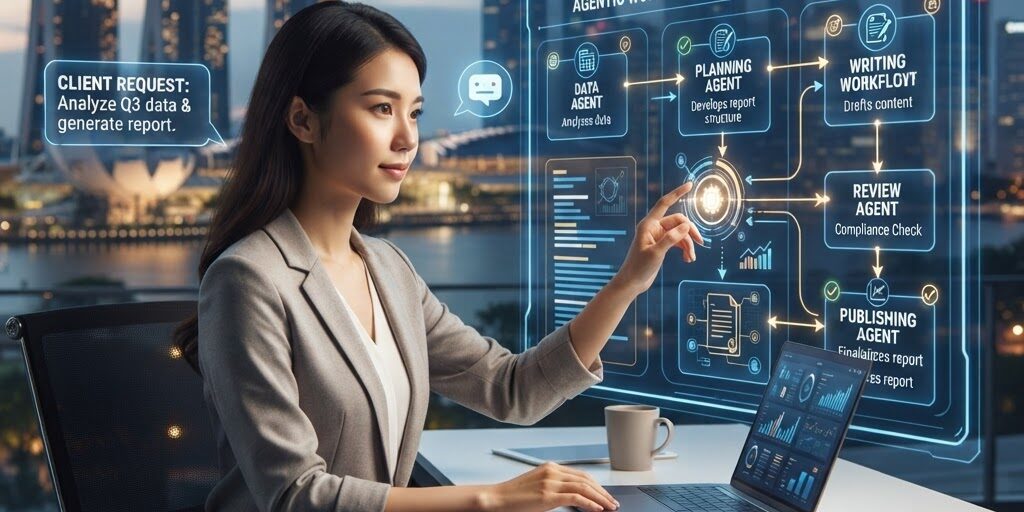
Mastering Agentic AI Workflows: The Essential Skill for Singapore Professionals in 2026
As we navigate the rapidly evolving digital landscape of 2026, the demand for sophisticated automation has moved beyond simple chatbots and basic text generation. Today, the most critical skill for Singaporean professionals aiming to maintain high levels of productivity and global competitiveness is the mastery of Agentic AI workflows. Unlike static AI tools that require constant human intervention for every minor task, agentic systems operate with a degree of autonomy that allows them to execute multi-step processes, self-correct, and make decisions based on defined logic parameters. For the modern Singaporean workforce, integrating these workflows is not merely a competitive advantage; it is a necessity for navigating the complexities of a fast-paced economy. Industry experts agree that moving from basic prompting to structured, autonomous agentic frameworks represents a fundamental paradigm shift in how business processes are managed. In this comprehensive guide, we will explore the core concepts, technical implementation strategies, and long-term career benefits of adopting these advanced AI architectures, ensuring you remain at the forefront of the technological revolution shaping Singapore’s future.
Table of Contents
Understanding the Paradigm Shift
The evolution from basic generative AI tools to complex Agentic AI workflows marks a historical turning point for professional productivity in Singapore. In previous years, professionals spent a significant portion of their daily schedules engaged in manual prompt engineering, constantly nudging language models to produce coherent outputs. While effective for single-turn tasks, this approach falls short when addressing enterprise-grade operations. Agentic AI shifts this interaction model by allowing the user to define a high-level goal rather than a specific set of instructions for every micro-action. These agents are designed to break down broad objectives into logical sub-tasks, prioritize them based on dependencies, and execute them across multiple software environments. For a project manager in a tech firm or a financial analyst in the central business district, this means the AI behaves more like a digital assistant that can actually perform the heavy lifting. By moving away from reactive prompting to proactive task delegation, workers can reclaim hours of their time each week. Furthermore, the reliability of these agents has improved drastically due to better feedback loops. When an agent encounters an error or a logic trap, modern frameworks allow it to assess its own performance, verify the output against data constraints, and attempt a different path without needing a human to re-prompt it. This self-correcting capability is the hallmark of a truly agentic system. It is vital to recognize that this shift is not about replacing human decision-making, but rather augmenting it with software that can handle the tedious, iterative, and high-volume tasks that often clutter our schedules. As Singapore continues to push for a smart nation digital economy, understanding the distinction between standard AI tools and fully functional agents will determine who succeeds in the long-term labor market.
The Architecture of Autonomous Systems
At the core of any successful deployment of Agentic AI workflows lies a robust architecture that balances autonomy with strict oversight. Most advanced systems rely on a combination of a central decision-making engine, a persistent memory module, and a set of specialized tools that allow the agent to interface with external APIs, databases, or cloud storage platforms. The decision-making engine functions as the brain, parsing user inputs into a structured action plan. This involves mapping out the sequence of steps required to achieve a desired outcome while considering potential bottlenecks. Meanwhile, the memory module ensures that the agent retains context from previous interactions or data retrieval operations, which is essential for tasks that require long-term project monitoring. This structure is fundamentally different from a simple chatbot because the agent is not limited to a single chat window; it is essentially a software process that interacts with the broader ecosystem. Our research into these systems suggests that the most effective agents are those that operate within a constrained environment where their reach is limited by security protocols. For instance, an agent tasked with financial reporting should have read-only access to specific ledger databases but no authority to initiate unauthorized transactions. This balance of power allows the agent to function independently while keeping human oversight firmly in place. Table 1 below highlights the primary differences between standard AI interactions and autonomous workflows to clarify the technical gap. By visualizing these differences, professionals can better appreciate why the transition is necessary for scaling complex operations. With high-performance cloud infrastructure widely available in Singapore, building and hosting these agentic architectures has never been more accessible to companies of all sizes, from SMEs to multinational corporations operating in the regional hub.
| Feature | Standard AI Prompting | Agentic AI Workflows |
|---|---|---|
| Task Scope | Single-turn requests | Multi-step, complex goals |
| Interaction Style | Reactive | Proactive and autonomous |
| Correction Method | Human re-prompting | Self-reflection and iteration |
| Integration Level | Isolated interface | API and tool connectivity |
Implementing Workflows in Singapore
Implementing Agentic AI workflows in the Singaporean professional context requires a thoughtful approach to data governance and cross-functional collaboration. Because Singapore is a highly regulated environment with strict data protection and privacy requirements, the integration of autonomous agents must prioritize compliance at every stage of the development lifecycle. Organizations looking to adopt these systems should begin by identifying high-frequency, low-variance tasks that are currently consuming valuable human capital. Examples include document reconciliation, market trend analysis, and automated customer service ticketing systems. Once these areas are identified, the next step involves mapping out the workflows that the AI will follow. This is where the skill of the professional comes into play; it is the human architect who defines the agent’s logic, the specific tools it can access, and the safety guardrails that prevent it from deviating into unauthorized territory. In Singapore, many firms are turning to internal sandbox environments to test these agents before deploying them into live production. This methodology mitigates risk while allowing teams to observe how the AI behaves in real-world scenarios. Another critical factor in successful implementation is the training of the workforce. It is not enough to simply purchase the software; organizations must invest in upskilling their staff so that they can effectively monitor, adjust, and optimize these AI workflows. This is a collaborative effort between IT departments, operational managers, and individual contributors. As the technology matures, we anticipate that businesses that successfully integrate agentic systems will gain significant productivity advantages, allowing them to scale their operations without necessarily increasing their headcount in the same proportion. The ability to manage these agents is becoming a new core competency in the local job market, and forward-thinking individuals are already seeking ways to integrate this knowledge into their daily workflows.
Future-Proofing Career Trajectories
As we look toward the later part of the decade, the ability to manage Agentic AI workflows will become a foundational expectation for roles ranging from administrative assistants to senior engineers. The rapid adoption of AI in the Singaporean economy suggests that those who can effectively deploy these agents will be the ones who lead teams and drive innovation. Future-proofing your career in this era is not about memorizing complex code, but about developing a deep understanding of logical flow, process optimization, and the art of setting strategic objectives for autonomous systems. The professionals who thrive in 2026 and beyond will be the ones who treat their AI agents as junior staff members, providing clear guidance and maintaining constant oversight. This creates a shift in focus from manual task execution to strategic management. We must also consider the evolving regulatory environment in Singapore regarding the ethical use of AI. Being an expert in agentic workflows means more than just technical proficiency; it includes a keen awareness of how to build systems that are transparent, secure, and respectful of personal data. By focusing on these high-level skills, professionals ensure they are not just staying afloat, but riding the wave of technological progress. The shift is already underway, and the barrier to entry is lowering every single month. By engaging with open-source frameworks, attending professional development workshops, and experimenting with small-scale personal automation, any motivated individual can begin to build their competency in this vital field. The future of work is not defined by humans against machines, but by the collaboration between humans and the agentic systems they have designed, directed, and optimized. This synergy is what will define the next chapter of Singapore’s success as a premier global business hub.
In conclusion, the mastery of Agentic AI workflows is no longer an optional skill for the ambitious Singaporean professional. It is the bridge between the simple automation of the past and the sophisticated, autonomous future that lies ahead. By understanding the architectural components, adhering to local regulatory standards, and cultivating a management-oriented mindset, professionals can secure their value in an increasingly AI-driven market. While the technology will continue to advance at a rapid pace, the core principle remains the same: the most effective workers are those who know how to direct, monitor, and refine the digital tools at their disposal. Now is the time to start building your agentic skillset, as the competitive advantages gained today will compound, creating a trajectory for long-term career resilience in our digital nation.
Frequently Asked Questions
What exactly are Agentic AI workflows? They are automated processes where AI models independently plan and execute multi-step tasks to achieve specific goals without needing human prompts for every single action.
Why is this important for professionals in Singapore? It allows for massive increases in personal productivity, helping professionals manage the high-pressure demands of the Singaporean economy by automating repetitive and data-heavy tasks efficiently.
Do I need to be a software developer to use these workflows? No, you do not need to be a coder. Many modern platforms offer no-code interfaces that allow non-technical professionals to design and implement their own agentic workflows.
How do these agents ensure data security and compliance? They function within strictly defined sandboxes and use secure APIs that respect organizational privacy policies and local data protection regulations, keeping sensitive information protected at all times.
How can I start learning about agentic AI today? You can start by exploring online AI documentation, experimenting with local agent-building tools, and focusing on process-oriented thinking to design small, useful automation tasks in your daily routine.