Mastering Agentic AI: The Essential Skill for Singapore’s Workforce in 2026
As Singapore moves toward a future defined by rapid digital transformation, the landscape of work is undergoing a fundamental shift. We are moving beyond the era of simple generative AI prompting into the age of autonomous systems. Agentic AI workflows represent the next frontier of professional productivity, enabling machines to act as independent operators rather than mere chatbots. For the Singaporean workforce, mastering these complex systems is no longer a luxury but an essential requirement for remaining competitive in the global market. These systems can break down abstract goals into actionable tasks, search for information, and execute entire projects with minimal human intervention. As we look toward 2026, the ability to architect, supervise, and refine these workflows will define the top-tier workforce. In this guide, we explore how these autonomous systems function, why they are essential for your career, and the specific strategies you need to implement to stay ahead of the curve. Preparing for this evolution ensures that you remain an architect of technology rather than a subject of its displacement, keeping your skills relevant in a highly efficient, automated economic environment.
Table of Contents
Defining the Evolution of Agentic AI Workflows
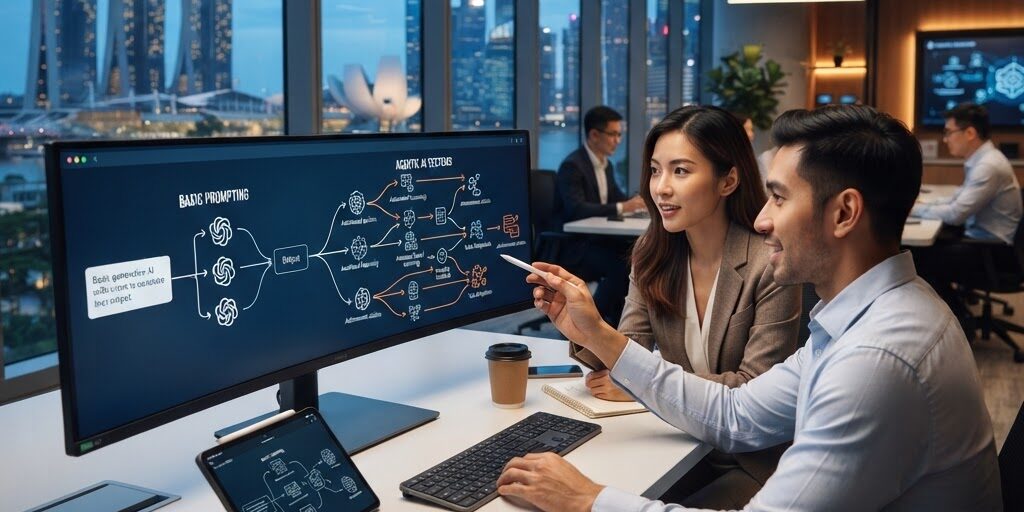
To understand the current shift, we must differentiate between standard generative AI and true agentic capability. Generative models operate on a request-response cycle. You provide a prompt, and the system produces an output. Agentic AI workflows, however, possess the capacity for reasoning, tool use, and iterative reflection. An agentic system can identify that it lacks information, decide to search an external database, verify the accuracy of the result, and then adjust its output accordingly. This capability transforms the machine from a passive assistant into a proactive partner capable of handling long-horizon tasks. In the context of the modern workplace, this means an AI can now draft an entire marketing strategy, cross-reference it against existing compliance guidelines, and format the final document for distribution without needing constant human oversight. The complexity of these systems is grounded in their ability to perform multi-step logical sequences. Industry experts suggest that the hallmark of these agents is their ‘thought loop’—a process where the model evaluates its own performance against the objectives provided by the user. By understanding how to structure these loops, professionals can dramatically increase their daily output. As these systems become more integrated into software suites, the technical barrier to entry lowers, but the strategic barrier rises. It is not enough to simply use these tools; one must understand the logical orchestration required to guide them. Businesses across Singapore are already deploying these agents to manage supply chains, customer inquiries, and data synthesis. Recognizing the potential for growth requires acknowledging that the agentic shift is a fundamental change in how we define digital labor. Instead of performing a task, you are now managing a team of autonomous digital workers, which necessitates a significant shift in your own mindset and operational toolkit.
The Strategic Implementation of Autonomous Systems
Implementing agentic AI workflows within your daily routine requires a structured approach to technical management. Unlike basic prompting, which is transactional, agents require an architecture of instructions, context, and feedback loops. To begin, professionals must clearly define the scope of the agent’s responsibilities. If the instruction is too vague, the agent may wander off into unproductive pathways. Industry experts emphasize the necessity of creating modular workflows where specific components of a task are isolated. For instance, if you are automating a report-generation process, the first agent should focus exclusively on data collection, while the second handles synthesis, and the third manages formatting. This compartmentalization ensures that if an error occurs, it is localized and easily rectifiable. Furthermore, effective implementation involves selecting the right tools and environments that support agentic functionality. Many modern platforms now offer visual interfaces to connect these agents, allowing users to build workflows that mimic human decision-making hierarchies. Below is a comparison table outlining the key differences between traditional prompting and agentic workflows to help you visualize the transition. Consider how each shift impacts your specific professional role and what skills you may need to acquire to bridge the gap. As we approach 2026, those who can map out these complex workflows will be the most valuable assets in the labor market. The goal is to reach a level of proficiency where your AI agents act as an extension of your own professional capabilities, allowing you to focus on high-level strategy and creative problem-solving while the agents handle the tactical execution of complex, repetitive, or data-intensive processes. This is the new standard of efficiency that will drive success in the upcoming fiscal years for industries ranging from finance to logistics.
| Metric | Traditional Prompting | Agentic AI Workflows |
|---|---|---|
| Task Scope | Single-step, narrow | Multi-step, complex |
| Intervention | Constant supervision | Periodic audit/oversight |
| Capability | Content generation | Reasoning and tool use |
| Outcome | Drafting | End-to-end execution |
Maintaining Workforce Competitiveness in Singapore
Singapore’s workforce is uniquely positioned to lead in the adoption of advanced automation. With a strong foundation in digital literacy and a government-led push toward high-value innovation, the city-state is rapidly creating an environment where agentic AI workflows are integrated into everyday operations. To remain competitive, local professionals must move beyond basic digital literacy and enter the realm of systems thinking. Systems thinking is the art of viewing a process as a collection of interconnected parts. When applied to AI, it means understanding how to feed data from one agent to another and how to structure the input so that the final output aligns with organizational objectives. The competition in 2026 will not be between humans and machines, but rather between professionals who utilize agents effectively and those who do not. Many industries are already seeing a massive shift in talent requirements. Positions that once focused on manual reporting are now being reclassified as ‘AI Operations’ or ‘Workflow Architecture’ roles. This transformation allows individuals to leverage the speed and accuracy of machines to solve problems that were previously too time-consuming to address. Engaging with these technologies requires a willingness to experiment and a resilient approach to troubleshooting. When an agent fails a task, the expert user does not abandon the tool; they iterate on the prompt or the system architecture to correct the logical flow. This iterative mindset is essential for the future of work. By staying updated on the latest breakthroughs and experimenting with low-code agent building platforms, you can ensure that your skillset remains robust. Singaporean companies are actively searching for individuals who can bridge the gap between business strategy and machine logic, making this the most critical skill for anyone looking to advance in the coming years.
Future-Proofing Your Career Through Agentic Mastery
The journey toward mastery in agentic AI workflows is an ongoing process of learning and adaptation. Future-proofing your career requires a commitment to understanding the limitations and the ethical implications of these autonomous systems. As machines take on more responsibility, the human role shifts toward oversight, verification, and creative direction. You must become a curator of the AI’s work. This means having the critical thinking skills to evaluate the validity of the data provided by your agent and the ethical judgment to handle sensitive information appropriately. In the next few years, the focus will shift from ‘how do I get the AI to do this’ to ‘how do I ensure this AI system is aligned with my professional standards and organizational goals.’ Developing this level of oversight requires a deep understanding of the underlying principles of large language models and the specific nuances of agentic reasoning. Industry experts recommend building a portfolio of successful agentic projects. Whether it is automating your administrative workload, building a custom research assistant, or developing an internal tool for your team, demonstrating that you can deploy these systems effectively is the best proof of your competence. Furthermore, networking with other professionals interested in AI operations will keep you informed of the latest safety protocols and performance-boosting techniques. The landscape is evolving daily, and those who remain static risk falling behind. By embracing the complexity of these workflows today, you are investing in a future where you are empowered by technology rather than replaced by it. The ability to command these autonomous agents to handle the heavy lifting while you focus on the creative and strategic vision will make you an indispensable member of the Singaporean workforce in 2026 and beyond. Prepare now, build your expertise, and position yourself at the forefront of this digital revolution.
Conclusion
Mastering agentic AI workflows is more than just learning a new software tool; it is a fundamental shift in how we approach professional productivity. As Singapore continues to set the standard for digital excellence, the ability to manage autonomous systems will become the primary differentiator for high-value talent. By moving from simple prompting to designing complex, multi-step agentic sequences, you position yourself as a leader in the digital economy. The transition requires a commitment to continuous learning, iterative problem-solving, and strategic thinking. Embrace the role of the workflow architect and utilize these powerful machines to scale your impact, streamline your operations, and secure your place in the future of work. The era of the agentic workforce is here, and those who master these autonomous systems will define the landscape of 2026.
Frequently Asked Questions
What are the primary differences between generative AI and agentic AI?
Generative AI produces content based on single prompts, while agentic AI workflows are autonomous systems that can reason, use external tools, and perform multi-step tasks to reach a specific objective.
Why is this skill critical for the Singapore workforce in 2026?
As industry standards evolve toward higher efficiency, companies will prioritize talent that can manage and optimize autonomous agents to handle complex operational workflows.
Do I need to be a programmer to build agentic workflows?
No, many modern platforms allow for the construction of agentic systems using low-code or no-code interfaces, making them accessible to non-technical professionals.
How can I start practicing agentic AI today?
Begin by identifying repetitive, multi-step tasks in your daily work and experiment with AI tools that allow for chained instructions, iterative reflection, and external tool integration.
What is the most important mindset shift for using these systems?
The most important shift is moving from ‘doing the task’ to ‘architecting the system’ that completes the task, focusing on oversight and strategic verification of the outputs.