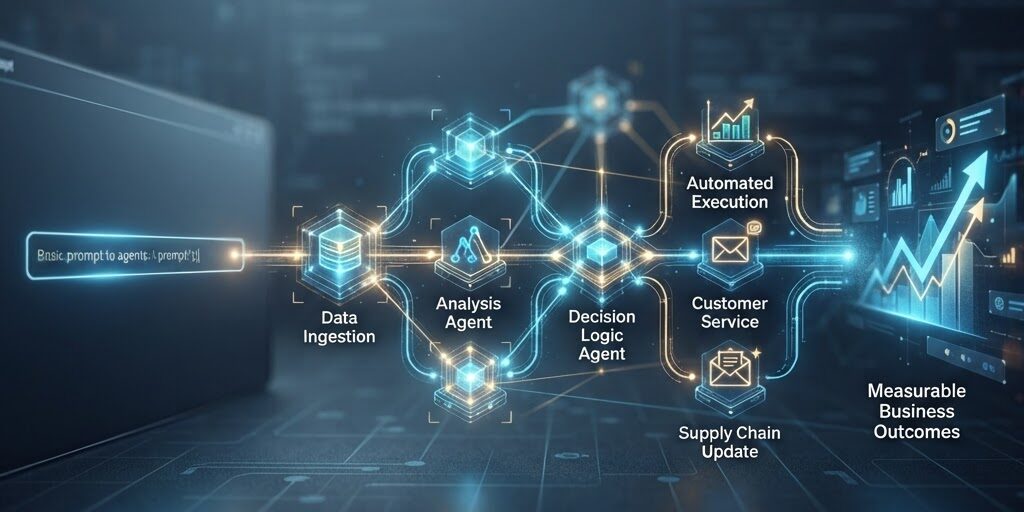
From Prompts to Agents: Mastering Agentic AI Workflows in 2026
In the rapidly evolving landscape of modern technology, the shift from simple prompt engineering to the sophisticated implementation of Agentic AI workflows represents a monumental leap forward for businesses worldwide. As we navigate through 2026, the reliance on human-input-heavy interactions has diminished, replaced by autonomous systems capable of reasoning, planning, and executing complex, multi-step tasks without constant supervision. Agentic AI workflows are no longer just a futuristic concept; they are the backbone of efficient digital transformation, driving measurable business outcomes by bridging the gap between intention and action. Unlike basic chatbots that merely reflect data, these intelligent agents analyze requirements, evaluate potential tools, and iterate on their processes to achieve specific goals. This transformation requires a fundamental change in how professionals approach AI integration, moving away from static query design and toward building adaptive systems that learn and adjust. This guide explores the foundational principles of these advanced architectures, providing a roadmap for those looking to harness the true potential of autonomous agents in their operational frameworks today and into the future.
Table of Contents
The Core Principles of Agentic AI Workflows
The transition toward agentic AI workflows is defined by a shift from reactive task completion to proactive goal-oriented execution. At the heart of this paradigm is the autonomous loop, where a system defines its path, executes actions, perceives outcomes, and adjusts its strategy based on real-time feedback. Industry experts emphasize that these agents must possess a high degree of context awareness to navigate the nuances of organizational requirements. A foundational aspect of these workflows is the concept of memory, which allows agents to retain information across sessions and apply learnings from previous attempts to future challenges. Furthermore, modular design is critical; by breaking down massive, complex objectives into smaller, manageable sub-tasks, agents can perform deep work more effectively. These sub-tasks are often managed through internal chains of thought that prioritize accuracy and error correction over pure speed. When we look at how these systems handle data, the focus is on the integration of various external tools—ranging from database queries to API calls—that expand the agent’s functional capacity. The intelligence of an agent is measured by its ability to select the right tool at the right time, minimizing human intervention. By establishing clear guardrails and defining success metrics at the outset, organizations can create robust systems that not only solve specific problems but also identify potential pitfalls before they occur. The sophistication of these models continues to grow as they become more integrated into existing software environments, effectively turning AI from a novelty into a utility that mimics high-level strategic planning. Mastering these principles requires a deep understanding of prompt chaining, state management, and the feedback mechanisms that allow autonomous systems to operate with unprecedented levels of precision and reliability throughout the entire lifecycle of a project.
Designing and Architecting Autonomous Systems
Architecting successful agentic AI workflows demands a rigorous approach to system design, one that prioritizes scalability and security from the ground up. The design process begins with the identification of a specific goal or set of business objectives that can benefit from continuous oversight. Once the goal is defined, designers must structure the agent’s decision-making environment, ensuring that the model has access to relevant documentation, reliable data sources, and necessary APIs. Crucially, the architecture must allow for multi-agent collaboration, where specialized agents perform distinct roles—such as data verification, report generation, or market analysis—within a single overarching pipeline. This collaborative approach mimics a human workforce, where division of labor results in higher collective output. Industry professionals often utilize a combination of long-term memory databases and short-term working memory to ensure the agent maintains consistency over long-running tasks. Furthermore, transparency and traceability are essential; the system must log its internal reasoning processes to allow for post-execution audit and improvement. This is where human-in-the-loop systems remain relevant, not for daily tasks, but for refining the logic and adjusting the decision-making thresholds of the agents. Table 1 below highlights the comparative differences between simple prompt-based systems and fully agentic workflows to help stakeholders understand the structural shift required for success. By implementing comprehensive monitoring tools, teams can track the health of these autonomous agents, ensuring they adhere to organizational compliance standards. The architectural challenge involves balancing autonomy with predictability, ensuring that as the agent learns, it does not drift away from the core mission or operational boundaries set by the leadership teams. By fostering an environment where agents can request human guidance for high-stakes decisions, designers ensure that the system remains safe, controllable, and consistently aligned with the evolving business strategy of the organization.
| Feature | Prompt-Based AI | Agentic AI Workflows |
|---|---|---|
| Task Scope | Single-turn requests | Multi-step complex processes |
| Autonomy | Low | High |
| Tool Interaction | Limited | Extensive and dynamic |
| Error Handling | Static | Self-correcting and adaptive |
| Goal Orientation | Input-dependent | Outcome-driven |
Driving Operational Efficiency Through Automation
Operational efficiency is arguably the most significant benefit of integrating agentic AI workflows into modern business practices. Unlike traditional automation, which relies on hard-coded scripts that break when conditions change, agentic systems possess the flexibility to handle ambiguity and unexpected variables. This fluidity allows businesses to scale their operations without a proportional increase in headcount. For instance, customer support departments can deploy autonomous agents that do not just provide answers from a knowledge base but can actually perform actions like processing refunds, updating account records, or escalating tickets to the appropriate department. This end-to-end management reduces the time-to-resolution, improving customer satisfaction metrics and freeing up human talent for higher-level creative or empathetic tasks. The efficiency gains extend to supply chain management, financial reporting, and even software development, where agents can assist in auditing code or managing deployment pipelines. Because these agents operate on logic-driven workflows, they provide a level of consistency that is difficult to achieve manually. By automating the mundane, repetitive elements of a job, organizations empower their staff to focus on strategy and growth. The key to maintaining this efficiency lies in the iterative testing of agent prompts and logic paths, ensuring that the autonomous processes remain optimized for speed and accuracy. Our internal reviews suggest that the best-performing organizations are those that continuously monitor their agents, identifying bottlenecks in the workflow and tweaking the underlying logic to improve throughput. This cycle of constant optimization is the hallmark of a mature agentic AI implementation, ensuring that the technology does not become stagnant. As these agents become more integrated, they create a compound effect on efficiency, where each improvement to a sub-process cascades into significant time savings across the entire organizational architecture, ultimately leading to substantial competitive advantages.
Future-Proofing Your Business Strategy
The future of work is undeniably agentic, and future-proofing a business requires an immediate commitment to building and deploying these autonomous capabilities. As we advance toward 2027, the gap between organizations that utilize basic LLMs and those that have implemented comprehensive agentic workflows will widen significantly. The most successful organizations are those that view AI not as a distinct tool, but as a layer that is woven into their digital infrastructure. To stay ahead, decision-makers must prioritize internal skill development, ensuring that the workforce is proficient in managing, auditing, and evolving these autonomous systems. Relying solely on third-party solutions without building internal expertise is a risk; instead, organizations should look to build proprietary agent frameworks that are tailored to their unique business domain. This involves investing in robust data governance, as the quality of an agent’s output is directly linked to the quality and accessibility of the data it processes. Furthermore, security protocols must evolve to account for the agent’s capacity to take actions; robust authentication and granular access controls are mandatory to prevent unauthorized operations. As agents become more capable, the focus will shift from simply ‘doing’ to ‘optimizing outcomes’ across complex ecosystems. This includes anticipating market trends, managing cross-departmental dependencies, and refining product roadmaps based on real-time feedback loops that the agents themselves help to monitor. The future belongs to those who view these agents as partners in innovation, capable of executing complex strategies with precision. By fostering a culture that embraces change and continuously assesses the potential of new agentic models, companies can ensure that they remain at the cutting edge of their industry. The transition is challenging, but the potential for growth, resilience, and operational excellence is profound for those who master the nuances of these advanced, autonomous, and goal-oriented artificial intelligence architectures today.
Conclusion
Mastering agentic AI workflows is the defining challenge for professionals in 2026. By moving beyond static prompt engineering, organizations can unlock unprecedented levels of efficiency, autonomy, and strategic clarity. The transition to agentic systems requires a focus on robust architecture, clear goal definition, and a commitment to continuous optimization. While the technical demands are significant, the ability to deploy intelligent agents that handle complex tasks autonomously provides a sustainable competitive advantage in an increasingly fast-paced digital economy. Industry experts agree that those who invest the time to architect these systems thoughtfully will lead their sectors, while others will struggle to keep pace with the relentless speed of autonomous innovation. Start by auditing your current workflows, identify areas where autonomous decision-making can drive the greatest value, and embrace the transformative power of agentic AI today.
Frequently Asked Questions
What distinguishes agentic AI workflows from traditional chatbot interactions?
Chatbots are generally reactive, answering questions based on training data. Agentic AI workflows are autonomous, goal-oriented systems that plan and execute sequences of tasks using external tools to achieve specific results.
How can organizations ensure data security when using autonomous agents?
Security is managed through granular access controls, human-in-the-loop verification for critical tasks, and rigorous data governance policies that ensure agents only interact with verified, private business datasets.
Are human workers still necessary in an agentic AI environment?
Absolutely. Humans shift from task execution to high-level strategic oversight, system architecture, auditing agent decisions, and handling complex interpersonal or creative challenges that AI cannot replicate.
What is the most important factor in scaling agentic workflows?
The most critical factor is modular design. Breaking complex tasks into smaller, executable sub-tasks allows for better monitoring, error correction, and overall system reliability as you scale.
How do I start implementing agentic AI in my business?
Begin by identifying a repetitive, high-impact process. Prototype a single agent to handle a sub-component of that task, measure the outcomes, and iteratively refine the workflow before expanding to broader operations.