Mastering Agentic AI: The Essential Skill for Singapore’s Workforce in 2026
As the digital landscape evolves at an unprecedented pace, Singapore finds itself at a critical juncture in the global technology race. For professionals looking to stay ahead, mastering Agentic AI training Singapore has become the most vital investment for the coming year. Unlike traditional generative models that require constant human prompting, agentic systems operate with a high degree of autonomy, managing multi-step workflows to solve intricate business challenges. By 2026, the ability to architect these systems will distinguish high-performing employees from those struggling to adapt to automated environments. Our industry experts suggest that the future of work is not just about using AI, but about orchestrating autonomous agents to handle complex reasoning tasks. This shift requires a deep understanding of how to bridge human strategy with machine execution. In this comprehensive guide, we will explore why agentic architectures are reshaping corporate productivity and how you can secure your professional edge in this highly competitive marketplace by developing these high-demand technical capabilities today.
Table of Contents
Understanding the Mechanics of Agentic Systems
Agentic AI represents a fundamental leap beyond the passive interaction models we have become accustomed to over the last few years. While conventional generative tools rely on explicit user inputs to produce specific text or code snippets, agentic systems are designed to function as goal-oriented entities. When a user defines an objective, an autonomous agent breaks this goal into smaller, actionable sub-tasks, determines the sequence of execution, and utilizes available tools to fulfill the requirement without human hand-holding. This autonomous reasoning capability is what makes agentic AI training Singapore so essential for local professionals who manage complex business logic. These systems leverage sophisticated loops of observation, thought, and action, effectively mimicking the human cognitive process of trial and error to reach an optimal conclusion. By understanding the underlying architecture of these agents—such as memory management, planning hierarchies, and tool-use capabilities—professionals can transition from being mere users to becoming systems architects. This shift is crucial because the efficiency of an agent depends heavily on the quality of its design, its grounding in reliable data, and its ability to self-correct during failure states. Industry experts emphasize that the technical proficiency to configure these autonomous workflows is the primary driver of digital transformation in our current era. As organizations integrate these tools into their core infrastructure, the demand for individuals who can troubleshoot agentic loops and refine model behavior will only increase, creating a premium market for those who have mastered the foundational concepts of modern autonomous systems and the ethical frameworks that govern their deployment within a strictly regulated professional environment.
The Strategic Advantages of Multi-Agent Frameworks
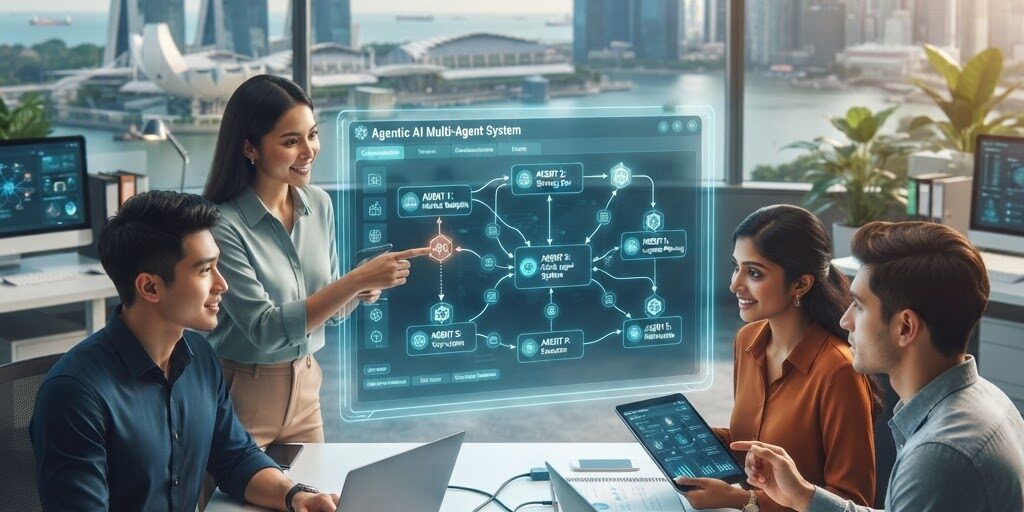
The transition from singular AI models to multi-agent frameworks is where the true strategic advantage for Singaporean firms lies. Imagine a corporate environment where specialized agents—each optimized for tasks like data analysis, legal compliance, project management, or creative drafting—collaborate in a digital ecosystem. These agents communicate via protocols, negotiating resources and handing off tasks to one another to maximize overall throughput. This collaborative structure is far more robust than any single model could ever be. By enrolling in Agentic AI training Singapore, professionals learn how to manage these multi-agent orchestrations, effectively acting as the digital project manager for an automated workforce. This capability allows for the automation of end-to-end business processes that were previously considered too complex for traditional scripts or basic automation tools. Furthermore, multi-agent systems provide built-in redundancy; if one agent encounters a technical failure, the system can self-diagnose and redirect resources, ensuring operational continuity. Our analysis of current market trends suggests that businesses implementing these frameworks achieve up to three times the productivity compared to those relying on fragmented, manual AI workflows. This efficiency gain is not merely about speed; it is about the ability to scale high-quality decision-making across an entire organization without needing to expand headcount proportionally. The following table highlights the distinct improvements seen in firms that have adopted these strategies:
| Feature | Traditional AI | Multi-Agent Systems |
|---|---|---|
| Autonomy Level | Low (Human Dependent) | High (Goal Oriented) |
| Task Scope | Single-point execution | End-to-end process management |
| Flexibility | Rigid workflows | Adaptive problem-solving |
| Scalability | Limited by manual input | High parallel processing |
By leveraging these strategic advantages, professionals can deliver immense value to their organizations, solving problems that require cross-departmental coordination through the sheer power of integrated autonomous agents.
Integrating Agentic AI into Singaporean Business Workflows
Integrating agentic systems into the existing workforce structure requires more than just technical deployment; it requires a cultural and operational change management strategy. In Singapore, where productivity and high-efficiency outputs are the benchmarks for success, the introduction of agentic workflows is being met with both excitement and trepidation. The core challenge lies in upskilling staff to act as supervisors for these systems. When an organization adopts autonomous agents, the role of the employee shifts from the doer of repetitive tasks to the auditor and strategist who ensures that the agentic workflows remain aligned with company objectives. Agentic AI training Singapore focuses heavily on these operational skills, teaching participants how to design clear guardrails, set performance metrics, and establish oversight mechanisms that mitigate risks such as AI hallucination or data privacy breaches. This is not about displacing human talent; it is about augmenting the human workforce by removing the burden of manual, high-cognition drudgery. Employees are then free to focus on high-level strategy, empathy-driven relationship management, and complex decision-making that AI cannot currently replicate. Our industry experts note that the most successful implementations occur when companies foster an environment of co-working between humans and agents, where the agents handle the high-volume processing and the humans handle the final verification and ethical checks. By integrating these systems successfully, businesses can reduce operational costs significantly while simultaneously increasing the quality of the final output. This harmonious integration is the hallmark of a future-ready organization, and those who lead this charge will inevitably define the competitive landscape of the Singaporean economy throughout the upcoming decade and beyond.
Future-Proofing Your Career with Advanced AI Skills
Looking toward 2026, the job market will undoubtedly favor those who possess practical experience with advanced agentic systems. As the barrier to entry for basic AI literacy lowers, the premium for complex, multi-agent orchestration skills will skyrocket. Preparing for this future requires a proactive approach to continuous learning and professional development. Engaging in specialized Agentic AI training Singapore provides the necessary foundation to navigate this shift with confidence. It is no longer sufficient to understand how to write a good prompt; you must understand the architecture of agents, the selection of the correct models for specific tasks, and the intricacies of long-term memory integration in AI workflows. Those who invest the time now to master these technical requirements will find themselves in high demand across sectors like finance, logistics, public policy, and technology development. Furthermore, the ability to build, iterate, and deploy custom agentic solutions will become a standard requirement for leadership roles. When you demonstrate the ability to drive real-world productivity gains through autonomous systems, you position yourself as an indispensable asset to your firm. Our guidance is clear: do not wait for the industry to mandate these skills before you start your journey. The technology is advancing rapidly, and the tools available today are more accessible than ever before. By building a portfolio of projects that utilize these systems, you prove your competence to employers and show that you are at the forefront of the technological revolution. The path forward is through constant experimentation, a growth mindset, and the dedicated application of cutting-edge AI frameworks to solve the most pressing challenges of our time, ensuring long-term resilience and professional relevance in a rapidly changing world.
The era of Agentic AI is here, and it is reshaping the workforce at an incredible velocity. By investing in training today, you position yourself to lead in the intelligent economy of 2026 and beyond. Start your path to mastering these transformative systems immediately.
FAQ
What is the primary difference between Generative AI and Agentic AI? Generative AI focuses on producing content, while Agentic AI focuses on autonomous goal-driven task completion.
Why is agentic training essential for Singapore’s workforce? It is essential because it allows local professionals to maximize productivity and maintain a competitive edge in global markets.
Are there specific prerequisites for this training? Most professional programs require a basic understanding of AI concepts, though technical coding skills are increasingly beneficial for advanced orchestration.
How can businesses manage the risks of using autonomous agents? Businesses manage these risks by implementing strict human-in-the-loop oversight, predefined operational guardrails, and robust data privacy protocols.
Will Agentic AI replace jobs in the Singaporean economy? It will change the nature of roles by automating manual tasks, allowing human employees to focus on high-level strategic and creative responsibilities.