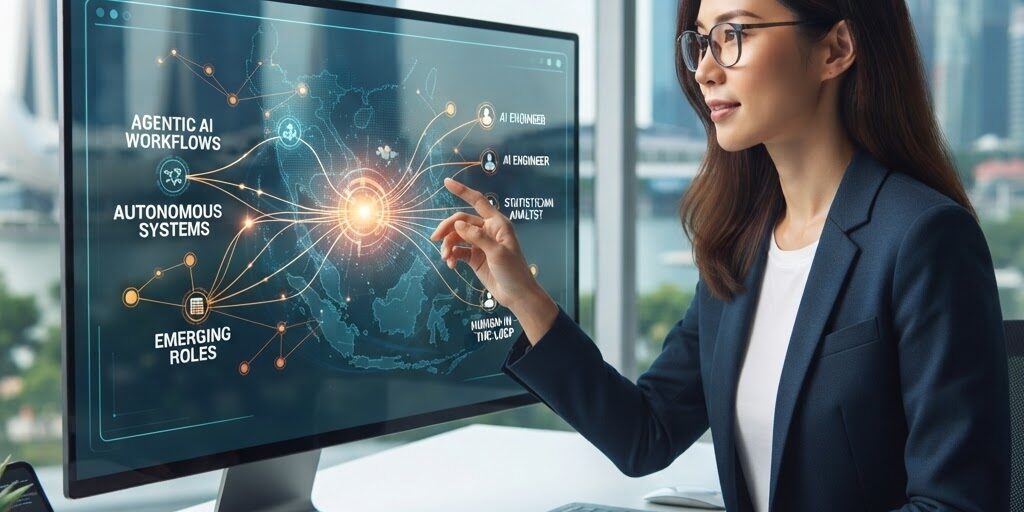
Mastering Agentic AI: The Essential Skill for Singapore’s 2026 Workforce
As the global digital economy shifts, Singapore stands at the forefront of a technological revolution. The recent launch of the ASEAN Labour Statisticians Network has illuminated a critical transformation in our regional job market, highlighting a shift toward sophisticated, autonomous digital systems. For professionals, the transition from basic AI literacy to mastering autonomous workflows has become a strategic priority. Seeking robust Agentic AI training Singapore has become the most effective way for local talent to remain competitive as industry leaders pivot toward intelligent automation. Agentic AI refers to systems capable of setting their own goals, making decisions, and executing multi-step tasks without constant human intervention. By 2026, this technology will redefine job descriptions across every major sector in the Lion City. Understanding the mechanics behind these autonomous agents is no longer just a technical luxury; it is the fundamental prerequisite for career longevity in a landscape where traditional roles are being augmented or replaced by intelligent, self-directed software entities that prioritize efficiency and complex problem-solving capabilities in real-time environments.
Table of Contents
The Evolution of Autonomous Systems
The progression from basic generative AI to advanced agentic frameworks marks the most significant leap in software engineering history. While early iterations of large language models functioned primarily as sophisticated chatbots or simple content generators, agentic systems act as autonomous digital workers capable of reasoning across complex data landscapes. These systems leverage iterative planning, tool use, and self-correction to navigate multi-layered project requirements. Industry experts emphasize that the core difference between a standard AI tool and an agentic system lies in the feedback loop. An agentic framework does not simply stop after a prompt is completed; it evaluates its own output, assesses the outcome against predefined success metrics, and pivots its strategy if the initial approach fails to yield the desired result. For those pursuing Agentic AI training Singapore programs, the focus is now shifting toward understanding how these agents utilize API integrations to manipulate external databases, manage cloud environments, and coordinate with other autonomous software units to perform holistic business tasks. This evolution means that the professional landscape is moving away from manual interface-heavy tasks toward a paradigm where humans act as supervisors and strategists of digital agent fleets. The ability to architect, oversee, and debug these autonomous workflows represents the pinnacle of modern technical capability. As these systems become integrated into the core operations of logistics, finance, and urban planning in Southeast Asia, the technical requirements for understanding agentic architecture will become as foundational as programming languages were a decade ago. Professionals must learn to move past passive tool usage and embrace the role of an agent orchestrator, ensuring that these autonomous processes remain aligned with organizational goals and ethical standards while driving unprecedented levels of operational efficiency across diverse digital infrastructures.
Why Singaporean Professionals Need Agentic Skills
Singapore operates in a uniquely high-cost, high-efficiency environment where labor optimization is the primary driver of national economic success. The necessity for Agentic AI training Singapore is dictated by the urgent need to maintain this competitive edge in a global market that is rapidly automating professional service roles. When organizations adopt agentic systems, they effectively bridge the gap between intent and execution. For example, in a financial reporting context, an autonomous agent can gather raw data, perform reconciliation, flag anomalies, and draft a final compliance report without human oversight. The skills required to build these systems are increasingly sought after by multinational corporations located in the Central Business District. This demand is not merely confined to software engineering roles; it extends to business analysts, supply chain managers, and project coordinators who must learn to configure these agents for specific industrial applications. Learning how to prompt an agent, define its autonomy parameters, and verify its logical chains is the new essential skill set for the modern worker. The following table illustrates the shift from legacy roles to agentic-integrated positions within the regional market.
| Role Type | Legacy Functionality | Agentic Enhanced Functionality |
|---|---|---|
| Data Analyst | Manual spreadsheet manipulation | Automated discovery and predictive modeling |
| Customer Support | Responding to individual tickets | Autonomous resolution of complex issues |
| Project Manager | Manual task scheduling | Adaptive workload balancing and re-routing |
| Supply Chain Lead | Inventory monitoring | Self-healing logistics and autonomous ordering |
As the workforce matures, those who possess these skills will be the ones defining the new benchmarks for productivity, moving away from repetitive operational tasks into high-level orchestration roles that define the strategic direction of technological deployment across the local and regional commercial landscape.
Implementing Autonomous Workflows in Enterprise
The successful implementation of autonomous workflows requires a disciplined approach to systems design and a deep understanding of agentic guardrails. In an enterprise setting, deploying an agentic system is rarely about letting software run wild; it is about defining the boundaries of autonomous operation to ensure safety, accuracy, and accountability. Professionals undergoing Agentic AI training Singapore learn that the most robust agents operate within a sandbox environment where their decisions can be audited and reversed if necessary. Enterprises are currently investing heavily in the creation of agentic frameworks that can manage cross-departmental operations, such as linking sales, inventory, and logistics into a single, cohesive, self-regulating ecosystem. This integration requires a fundamental shift in how organizations think about their software stack. Instead of purchasing siloed software for individual departments, modern enterprises are looking to build agent-based platforms that communicate via structured protocols. The challenge for many professionals lies in managing the hand-off points where human intuition meets artificial reasoning. Training programs focus on teaching the design of robust prompt chains, the integration of long-term memory systems for agents, and the creation of reliable feedback loops that prevent hallucinations or erroneous decision-making. As these workflows become standard, the role of the professional evolves into that of an architect of intent. You define the objective, set the constraints, and provide the access; the agent handles the heavy lifting of execution. This shift effectively doubles or triples the capacity of small teams to achieve outcomes that were previously only possible with large operational departments, solidifying the need for expert-level training in the current Singaporean market environment.
Future-Proofing Your Career by 2026
Preparing for the 2026 workforce means acknowledging that basic AI literacy will become a baseline expectation, much like using a word processor is today. To remain truly valuable, one must look toward the frontier of agentic engineering. Future-proofing your career requires a commitment to continuous learning and the ability to adapt to new frameworks as they emerge. The landscape of Agentic AI training Singapore is currently expanding to include advanced topics such as multi-agent collaboration, where several specialized agents work together to solve complex, multifaceted problems. Understanding how to manage the interaction between these agents, ensuring they do not conflict, and maintaining a high level of performance is the next big wave of employment demand. Furthermore, the ethical implications of using autonomous systems must be at the forefront of every professional’s knowledge base. Understanding data privacy regulations, algorithmic bias, and the importance of human-in-the-loop verification processes will distinguish top-tier talent from casual users. By 2026, those who have spent the preceding years mastering these technologies will be the architects behind the next generation of Singapore’s digital economy. They will be the experts who design the internal workflows of startups, the autonomous reporting systems of large banks, and the intelligent urban management platforms of the future. The shift toward agentic systems is not a temporary trend but a permanent restructuring of how work is performed. By investing in specialized training today, you are ensuring that you have the skills to lead, build, and innovate in a world that is becoming increasingly automated, agile, and intelligent. The opportunity is open to those who recognize that the future of work is not just about using AI, but about mastering the agency of intelligent machines.
Conclusion
Mastering Agentic AI is the defining challenge for professionals in Singapore as we approach 2026. The shift from passive, command-based tools to autonomous, goal-oriented agents represents a fundamental change in the nature of labor. By engaging in professional Agentic AI training Singapore, you position yourself as a leader in the next iteration of the digital revolution. Whether you are an engineer looking to build the next generation of autonomous platforms or a business leader aiming to streamline operations, the principles of agentic orchestration are now non-negotiable. As the ASEAN Labour Statisticians Network continues to track these shifts, the data confirms that those who master these autonomous workflows will set the standard for productivity, innovation, and long-term career success in our rapidly evolving technological landscape.
Frequently Asked Questions
What is the core difference between Generative AI and Agentic AI? Generative AI creates content, whereas Agentic AI sets goals, selects tools, and executes multi-step tasks autonomously to reach a specific outcome.
Why is Agentic AI considered essential for Singapore’s 2026 workforce? As labor costs rise, Singapore must pivot to high-efficiency, automated workflows to maintain competitiveness, making agentic expertise a core requirement.
Is technical coding knowledge required for Agentic AI training? While some programming knowledge helps, many modern training programs focus on architecture, logic, and system orchestration rather than low-level coding.
How do I ensure my agentic systems remain ethical and accurate? Proper training emphasizes building guardrails, implementing human-in-the-loop verification, and conducting regular audits of autonomous decisions.
Where can I find reputable Agentic AI training in Singapore? Look for industry-recognized certification programs that focus on practical, enterprise-grade applications and the latest frameworks in autonomous system design.