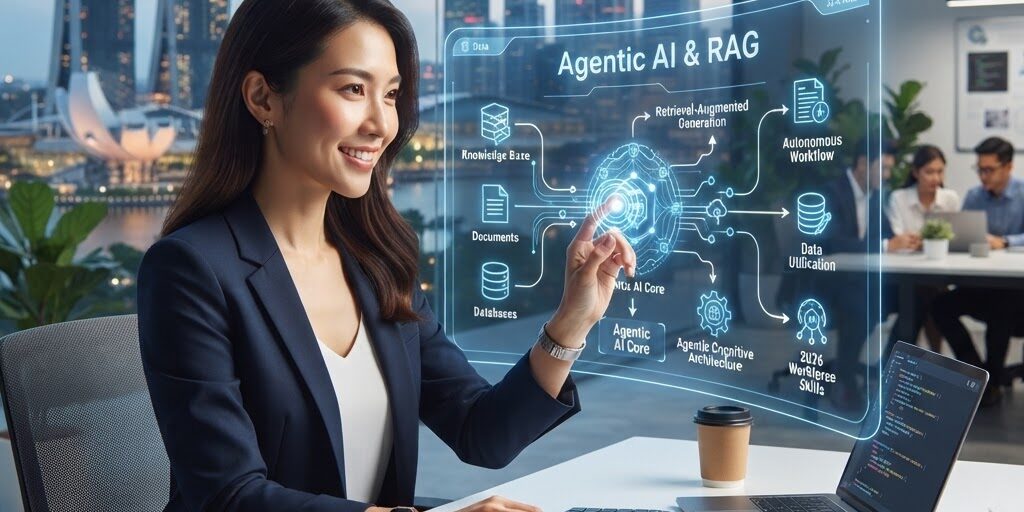
Mastering Agentic AI and RAG: Essential Skills for the 2026 Singapore Workforce
The technological landscape of 2026 is evolving at an unprecedented pace, with Singapore positioning itself as a global hub for innovation. Professionals across all industries are finding that traditional digital literacy is no longer sufficient to remain competitive in an increasingly automated environment. At the core of this transition lies the need for specialized Agentic AI training Singapore residents must adopt to maintain their professional edge. Agentic AI, which focuses on systems capable of making independent decisions to complete tasks, is fundamentally changing how we interact with technology. Combined with Retrieval-Augmented Generation (RAG), which allows AI to access and synthesize real-time data from internal databases, these two technologies form the cornerstone of modern efficiency. This article explores why mastering these advanced frameworks is not just a career booster but a vital requirement for the future workforce. By understanding how to orchestrate autonomous agents and ground them in reliable data, you can significantly enhance organizational productivity while securing your role in a rapidly shifting, AI-driven economy that demands sophisticated technical acumen from all its participants.
Table of Contents
Understanding Agentic AI Architecture
Agentic AI represents a massive leap forward from the static chatbots that dominated the early twenties. Unlike basic automation, agentic frameworks allow for systems to perceive their environment, reason through complex problems, and execute multi-step workflows without constant human oversight. For professionals in Singapore, engaging in high-quality Agentic AI training Singapore platforms offer is essential to grasp how these systems define goals and optimize their own processes. These agents utilize large language models as their brains but supplement them with tools, APIs, and action-oriented memory to perform tasks ranging from complex data analysis to project management. When an agent is deployed, it does not simply provide an answer; it interacts with external software, verifies its own results, and pivots if a strategy fails to yield the intended outcome. This autonomy is transformative. Imagine a supply chain manager using an agent that autonomously monitors global shipping routes, identifies potential disruptions, and proposes alternative logistics solutions before the human manager even receives a notification. This transition from passive tools to active participants requires a deep understanding of prompt engineering, chain-of-thought reasoning, and system architecture. Industry experts emphasize that the focus must shift from simply using AI to orchestrating it. By learning how to design and oversee these agentic systems, workers can transition from manual operators to strategic managers of autonomous resources. The capacity to delineate boundaries, establish guardrails, and monitor performance metrics for these agents will soon become a baseline requirement for high-performing roles across finance, manufacturing, and public sector operations in the region. Embracing this architectural mindset allows you to leverage intelligence that works continuously, ensuring that your output remains consistent and accurate even during periods of intense high-pressure professional demand.
The Power of Retrieval-Augmented Generation
While Agentic AI handles the execution, Retrieval-Augmented Generation (RAG) ensures that the information powering these decisions is accurate, relevant, and contextually grounded. A common issue with standard artificial intelligence models is the tendency to hallucinate or rely on outdated knowledge bases. RAG solves this by connecting the AI model to private, trusted document repositories, enabling the agent to search for verified information before generating a response. This process reduces errors and builds trust in automated systems, which is crucial for sectors like legal services, healthcare, and finance. Through specialized Agentic AI training Singapore professionals learn how to structure data so that it is readable for RAG pipelines, ensuring that the model pulls the right insights at the right time. The mechanics of RAG involve sophisticated vector databases where documents are converted into numerical representations, allowing the model to perform semantic searches rather than simple keyword matches. This capability is revolutionary for knowledge workers who spend hours searching through internal wikis, policy documents, or historical project files. With a well-implemented RAG system, an agent can instantly synthesize information across thousands of pages to provide a coherent summary or a specific recommendation. This efficiency gain is astronomical for firms that deal with massive volumes of documentation. By mastering RAG, you bridge the gap between abstract artificial intelligence capabilities and the hard, reality-based data that dictates business success. Professionals who understand how to configure these systems to reference specific, up-to-date sources will become indispensable, as they possess the unique skill set required to turn chaotic data environments into streamlined, reliable knowledge sources that drive intelligent decision-making across their entire enterprise framework.
| Skill Category | Why It Matters | Key Focus Area |
|---|---|---|
| AI Orchestration | Allows for complex task management | Agentic workflows |
| RAG Optimization | Ensures data accuracy and relevance | Vector database indexing |
| Prompt Engineering | Guides autonomous reasoning | Contextual instruction |
| Data Security | Protects sensitive information | Governance frameworks |
Implementing AI Solutions in Singapore
Singapore is ideally positioned to capitalize on the rise of autonomous systems due to its robust digital infrastructure and forward-thinking regulatory environment. Implementing these solutions locally requires a nuanced understanding of both the technical requirements and the cultural context of business operations. For those seeking Agentic AI training Singapore based programs are increasingly focusing on practical, hands-on implementation strategies that account for local labor laws and industry-specific regulations. Many organizations find that the biggest hurdle to adoption is not the software itself but the integration of agents into existing legacy workflows. This requires a tiered approach: starting with small, low-stakes automation tasks, then scaling up to full agentic autonomy once confidence is established. Industry experts recommend a phased rollout that emphasizes training employees not just on how to use AI, but on how to audit its performance. As Singapore moves toward a smarter economy, the demand for professionals who can bridge the gap between IT infrastructure and business goals will skyrocket. This role, often described as an AI Architect, involves configuring RAG pipelines to ensure that agents remain compliant with local data privacy acts while maintaining high performance. Furthermore, local implementation must prioritize security, as the autonomy of agentic systems poses unique risks. Training modules now cover the creation of secure API connections and the implementation of human-in-the-loop validation, which adds a layer of safety to automated decision-making. By adopting these best practices, professionals in Singapore can ensure that their AI implementations are not only effective but also sustainable and scalable, fostering a culture of innovation that respects existing operational standards while boldly pushing toward a more technologically efficient and highly competitive future.
Future Skills for the Digital Economy
As we look toward the remainder of the decade, the job market will bifurcate into those who can effectively command autonomous agents and those who are displaced by them. The essential skills of 2026 are not centered on technical coding alone, but on the ability to translate strategic business needs into agentic workflows. Professional development in Agentic AI training Singapore markets prioritize is shifting away from basic tool operation to high-level strategic oversight. This shift includes skills like system design, where you map out how an agent should move through a multi-step process, and outcome evaluation, where you measure the long-term impact of AI-driven decisions on company performance. Additionally, emotional intelligence and human-centric leadership remain critical. An agent can optimize a schedule, but it cannot negotiate a delicate client conflict or inspire a team during a difficult quarter. Therefore, the future workforce will be characterized by a synthesis of high-tech proficiency and soft-skill mastery. Being an ‘AI-enabled professional’ means using these tools to offload the mundane, repetitive elements of your role so you can focus on the creative, relational, and high-level strategic tasks that machines cannot perform. This evolution is particularly important in a small but dense economy like Singapore, where maximizing human capital through technological leverage is the primary path to growth. Staying ahead of the curve means constant learning; the speed of development in the fields of agentic reasoning and RAG technology means that what is considered best practice today may be replaced by something more efficient in six months. Commit to continuous education, network with other professionals in the AI space, and maintain a flexible mindset that allows you to adapt to new methodologies as they emerge.
In conclusion, mastering Agentic AI and RAG is the most effective way to future-proof your career in the 2026 Singaporean job market. These technologies represent the next frontier of productivity, moving us beyond simple automated tasks into a world of intelligent, autonomous collaboration. By investing in comprehensive Agentic AI training Singapore offers, you gain the skills needed to design, implement, and monitor complex systems that will define the leaders of the next decade. Success in this new era requires a blend of technical mastery, strategic foresight, and an unwavering commitment to lifelong learning. Do not let this transformation pass you by; instead, take the initiative to understand these foundational technologies and position yourself as an indispensable asset in an increasingly automated and data-rich global economy.
Frequently Asked Questions
- What is the primary difference between Agentic AI and standard AI? Agentic AI can make decisions and use tools to achieve a specific outcome autonomously, whereas standard AI usually just generates text or answers based on prompts.
- Why is RAG important for business applications? RAG provides factual grounding for AI, ensuring that information pulled from internal databases is accurate, up-to-date, and relevant to the specific business context.
- How can professionals in Singapore get started with this training? Many professional development providers and academic institutions in Singapore now offer specialized courses focusing on AI orchestration, RAG, and autonomous systems.
- Is coding knowledge required to master these AI tools? While foundational coding is helpful for deeper customization, many modern agentic platforms are moving toward low-code or no-code interfaces designed for business users.
- What are the long-term career benefits of these skills? Developing these skills allows you to transition into higher-value roles, such as AI operations manager or digital strategist, significantly increasing your professional longevity and market value.