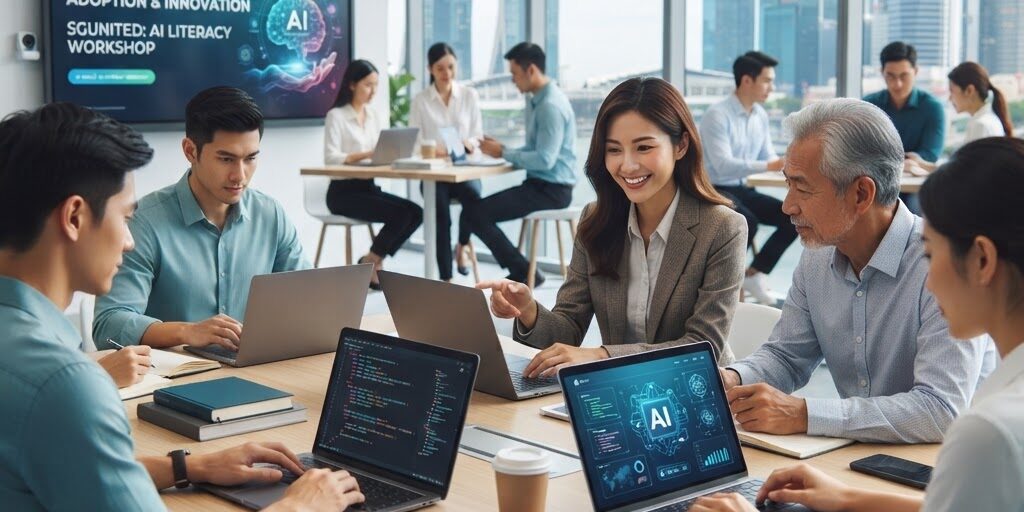
AI Literacy in Singapore: A Practical Guide for Professionals and SMEs in 2026
As the year 2026 unfolds, the digital landscape of Singapore has shifted dramatically, moving past the initial phase of AI curiosity toward a period of deep operational integration. For professionals and local businesses, AI literacy training Singapore has transitioned from a competitive advantage into an essential survival skill. The government continues to push for nationwide digital transformation, supported by robust financial incentives such as the Enterprise Innovation Scheme. These programs are designed to lower the barrier to entry for small and medium-sized enterprises (SMEs) that need to navigate the complexities of machine learning, generative tools, and automated workflows. As global markets pivot toward AI-native service delivery, Singaporean workers find themselves at a critical crossroads. Developing a strong foundation in AI literacy is no longer optional; it is the fundamental currency of the modern workforce. This guide serves to demystify the current AI ecosystem, offering practical steps for individuals and organizations to harness these powerful technologies effectively, ethically, and efficiently within the unique regulatory framework of our nation.
Table of Contents
The Growing Urgency of AI Proficiency
The urgency surrounding AI literacy training Singapore is driven by the rapid evolution of digital infrastructure. By 2026, AI is no longer a peripheral software tool but the backbone of administrative and creative processes. Organizations that fail to grasp the nuances of algorithmic decision-making risk falling behind in a market that prioritizes speed and precision. Industry experts emphasize that literacy is not merely about learning how to prompt a chatbot; it encompasses understanding data security, recognizing model bias, and managing human-AI collaboration. When employees are trained to identify where AI can augment their specific job roles, they unlock levels of productivity previously thought impossible. For instance, in sectors like finance, logistics, and retail, automated predictive analytics are currently defining the difference between stagnant growth and explosive scaling. The challenge lies in the rapid pace of change, which requires a commitment to continuous learning rather than one-off workshops. By prioritizing structured training, professionals can future-proof their careers while helping their companies maintain compliance with Singapore’s evolving ethical guidelines. This literacy gap is currently the most significant obstacle to national digital maturity, making professional-led training initiatives more valuable than ever. To remain relevant, organizations must foster an internal culture that views technology as a supportive partner rather than an existential threat. When a workforce is empowered with the correct knowledge, they are better equipped to navigate the ethical dilemmas that come with widespread implementation. Developing these core competencies requires a strategic approach that blends technical instruction with critical thinking, ensuring that employees are not just using tools but are also understanding the long-term impact of their digital decisions on the broader local economy and their specific industry niche.
Strategic Implementation for SMEs
For SMEs in Singapore, the path to successful AI adoption is paved with careful planning and utilization of available national support. The Enterprise Innovation Scheme provides a bridge that allows smaller firms to offset the costs of technical upgrades and staff development. However, money is only half the battle; the other half is the human element. Effective AI literacy training Singapore programs for SMEs must be tailored to the specific operational constraints of a smaller team. Unlike larger corporations with dedicated data scientists, SMEs need accessible, high-impact training that focuses on low-code and no-code solutions. These tools allow team members to create custom workflows without needing deep programming expertise. By focusing on practical application, such as automating client communications or optimizing inventory supply chains, SMEs can see an immediate return on investment. Furthermore, leaders must prioritize training that emphasizes cybersecurity. As AI becomes more embedded in business operations, the volume of data being processed increases, creating new vulnerabilities. A well-trained team acts as the first line of defense, capable of identifying potential risks associated with cloud storage and third-party AI integrations. Below is a simple table highlighting common focus areas for SMEs:
| Area of Focus | Benefits for SME | Complexity Level |
|---|---|---|
| Task Automation | Increased efficiency and focus | Low |
| Predictive Forecasting | Better inventory management | Medium |
| Data Security | Risk mitigation and compliance | Medium |
| Customer Experience | Personalized user engagement | High |
SME owners should prioritize training sessions that allow employees to test these tools in controlled sandbox environments before moving to live data. This hands-on experience builds confidence and reduces the apprehension often associated with learning new, sophisticated systems. By aligning AI education with core business goals, owners create a sustainable ecosystem where innovation is a daily objective rather than a distant dream, ensuring that even the smallest players can compete on the global stage.
Upskilling the Modern Singaporean Workforce
The transformation of the Singaporean workforce in 2026 is grounded in the philosophy of lifelong learning. The shift toward an AI-integrated economy necessitates a complete overhaul of how we approach professional development. When individuals participate in high-quality AI literacy training Singapore, they are not just learning software; they are developing the agility to adapt to shifting technological demands. This process of upskilling involves moving beyond basic functional training to a deeper understanding of computational logic and machine learning fundamentals. Educators are increasingly focusing on the hybrid model, where workers are encouraged to combine their unique industry knowledge with the computational power of AI tools. This combination is what industry experts call cognitive augmentation. It allows for higher levels of accuracy in task execution, from writing complex legal documentation to managing large-scale infrastructure projects. Furthermore, the focus has shifted toward soft skills such as emotional intelligence and creative problem-solving, which become even more vital when machines handle the routine aspects of work. It is essential for workers to understand that AI is a tool of orchestration; humans remain the architects of strategy and the arbiters of ethical standards. Companies should incentivize their staff to pursue certifications that validate these skills, creating a clear career development pathway that recognizes expertise in AI-driven workflows. By fostering an environment where curiosity is rewarded, organizations create a workforce that is eager to learn and resilient against the challenges of a volatile market. As we move further into the decade, those who take ownership of their professional education through specialized training will find themselves in positions of greater influence and autonomy, ready to lead the charge in a hyper-connected, AI-first economy that rewards those who dare to master the underlying mechanics of modern digital disruption.
Navigating the Future of AI Integration
Looking ahead, the long-term success of AI literacy training Singapore relies on the synergy between institutional guidance and individual ambition. As we move past 2026, the complexity of these models will only increase, making ongoing education a structural necessity rather than a periodic requirement. The future of AI integration in Singapore will be defined by its focus on transparency, accountability, and user-centric design. We are seeing a shift toward decentralized AI systems that allow for more localized control, a trend that is particularly important for local businesses dealing with sensitive consumer data. Professionals must keep pace with these advancements to ensure they are not left with obsolete strategies. Continuous engagement with industry forums, government-sponsored webinars, and peer-to-peer knowledge sharing is critical for maintaining this edge. When an organization treats training as a continuous, organic process, it transforms from a static entity into a learning organization capable of evolving with the technology. This level of maturity allows firms to anticipate changes in regulation and adopt new ethical frameworks before they become mandatory. Moreover, as the local workforce gains proficiency, we expect to see a surge in homegrown AI-led innovations that are specifically designed to address local market needs and cultural nuances. This indigenous approach to technology is the ultimate goal of the current push for literacy. It empowers Singaporeans to build their own tools, solve their own problems, and lead the regional conversation on responsible development. By committing to this path, the nation is not merely adopting foreign technology but is actively shaping the evolution of the global AI landscape, ensuring that the benefits of this technological revolution are felt equitably across all layers of our vibrant society and economy.
Conclusion
AI literacy has become the definitive skill set for professionals and SMEs navigating the landscape of Singapore in 2026. Through structured AI literacy training Singapore, organizations and workers alike can bridge the current adoption gap and secure their place in the future economy. By leveraging government incentives, focusing on practical implementation, and prioritizing continuous skill development, businesses can unlock unparalleled levels of efficiency and innovation. The journey toward becoming an AI-empowered nation requires patience, dedication, and a commitment to ethical standards. As technology continues to evolve at breakneck speeds, those who invest in their foundational knowledge today will be the ones who lead tomorrow. Embrace the change, seek out reputable training resources, and ensure your team is prepared to thrive in this new, technologically advanced era of work.
Frequently Asked Questions
1. Why is AI literacy training Singapore essential for SMEs right now? It is essential because it allows smaller businesses to scale efficiently, optimize costs, and remain competitive against larger, tech-heavy rivals through automation and data-driven insights.
2. What government support is available for AI training? Programs like the Enterprise Innovation Scheme provide financial support and tax incentives for businesses that invest in upgrading their workforce’s technical capabilities and digital infrastructure.
3. Does AI literacy require deep coding knowledge? No. Most modern AI literacy focuses on no-code and low-code tools that allow professionals to leverage AI for productivity without needing advanced software engineering degrees.
4. How can I identify the right training provider? Look for providers that focus on practical, industry-specific applications, offer recognized certifications, and have a proven track record of supporting local businesses in Singapore.
5. Will AI replace my job in the future? Most industry experts suggest that AI will augment jobs rather than replace them, making the ability to work alongside AI tools a critical skill for career longevity and professional relevance in the coming years.