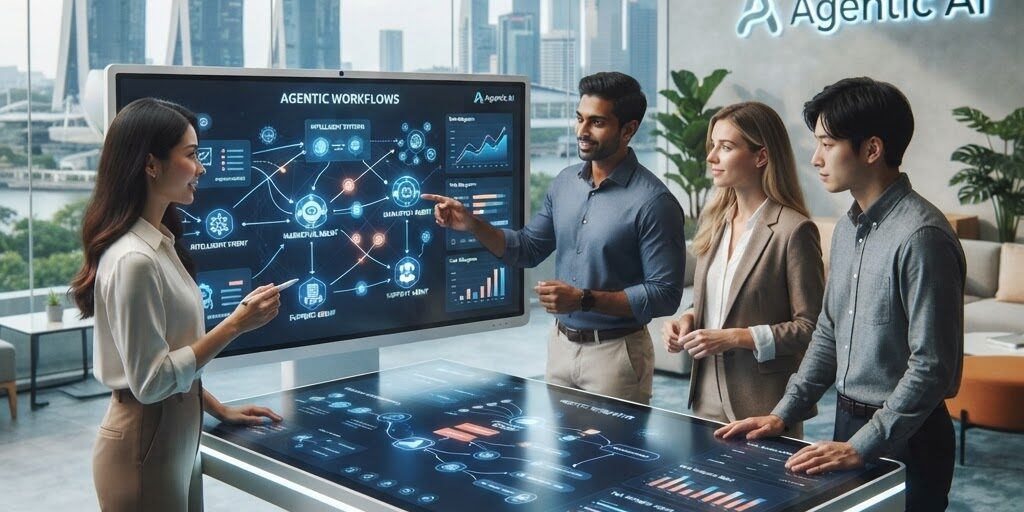
Mastering Agentic AI Workflows: The Essential Skill for Singapore Professionals in 2026
In the rapidly evolving landscape of the digital economy, Singapore professionals are constantly seeking the next competitive edge to stay relevant. As of 2026, the rise of agentic AI workflows has transformed the way organizations approach productivity, moving beyond simple automation tasks into the realm of intelligent system orchestration. Unlike traditional software that follows rigid rules, agentic AI functions as a specialized team member, capable of reasoning, planning, and executing complex objectives across various domains. Mastering these advanced systems is no longer a technical luxury but a fundamental necessity for anyone aiming to lead in Singapore’s competitive corporate environment. By integrating these autonomous agents into your daily operations, you can shift your focus from repetitive execution to high-level strategic decision-making. This comprehensive guide will explore how agentic AI workflows empower individuals to achieve unprecedented efficiency, ensuring that your skill set remains at the forefront of the global industry. Understanding the mechanics of these intelligent agents is the first step toward future-proofing your career in an era where human-AI collaboration defines professional success.
Table of Contents
What Are Agentic AI Workflows?
Agentic AI workflows represent a paradigm shift in how we conceive of software interactions. At their core, these workflows involve autonomous agents that possess the capability to perceive their environment, reason about their goals, and execute a series of chained actions to reach a specific outcome. While basic automation focuses on completing single tasks, agentic systems manage end-to-end processes. Imagine a project where an AI does not just type a document but researches market data, formats the report, drafts emails for relevant stakeholders, and schedules follow-up meetings based on calendar availability. This capability is made possible by sophisticated large language models acting as the reasoning engine for the system. Industry experts suggest that the power of these workflows lies in their ability to handle uncertainty and adapt to new information in real-time. By utilizing memory modules and recursive reflection, these agents can learn from previous errors, ensuring that subsequent outputs are more accurate and better aligned with the intended goal. For the professional in Singapore, this means delegating cognitive load to systems that can handle administrative complexity with precision. As the technology matures, these agents will likely become standard tools in every business suite. The transition from passive software tools to active, agentic collaborators is the defining characteristic of the 2026 professional landscape. Understanding the underlying logic of these workflows involves mastering prompt engineering, tool selection, and guardrail implementation, ensuring that the agents operate within established corporate policy and safety standards. As businesses adopt these technologies, the demand for individuals capable of bridging the gap between human objectives and machine execution will continue to grow exponentially, making this a critical area for professional development and training.
Designing Effective Orchestration Strategies
Designing effective orchestration strategies for agentic AI workflows requires a fundamental shift in technical and operational thinking. Instead of writing linear scripts, professionals must learn to architect systems where agents interact with various APIs, databases, and software tools. A successful strategy begins with modularity; by breaking down complex business processes into smaller, manageable sub-tasks, you allow the agents to specialize and perform better. Each agent in your workflow should have a specific role, defined by a clear set of instructions and access to relevant data sources. This multi-agent architecture is highly efficient because it mirrors traditional organizational structures, allowing for specialized agents to handle finance, marketing, or research independently before integrating their results. When designing these systems, it is essential to incorporate feedback loops. These loops enable the agentic system to verify its own work, cross-reference data, and request human intervention only when necessary. Industry leaders emphasize that the quality of your workflow design depends heavily on the constraints you place on the agents. Without proper guardrails, agents may suffer from hallucinations or deviate from their primary goals. Table 1 below highlights the contrast between traditional automation and modern agentic workflows, showcasing why the shift is necessary for modern operations. By focusing on robustness and error handling during the design phase, you ensure that the AI remains a reliable partner rather than an unpredictable experiment. Furthermore, maintaining clear documentation of your workflows is vital for scaling these processes across a larger team. As you gain experience, you will find that the orchestration of these intelligent systems becomes a form of creative problem-solving, where your ability to define clear goals and effective toolchains directly correlates with the productivity gains achieved by your digital workforce.
| Feature | Traditional Automation | Agentic AI Workflows |
|---|---|---|
| Task Scope | Static and predefined | Adaptive and goal-oriented |
| Flexibility | Low; breaks on changes | High; handles environmental changes |
| Decision Making | None; logic-based only | Autonomous; reasoning-based |
| Human Effort | Continuous maintenance | Strategic supervision |
The Business Impact in Singapore
The business impact of agentic AI workflows in Singapore is profound, particularly as local enterprises strive to maintain productivity amid rising operational costs and talent shortages. In a hyper-connected city-state that thrives on efficiency, the ability to automate high-value, high-context cognitive tasks provides a distinct competitive advantage. Many organizations are now implementing these workflows to streamline supply chain logistics, optimize financial forecasting, and personalize customer engagement at scale. By deploying autonomous agents, companies can reduce the time taken to respond to market shifts from days to minutes. This level of responsiveness is vital in sectors like fintech and logistics, where speed is synonymous with profitability. Industry experts note that early adopters in Singapore are already seeing significant improvements in their net operating margins, as these workflows eliminate the overhead associated with manual data processing. Moreover, the focus is shifting toward ‘human-in-the-loop’ configurations, where professional employees act as the managers of digital agent teams. This empowers the workforce to take on more strategic roles, fostering a culture of innovation rather than mere maintenance. The integration of agentic AI into the daily workflow also supports Singapore’s Smart Nation initiative, as it encourages the adoption of advanced digital infrastructure at the granular level of individual professional tasks. As these workflows become more sophisticated, they will likely influence how corporate teams are structured, leading to leaner, more agile organizations. The economic multiplier effect of such widespread AI adoption could position Singapore as a global hub for agentic software development and implementation. Businesses that successfully integrate these tools will not only lower their operating costs but also unlock new business models that were previously impossible to execute due to labor constraints, ensuring long-term resilience in an unpredictable global market.
Future-Proofing Your Career
Future-proofing your career in 2026 requires more than just technical aptitude; it demands a strategic mindset regarding the synergy between humans and artificial intelligence. As agentic AI workflows become standard in the corporate world, the most valuable professionals will be those who excel at orchestrating, supervising, and refining these intelligent systems. You should view yourself not as a competitor to AI, but as the architect of the agentic teams that drive value for your organization. The shift toward agentic capabilities means that your ability to communicate complex, abstract requirements into clear objectives for an AI will be your greatest asset. It is recommended that professionals engage in continuous training to stay updated on the latest frameworks, security protocols, and ethical considerations surrounding autonomous agents. Networking with other industry experts who are currently deploying these solutions will provide you with practical insights and best practices that are not always available in academic or formal coursework. Furthermore, developing a strong grasp of data literacy and system security is essential, as these agents often handle sensitive information and rely on high-quality data to function correctly. By embracing this new technological era, you position yourself as a leader who can manage the complexities of modern digital workplaces. The future of work is not about doing less, but about achieving significantly more by leveraging the intelligence of agentic systems. As you refine your skills in prompt engineering and workflow design, you will become increasingly indispensable to any firm looking to scale their operations. Ultimately, the career path of the future belongs to those who view agentic AI workflows as an extension of their own professional potential, creating a collaborative environment where humans and machines work in harmony to solve the most pressing challenges of our time, ensuring sustainable growth and personal relevance for many years to come.
Conclusion
In conclusion, mastering agentic AI workflows is an essential milestone for any Singapore professional seeking to thrive in the complex corporate landscape of 2026. By moving from simple automation to the orchestration of intelligent, autonomous systems, you enable yourself to achieve unprecedented levels of productivity and strategic impact. This transition is not merely about learning new software, but about fundamentally reimagining how work gets done. As these tools continue to evolve, your role as the architect and supervisor of these agentic teams will become the cornerstone of your professional value. Stay curious, focus on building robust workflows, and remain committed to continuous learning. By doing so, you will ensure that you are not just keeping pace with technological change, but actively leading the way into a more efficient, AI-powered future.
Frequently Asked Questions
1. What is the main difference between basic automation and agentic AI? Automation follows fixed rules for repetitive tasks, while agentic AI uses reasoning to achieve goals autonomously.
2. Is technical coding knowledge required to build agentic workflows? While programming helps, many low-code platforms now allow professionals to orchestrate agentic workflows through intuitive visual interfaces.
3. How do I ensure my agentic agents are working securely? Always implement strict guardrails, define clear task boundaries, and conduct regular audits of the agent’s output and logic flows.
4. Can agentic AI replace human judgment in professional roles? No, AI provides the processing power, but human professionals remain essential for setting objectives, managing ethics, and making final strategic decisions.
5. Where can I start learning about these workflows today? You can start by exploring online tutorials on agent orchestration frameworks and joining local professional communities focused on AI integration.