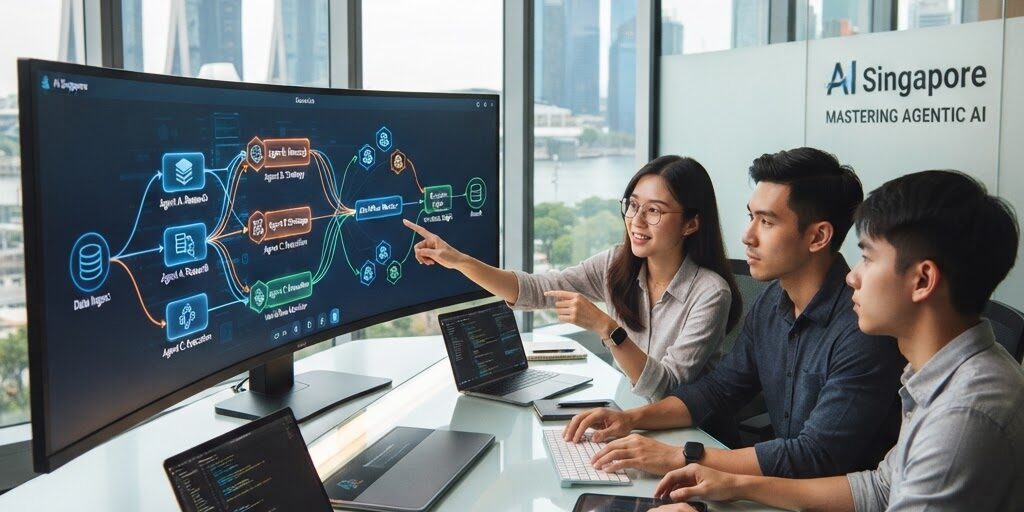
Mastering Agentic AI: The Essential Skill for Singapore’s Workforce in 2026
As the digital landscape of Singapore continues to evolve with unprecedented speed, the demands placed upon the local workforce have shifted dramatically. By 2026, the reliance on basic generative tools has reached a plateau, giving way to a more sophisticated paradigm: Agentic AI. For professionals navigating this changing terrain, specialized Agentic AI training has become the primary differentiator between those who simply use software and those who orchestrate autonomous, multi-agent systems to drive business value. Agentic AI transcends traditional chatbot interfaces by enabling software to execute complex, multi-step workflows with minimal human oversight. These autonomous agents can research, plan, execute, and refine tasks across various business functions, from supply chain logistics in the Jurong Innovation District to data analysis in the Central Business District. Understanding how to manage these digital coworkers is now an essential skill. This guide explores why transitioning from passive prompting to active agent management is the critical next step for Singaporean professionals aiming to remain competitive in a landscape defined by hyper-automation, strategic oversight, and technical fluidity.
Table of Contents
Understanding the Agentic Shift
The transition from generative AI to agentic systems represents the most significant technological leap of the decade. While generative models focus on creating content based on probabilistic patterns, agentic systems are designed to reach a specific goal through a sequence of actions. They possess agency—the ability to assess a situation, formulate a plan, use tools like external databases or web browsers, and self-correct if the initial output is insufficient. For professionals in Singapore, this means moving beyond simple prompts. Agentic AI training focuses on teaching users how to define objective functions, set operational boundaries, and oversee these agents as they navigate complex tasks. This shift requires a mental reorientation. Instead of thinking about what to ask a machine, experts must now focus on what outcomes to delegate and how to establish guardrails that ensure safety, compliance, and accuracy. The autonomy of these agents allows for a massive increase in organizational productivity, as they can handle repetitive high-level operations that would otherwise consume human hours. However, this power necessitates a deep understanding of the underlying logic and system architecture. The role of the professional has transformed from a hands-on operator to a system architect and supervisor. Learning the nuances of these autonomous frameworks is no longer an optional skill for those working in the competitive sectors of finance, logistics, or government policy. As these systems become integrated into enterprise resource planning software, the capability to manage multi-agent workflows will define the next generation of leadership in the island nation. Embracing this shift early allows professionals to act as leaders in the digital transition rather than spectators of an industry-wide change.
The Core Pillars of Agent Management
To effectively harness the potential of these technologies, professionals must master several core pillars of Agentic AI management. The first pillar is goal setting. Agentic systems perform best when given clear, unambiguous objectives that prioritize high-impact outcomes. The second pillar is environmental context. An agent must be provided with the right data, tools, and constraints to function effectively. This is where specialized training programs provide immense value, teaching individuals how to map out workflows that allow for seamless interaction between humans and autonomous entities. The third pillar is oversight and evaluation. Because agents operate autonomously, they require rigorous monitoring to ensure they remain within the bounds of policy. This includes setting up automated checkpoints where the agent must report back on its progress before proceeding to the next, more complex stage of the project. A significant part of Agentic AI training involves understanding how to troubleshoot these agents when they hit a logic roadblock or encounter unexpected data patterns. Table 1 provides a comparison between traditional AI interaction and modern Agentic AI workflows to illustrate this evolution.
| Feature | Traditional AI (2023) | Agentic AI (2026) |
|---|---|---|
| Operation Mode | Prompt-Response | Autonomous Workflow |
| Goal Orientation | Single Task | Complex, Multi-step Objective |
| Tool Interaction | Limited | Full Integration/API Access |
| Human Involvement | Continuous Loop | Supervisory/Management Role |
By focusing on these pillars, professionals can design systems that handle massive datasets, perform real-time market sentiment analysis, or manage inventory flows without manual intervention. This level of sophistication requires an understanding of how to sequence tasks correctly to ensure the agent logic remains coherent throughout the execution phase.
Strategic Implementation in Singapore
Implementing agentic solutions within the unique Singaporean business environment requires careful consideration of local standards, data privacy laws, and industry regulations. As a global hub, Singapore faces specific challenges regarding cross-border data flows and strict compliance requirements. Agentic AI training helps professionals understand how to develop agents that operate within these frameworks while maximizing operational efficiency. Whether a company is operating within the Fintech sector or the local manufacturing industry, the core objective remains the same: scaling impact without scaling headcount. Strategic implementation involves identifying bottlenecks where human decision-making is currently being overwhelmed by information density. These are the prime locations to deploy multi-agent systems. Training modules often focus on a modular design approach, where specialized agents are given narrow, well-defined tasks that contribute to a larger company objective. For instance, one agent might be responsible for gathering regulatory data, while another is tasked with checking compliance against current guidelines, and a third creates the summary report. This division of labor not only increases accuracy but also creates a system that is easy to update as rules or organizational needs change. Furthermore, training emphasizes the importance of ethical design and the mitigation of bias in autonomous systems. By proactively teaching professionals how to integrate feedback loops and human-in-the-loop verification, organizations can build systems that are not only productive but also resilient and trustworthy. The ability to articulate these strategic choices to stakeholders is a key skill developed during advanced training, ensuring that projects get the necessary buy-in from leadership to scale across the enterprise successfully.
Future-Proofing Your Professional Career
Looking toward the future, the integration of agentic systems into the Singaporean workforce is inevitable. The pace of technological adoption in the region suggests that by late 2026, many of the standard tasks associated with middle management will be performed by autonomous systems. Those who invest in Agentic AI training now are positioning themselves to manage these resources rather than being replaced by them. Future-proofing is less about mastering a single software package and more about developing a mindset of continuous system orchestration. This includes honing critical thinking skills, improving one’s ability to communicate complex goals to non-technical stakeholders, and staying updated on the rapid advancements in agentic architecture. By treating agents as team members with specific capabilities and limitations, professionals can cultivate a managerial style that focuses on resource allocation, strategic planning, and performance optimization. This transition is also opening up new career paths. Roles such as AI Orchestrator, Agent System Designer, and Ethics Compliance Officer for Autonomous Systems are becoming increasingly relevant in the job market. Investing in this education allows individuals to pivot into these high-growth areas, securing their place in the future economy. Industry experts emphasize that the most successful professionals will be those who can blend human creativity with the raw processing power of agentic tools. The goal is to build an environment where these technologies amplify human potential, allowing individuals to focus on strategy and empathy while the machines handle the execution. As we move closer to a fully autonomous era, the value of the human overseer will only increase, making this specific type of training the most vital investment for any serious career-minded professional in Singapore today.
Conclusion
In conclusion, the shift toward agentic systems marks a new chapter for the Singaporean workforce. By moving beyond traditional prompting and mastering the art of delegating to autonomous agents, professionals can unlock new levels of productivity and strategic depth. Agentic AI training serves as the bridge to this future, equipping workers with the expertise to design, manage, and scale complex workflows that operate independently. As these systems become the backbone of modern industry, the ability to act as a system orchestrator will be a defining attribute of successful careers. Embracing this shift now ensures that you are not just keeping pace with technological change but are actively leading the transformation. Start your journey into agentic management today to ensure long-term professional relevance in our rapidly evolving landscape.
Frequently Asked Questions
- What is the primary difference between prompt-based AI and Agentic AI? Prompt-based AI requires a human for every step, whereas Agentic AI can complete multi-step tasks independently by using tools.
- How can Agentic AI training help my career in Singapore? It prepares you for the shift toward automation-focused roles, enabling you to supervise autonomous workflows rather than just executing manual tasks.
- Is programming knowledge required for Agentic AI training? No, modern training focuses on system design, goal setting, and logical workflow management rather than complex coding.
- How do I ensure that my agents comply with Singaporean regulations? Training covers the integration of specific guardrails and compliance protocols within the agent’s logic to ensure strict adherence to local laws.
- Can Agentic AI work in any industry? Yes, its modular design allows for deployment in fields as diverse as healthcare, logistics, legal services, and financial trading.