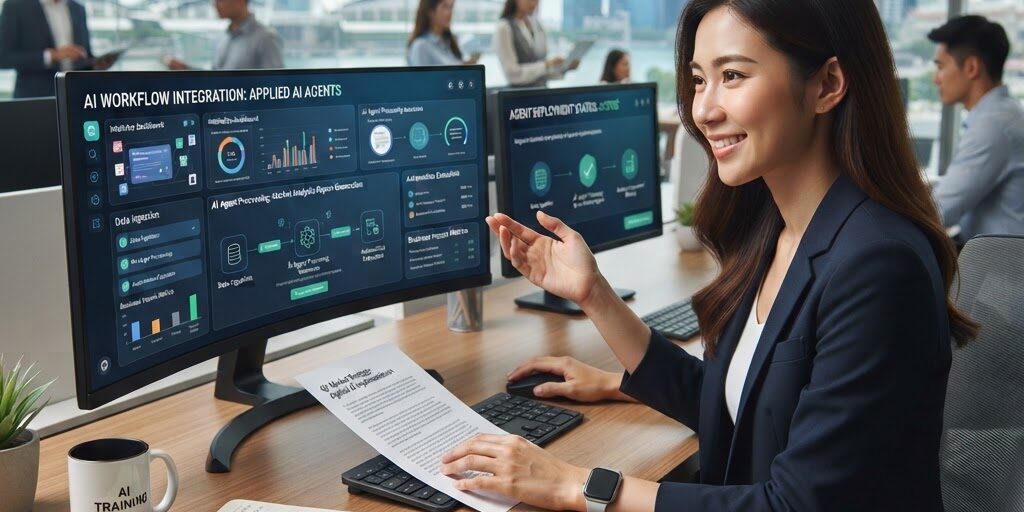
Moving Beyond AI Tools: Mastering Applied AI for Your Career in 2026
In the rapidly evolving landscape of 2026, the global workforce has entered a transformative era where AI literacy is no longer a luxury but a fundamental requirement. Professionals who were once fascinated by simple generative prompts are now finding themselves at a critical crossroads. The current standard for career growth centers on applied AI skills training, which focuses on the transition from experimental awareness to the integration of complex AI agents within professional workflows. Whether you are navigating the competitive Singapore market or engaging with global digital sectors, the ability to synthesize AI outputs into measurable business impact is the primary differentiator for high-performers. As tools become increasingly autonomous, the value shifts toward those who can orchestrate these systems to solve unique, high-stakes organizational challenges. This guide explores the essential competencies needed to excel in this new paradigm, ensuring that you remain relevant and indispensable in a year where practical application defines success. By moving past surface-level interaction with chatbots, you will learn how to design, implement, and audit AI-driven workflows that provide tangible value to your organization and sustain long-term career growth.
Table of Contents
The Shift to Agentic Workflows
The transition from using simple AI tools to managing sophisticated agentic workflows represents the most significant shift in workplace technology during 2026. In previous years, professionals spent considerable time manually prompting models for basic text generation or research tasks. Today, industry expectations have surged, demanding the deployment of autonomous agents capable of chaining multi-step processes without constant human oversight. Understanding how to construct these chains—where one AI agent gathers data, a second analyzes it, and a third drafts a strategic response—is now a core operational requirement. This shift requires a deep understanding of systems thinking rather than just linguistic ability. Professionals must learn to define the boundaries of an agent’s authority and understand the protocols for data validation and error handling within automated loops. By mastering these agentic systems, you transition from being a casual user to a systems architect capable of building efficiency into every corner of the business enterprise. The complexity of these workflows allows organizations to scale operations at speeds previously thought impossible, turning what used to be a week of manual labor into a few hours of supervised automated execution. As we look at the requirements for modern roles, the capability to oversee these agents is rapidly replacing entry-level analytical positions. It is essential to recognize that while the AI performs the heavy lifting, the human element involves strategic oversight, continuous refinement of the agent’s logic, and the final verification of outcomes to ensure alignment with organizational goals. This paradigm shift requires professionals to cultivate a mindset of perpetual learning, as the capabilities of these agents expand daily. Those who adapt to managing these autonomous chains will be the leaders of their respective fields, moving beyond simple task automation into comprehensive workflow orchestration.
Developing Applied AI Skills Training Competencies
Effective applied AI skills training requires a structured approach that moves beyond theory and into the realm of practical, hands-on implementation within your unique work environment. In 2026, training is not about learning how to use one specific piece of software, but rather about developing a framework for evaluating and implementing various technological solutions across different departments. A robust training program emphasizes four key pillars: technical literacy in API integration, prompt engineering for complex system logic, data privacy governance, and ethical AI auditing. Professionals must understand how to securely connect their AI agents to internal proprietary data sets, as this is where the real competitive advantage lies. Industry experts suggest that the most successful employees are those who can identify redundant processes in their current daily routine and replace them with AI-augmented alternatives. This necessitates a degree of comfort with experimentation and the resilience to iterate on systems that do not function perfectly upon the first attempt. Training should also cover the crucial aspect of AI collaboration—specifically, how to lead a hybrid team where human talent and autonomous software operate in tandem. This means learning how to communicate intent clearly to an AI agent so that the output adheres to brand guidelines and technical standards. Additionally, internalizing the legal and ethical implications of using generative models ensures that your work remains compliant with evolving global standards, especially in high-regulation regions like Singapore. When evaluating training programs, prioritize those that provide access to sandboxed environments where you can safely test the limits of your agency orchestration. Mastering these competencies turns an individual contributor into a critical infrastructure partner, effectively embedding themselves into the long-term success of the organization by providing reliable, scalable, and intelligent solutions to persistent business problems.
| Skill Level | Focus Area | Expected Outcome |
|---|---|---|
| Foundational | Tool Exploration | Basic efficiency gains |
| Intermediate | Workflow Automation | Time reduction in recurring tasks |
| Advanced | Agent Orchestration | Measurable ROI for complex projects |
| Expert | Systems Architecture | Strategic competitive advantage |
Furthermore, the evolution of these skills demands a commitment to understanding the limitations of the technology itself. A professional with strong applied AI training will know exactly when an AI agent should not be deployed, recognizing the specific scenarios where human intuition, emotional intelligence, or complex interpersonal nuance cannot be replaced. This level of discernment is what elevates a person from an operator to a consultant within their own organization. By building a portfolio of successful AI-integrated projects, you demonstrate not only technical ability but also the wisdom to deploy tools strategically for high-value impact. The investment in these skills is arguably the most significant move one can make for long-term career stability in the mid-2020s. As companies streamline their operations, they are holding onto individuals who serve as force multipliers, and these individuals are invariably those who have dedicated the time to bridge the gap between AI capabilities and actual business requirements through rigorous, practical training methodologies.
Optimizing Business Impact with AI Integration
Optimizing business impact through AI integration involves a deliberate focus on measurable outcomes rather than merely adopting the newest technology for the sake of novelty. In 2026, the key metric for success is the return on time invested and the quality of the final output compared to traditional methods. To achieve this, professionals must learn to map their AI initiatives to specific organizational key performance indicators, ensuring that every automated workflow contributes directly to the bottom line. This requires a shift in focus from output volume to output precision. For instance, instead of using AI to generate thousands of generic social media posts, a highly skilled professional will leverage AI to analyze customer sentiment and generate highly personalized content that drives conversion rates. This type of high-leverage work is where modern organizations find true value. Furthermore, integration must be treated as a change management project. It involves training teammates, documenting new procedures, and continuously gathering feedback to refine the performance of the AI agents. You must become adept at reading the data signals produced by your AI systems to understand where bottlenecks are occurring and how to adjust the agent’s logic to improve throughput. Collaboration is also key; by sharing successful AI-driven solutions across different departments, you demonstrate leadership and cross-functional utility. It is important to remember that AI is a tool of empowerment, not a replacement for talent. By using AI to handle mundane and repetitive tasks, you free up human resources to focus on creative problem-solving, strategic planning, and building deeper relationships with clients and partners. The most valuable professionals are those who use their increased capacity to take on more complex, value-driven initiatives, thereby driving growth and innovation within their organizations. This holistic approach to integration ensures that AI becomes a sustainable pillar of your work, rather than a fleeting project.
Future-Proofing Your Career in an AI-First Economy
Future-proofing your career in an AI-first economy is a proactive process that involves balancing technical adaptability with the cultivation of inherently human traits. As applied AI skills training becomes standardized, the next frontier will involve leveraging these skills to lead organizational change. You must position yourself as an expert who can navigate the ambiguity of AI development, bridging the gap between technical limitations and business aspirations. This involves developing a robust network of industry peers to share best practices, as the technology moves faster than any single individual can track. Focus on deepening your expertise in areas that require high-level critical thinking, ethical judgment, and complex emotional intelligence—areas where AI still struggles to perform with consistency. Additionally, maintain a strong focus on data literacy; understanding how data is sourced, stored, and utilized by AI systems will make you an indispensable resource in an era of strict data privacy regulations. Career stability in the coming years will depend on your ability to pivot, learn, and apply new frameworks rapidly. This is the definition of agility in the modern workforce. Consider pursuing certifications that focus on the architectural side of AI, as well as those that emphasize responsible implementation. As you continue to refine your craft, remember that the goal is not to become a machine, but to use machines to become a better, more effective version of yourself. The professionals who thrive in 2026 and beyond will be those who view their career as a continuous journey of growth, embracing change as an opportunity to expand their impact. By remaining curious, disciplined, and focused on the practical application of AI to solve real-world problems, you will secure your place at the forefront of the global economy, becoming a leader who guides others through this era of profound technological transition and achievement.
Conclusion
In 2026, mastery of applied AI is the ultimate career accelerator. We have moved past the hype cycle into a phase defined by practical execution and business-driven results. By focusing on applied AI skills training, developing agentic workflows, and prioritizing measurable business impact, you position yourself as a vital asset in any organization. The transition to an AI-first career is not about replacing human ingenuity, but rather amplifying it through sophisticated, autonomous systems. As you refine your ability to orchestrate these agents, you will discover new opportunities for innovation and growth that were previously out of reach. Embrace this shift, commit to continuous learning, and use these tools to build a career that is as resilient as it is impactful in our rapidly changing digital world.
FAQ
What is the difference between simple AI tools and agentic workflows?
Simple tools perform single tasks upon request, while agentic workflows link multiple AI actions together to complete complex, multi-step processes autonomously.
Why is applied AI skills training necessary in 2026?
It is necessary because businesses now require employees who can integrate AI into daily operations to drive measurable efficiency and strategic ROI.
How can I start implementing AI agents in my workflow?
Start by identifying a repetitive, data-heavy task, choose a workflow automation platform, and design a simple chain of command for an AI to assist you.
What is the most important human skill in the age of AI?
Critical thinking and strategic oversight remain essential, as AI requires human direction and ethical verification to provide true value.
How do I stay updated with the latest AI trends?
Engage with industry professional networks, participate in specialized training programs, and experiment with new tools in a secure, sandbox environment.