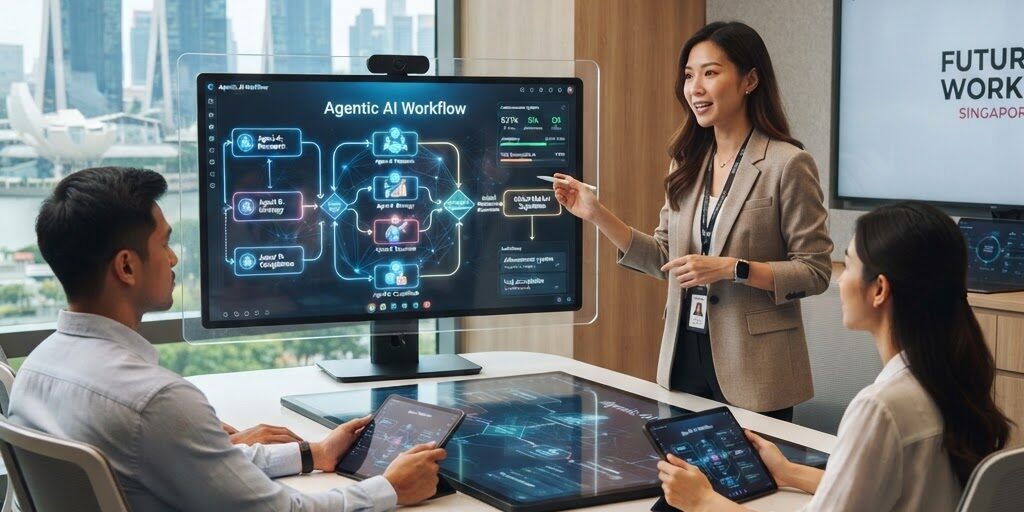
Mastering Agentic AI Workflows: The Essential Skill for Singapore Professionals in 2026
As the digital landscape of 2026 continues to evolve at an unprecedented pace, Singaporean professionals are finding that basic prompting skills are no longer sufficient to maintain a competitive edge. The industry is currently witnessing a massive transformation where the focus has shifted entirely toward Agentic AI training. Unlike standard large language models that merely respond to static inputs, agentic systems are designed to operate autonomously, making decisions, navigating complex software environments, and executing multi-step business processes without constant human oversight. For workers in the Lion City, mastering these workflows is not just an advantage; it is the most essential career skill of the year. Companies across the financial, logistics, and technology sectors are now prioritizing hires who demonstrate deep technical proficiency in orchestrating these autonomous digital agents. By understanding the underlying architecture of these systems, professionals can transition from being mere users of technology to architects of efficient, automated business ecosystems. This article explores the core components of agentic workflows, providing the roadmap necessary for anyone aiming to thrive in this new professional era while ensuring long-term employability in a rapidly shifting, AI-integrated workforce.
Table of Contents
Understanding the Evolution of Agentic AI
To grasp the significance of Agentic AI training, one must first recognize the fundamental shift from static to autonomous intelligence. In earlier iterations, generative AI served as an interactive tool that required manual prompting for every task. If you needed a report, you provided the data and the instructions, and the model provided the output. Today, however, agentic systems possess reasoning capabilities that allow them to determine which tools to use, when to pause for external data retrieval, and how to iterate based on failures. This represents a monumental leap in productivity for Singaporean professionals who manage high-volume workloads. Agentic AI essentially functions like a digital employee capable of managing its own workflow. For example, instead of manually tracking inventory and manually drafting procurement orders, an agentic system can identify stock discrepancies, query supplier databases, compare pricing, and draft purchase requests for approval. This evolution demands a new skillset that emphasizes logic-based structuring, error handling, and security oversight. Industry experts suggest that the ability to supervise these autonomous agents is replacing traditional management tasks. The complexity of these systems requires a foundational knowledge of Python-based frameworks, API integration, and natural language processing logic. By understanding how agents communicate with external environments, professionals can ensure that their business operations remain stable despite the inherent unpredictability of autonomous execution. This section of our training focuses on the anatomy of an agent, including memory modules, planning capabilities, and tool-use interfaces, which serve as the backbone for all subsequent automation tasks. As we move further into 2026, those who treat agents as black boxes will struggle, while those who understand the inner mechanics will lead the next wave of corporate innovation in the Southeast Asian technology corridor.
Designing Robust Autonomous Workflows
Designing an effective agentic workflow requires more than just technical setup; it demands a strategic mindset that accounts for edge cases and failure states. When building a system that acts on behalf of a company, the workflow must be architected with clear boundaries, authorization protocols, and error logs. Many professionals fail at this stage because they treat agents like simple chatbots rather than complex logical systems. A robust workflow begins with defining the objective clearly and breaking down the process into discrete, manageable steps that an agent can execute sequentially. You must consider the data sources the agent will interact with and ensure those connections are secure and verified. The following table highlights the essential differences between standard AI prompting and Agentic AI workflows to assist professionals in mapping out their transition. Effective design also involves creating feedback loops where the agent reports back to the human supervisor only when a decision requires high-level authorization or when a threshold for risk has been crossed. This human-in-the-loop approach is critical for maintaining quality and safety in corporate environments. Furthermore, testing these agents in sandboxed environments allows designers to observe how the AI makes decisions under various pressure scenarios. By refining these triggers and guardrails, professionals can build reliable autonomous systems that perform consistently across different time zones and business contexts. The goal is to maximize efficiency while minimizing the potential for hallucinations or unauthorized actions. As agents become more capable, their interaction with software APIs will replace manual keyboard entry, transforming the way data flows throughout an organization. Learning to structure these workflows is a prerequisite for advanced orchestration, ensuring that your AI systems can handle the intricacies of modern corporate infrastructure without constant supervision or expensive downtime.
| Feature | Standard AI Prompting | Agentic AI Workflow |
|---|---|---|
| Autonomy Level | Passive/Reactionary | Active/Autonomous |
| Workflow Execution | Single Step | Multi-Step Sequences |
| Tool Interaction | None/Limited | Advanced API/Software Use |
| Reasoning Capability | Basic Output | Recursive Problem Solving |
| Human Oversight | Constant Supervision | Management by Exception |
Integrating AI Into Modern Business Operations
Integrating agentic workflows into existing business operations is a delicate balancing act that requires a deep understanding of organizational goals and technical capabilities. In Singapore, many enterprises are already adopting these technologies to bridge the gap between human innovation and machine speed. The integration process starts with identifying high-impact, repetitive tasks that are currently consuming valuable human hours. For instance, customer support departments are moving toward agentic solutions that do not just provide answers but also execute account updates and initiate service recovery processes. This integration requires a phased approach where the agentic system is introduced alongside current processes, allowing for a transition period where human staff can monitor and validate AI performance. As trust in the agentic system builds, the level of autonomy can be increased, effectively scaling the business operations without the need for proportional increases in human headcount. This approach is highly effective in the local SME market, where resource optimization is crucial for survival and growth. Integration also demands rigorous data hygiene; since agents operate on the information they are provided, clean and accessible data architecture is non-negotiable. Professionals tasked with this integration must bridge the gap between IT and operations, ensuring that the agents have access to the necessary databases without violating privacy regulations. Compliance with regional data protection standards is an essential component of this phase, as autonomous agents must adhere to strict information access policies. By successfully embedding these agents into standard operating procedures, professionals can create a unified system where data, strategy, and execution are intrinsically linked. This creates a powerful competitive advantage that allows companies to respond to market changes in real-time, effectively automating the agility that was once only possible through massive human teams. Success in this area is measured by improved accuracy, reduced latency, and the ability of the workforce to pivot toward higher-value strategic planning instead of administrative execution.
Future-Proofing Your Career in Singapore
Future-proofing your career in the Singaporean economy requires a continuous commitment to learning and a willingness to embrace the shift toward autonomous systems. The professional of 2026 is an AI manager, an architect of workflows, and a strategic overseer of agentic capabilities. To stay ahead of the curve, it is essential to participate in formal Agentic AI training programs that go beyond theoretical knowledge and offer hands-on experience with emerging agentic frameworks. These frameworks, which are constantly evolving, are becoming the standard tools of the trade. Networking with other AI professionals to discuss best practices and shared challenges is another vital component of career growth. We are witnessing the birth of a new job category entirely dedicated to AI infrastructure maintenance and oversight. Skills such as prompt engineering for autonomous goal-setting, ethical AI design, and long-term agentic behavior monitoring are becoming the new high-value currencies in the labor market. Furthermore, keeping an eye on local policy shifts and industry-specific regulations regarding automated decision-making will ensure that your career path remains aligned with the broader societal expectations. It is not just about using the tools but about understanding the strategic impact that these tools have on business models and long-term profitability. By focusing on the intersection of human intuition and agentic logic, you can position yourself as a leader who can navigate both the technical and human-centric aspects of the modern workplace. The transition might seem daunting, but the shift towards autonomy is inevitable. Embracing it now ensures that you are at the forefront of the technological evolution rather than chasing it from behind. Ultimately, your career security in 2026 and beyond depends on how well you can leverage the capabilities of AI agents to amplify your own productivity, creativity, and strategic decision-making abilities within the fast-paced ecosystem of a global business hub.
In conclusion, the transition to Agentic AI represents the most significant shift in professional requirements in recent history. By mastering these autonomous workflows, you are not simply learning a new tool; you are future-proofing your career in an era where machine intelligence will act as your most capable assistant. Singapore remains at the forefront of this digital adoption, providing a unique environment to test, refine, and deploy these high-impact systems. Whether you are in finance, logistics, or creative services, the integration of agentic systems into your daily routine will unlock unprecedented levels of efficiency. Stay curious, focus on the architecture behind the output, and continue to refine your oversight strategies. The path toward professional mastery in 2026 begins with understanding that you are now the architect of your own automated success.
Frequently Asked Questions
What is the primary difference between a chatbot and an agentic AI? A chatbot responds to messages, whereas an agentic AI autonomously performs multi-step tasks across various software tools to achieve a specific goal without constant manual guidance.
Why is Agentic AI training critical for Singapore professionals? As automation becomes the standard in Singapore’s highly competitive digital economy, professionals must manage these systems to maintain operational efficiency and remain relevant in the workforce.
Do I need to learn programming to work with Agentic AI? While basic Python and API knowledge are highly beneficial for customizing agents, many low-code platforms are becoming available that allow users to design complex workflows without extensive coding.
Are there specific risks associated with autonomous AI workflows? Yes, risks include decision-making hallucinations, unauthorized data access, and lack of human oversight, which is why robust guardrails and constant monitoring are essential components of any workflow.
How can I start learning about Agentic AI today? You can start by exploring foundational courses on agentic architectures, experimenting with open-source agent frameworks, and keeping up with industry updates to understand how these systems are applied in your specific sector.