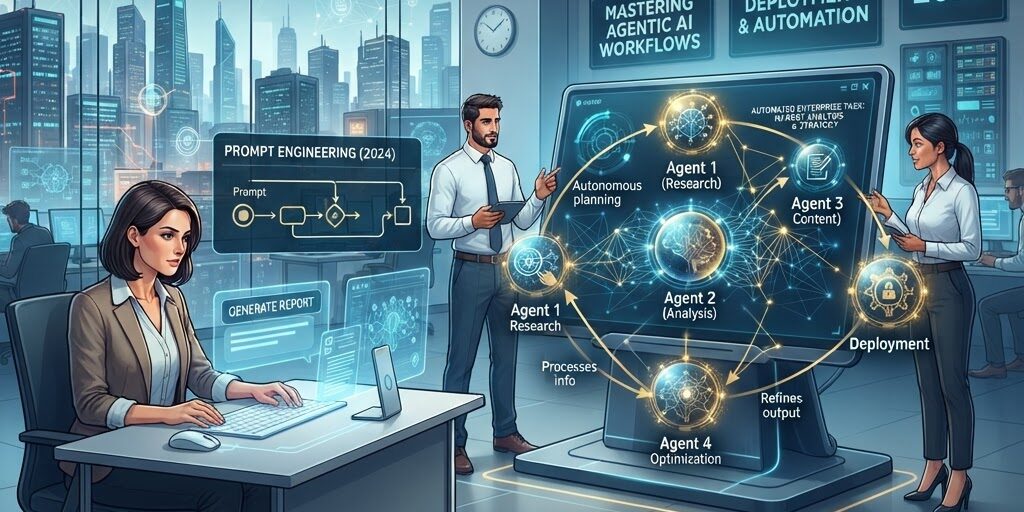
From Prompts to Agents: Mastering Agentic AI Workflows in 2026
As the digital landscape evolves into the second half of 2026, the era of basic prompt engineering is rapidly giving way to a more sophisticated paradigm known as agentic AI workflows. Professionals across industries are shifting their focus from merely asking chatbots for quick answers to designing autonomous systems capable of planning, iterating, and executing complex, multi-step enterprise tasks without constant human intervention. This fundamental transition represents a seismic shift in how we interact with machine intelligence, moving beyond static queries to dynamic, goal-oriented collaboration. To stay relevant in this high-velocity environment, understanding how to architect, manage, and scale these autonomous agents is no longer optional—it is a core competency for modern professionals. By leveraging specialized training and robust frameworks, organizations can unlock unprecedented levels of productivity, ensuring that their systems do not just provide information, but actively solve problems in real-time. This guide explores the essential components of agentic AI, helping you transition from simple prompt-based interactions to sophisticated automation strategies that drive significant business impact in an increasingly competitive global economy.
Table of Contents
The Rise of Agentic Intelligence
In the landscape of 2026, agentic AI workflows have redefined the boundaries of automation. Unlike previous iterations of conversational interfaces, agentic systems possess the unique ability to decompose broad, high-level objectives into actionable sub-tasks. These systems are empowered with the capacity to utilize external tools, navigate web environments, interact with proprietary databases, and engage in recursive reasoning until a final output is achieved. Industry experts agree that the primary difference lies in the agency granted to the model. While standard generative models function as static response engines, agents operate with a goal-oriented mindset. They evaluate their progress against the desired end state, identify bottlenecks, and refine their approach based on the feedback received during the execution cycle. This capability transforms the AI from a simple text processor into a functional digital colleague that can handle end-to-end project management. The transition from prompts to agents is a shift toward reliability and autonomy. When companies invest in these workflows, they reduce the cognitive load on staff, allowing them to focus on high-value decision-making while the agents manage the repetitive, logistically intensive aspects of the operation. This shift requires a deep understanding of prompt chaining, context management, and the integration of memory modules that allow agents to learn from previous attempts, effectively increasing the system success rate over time. As these systems become more integrated into the enterprise ecosystem, professionals must learn to distinguish between tasks that require human nuance and those that can be safely offloaded to an autonomous agent. By mastering this distinction, organizations can maximize the output of their infrastructure while maintaining the quality standards necessary for modern enterprise environments, effectively turning their technological investments into measurable assets that continue to scale alongside their business requirements.
Architecting Complex Systems
Architecting successful agentic AI workflows requires more than just picking a model; it demands a robust structural foundation that can handle failures, manage state, and maintain security. In 2026, the standard architecture involves a layered approach where the agent core is supported by specialized memory stores and external tool interfaces. A well-designed system will include a planning layer, a perception layer, and an execution layer. The planning layer utilizes logic to determine the sequence of actions, while the perception layer gathers data from the environment, and the execution layer carries out the actual commands. This multi-layered design ensures that if one part of the workflow encounters an error, the agent can rollback and attempt a different strategy, a process known as self-correction. Furthermore, the integration of long-term and short-term memory allows the agent to maintain context over long durations, which is critical for projects involving multiple weeks of work. Professionals should prioritize modularity, ensuring that each tool the agent uses can be swapped or updated without breaking the entire workflow. Security is another pillar of this architecture; because agents often have access to APIs and databases, rigorous logging and access control protocols must be embedded at the ground level. We recommend that teams implement sandboxed environments where agents can test their plans before executing them in production. This approach minimizes risk while providing the flexibility required to iterate quickly. By treating these systems as software products rather than static queries, architects can ensure that their autonomous agents remain resilient, scalable, and fully aligned with organizational objectives. The following table highlights the core differences between standard prompt-based systems and modern agentic workflows, showcasing why the shift is necessary for enterprise-grade applications and long-term technical sustainability.
| Feature | Prompt-Based AI | Agentic AI Workflows |
|---|---|---|
| Task Scope | Simple, Single-Turn | Complex, Multi-Step |
| Autonomy Level | Low, Human-Directed | High, Self-Directed |
| Environment Interaction | None (Closed) | Full API/Tool Access |
| Error Handling | Static Error Messages | Self-Correction/Iterative |
| Memory | Context Window Only | Dynamic Persistent Memory |
The Role of Human Oversight
As agentic AI workflows take on increasingly complex roles, the role of the human operator is shifting from an active participant to a strategic overseer. This transition, often referred to as human-in-the-loop (HITL) management, is essential for maintaining accuracy and ethical standards. Even the most advanced autonomous systems can occasionally hallucinate or take inefficient paths when faced with ambiguous requirements. Therefore, our team emphasizes the importance of design patterns that require periodic human validation. By inserting “checkpoints” into the agent’s workflow, users can review the progress and intermediate results before the system commits to irreversible actions. This oversight is not about hindering the agent, but about providing the guardrails that allow it to operate safely within enterprise parameters. For instance, in financial or legal sectors, human experts must review the agent’s research before it is finalized. The goal is to build a collaborative synergy where the agent handles the heavy lifting—data collection, preliminary analysis, and formatting—while the professional provides the strategic intuition and final sign-off. As we move through the second half of 2026, the demand for professionals who can effectively audit and manage these autonomous workflows is skyrocketing. Training programs must focus on risk assessment, error detection, and the development of intuitive dashboards that visualize the agent’s thought processes. When humans can see exactly how an agent reaches a conclusion, trust in the system increases, and the adoption rate within the organization rises accordingly. Managing agents effectively means learning when to step in and when to stand back, a skill that requires both technical knowledge and deep industry expertise. Ultimately, human oversight is the mechanism that ensures innovation remains safe and aligned with human values.
Future-Proofing Your Career
In 2026, future-proofing your career in AI is fundamentally about moving up the value chain from text generation to workflow orchestration. As basic prompt engineering becomes commoditized, the real value lies in the ability to design, deploy, and refine agentic AI workflows that solve real business problems. This entails acquiring a diverse set of skills, including basic coding, systems thinking, and an understanding of data governance. You do not need to be a software engineer to excel, but you must understand how to chain models together using modern orchestration frameworks. Those who can identify friction points in a business process and then build an agentic solution to eliminate them will be the most sought-after professionals in the labor market. Our training initiatives emphasize a hands-on approach where learners build their own agents from scratch, focusing on real-world use cases like automated customer support, supply chain analysis, and personalized content creation. Staying ahead of the curve also means keeping up with the rapid development of open-source frameworks and proprietary agent platforms. By contributing to industry discussions and exploring the latest developments in reinforcement learning from human feedback, you can position yourself as a leader in this space. As the technology continues to mature, we expect to see even greater integration between agents and enterprise resource planning software, making these systems essential to the daily operation of global firms. Your commitment to mastering these new methodologies will provide you with a significant competitive advantage. The future belongs to those who view AI as a collaborative partner rather than a replacement. Start by building a small pilot project today, and you will quickly see how agentic systems can transform your personal and professional productivity, setting the stage for a long and successful career in the era of autonomous intelligence.
To conclude, the shift toward agentic AI workflows represents one of the most significant advancements in modern technology. By moving beyond simple prompts, organizations can harness the power of autonomous agents to achieve complex, goal-oriented tasks that were previously impossible to automate. Mastering this transition requires a commitment to structural design, human-centric oversight, and continuous learning. As we navigate the complexities of 2026, the professionals who succeed will be those who can effectively architect these systems and manage the collaboration between human expertise and machine agency. Embrace the opportunity to upskill and lead this digital transformation, ensuring your organization stays at the forefront of the artificial intelligence revolution while building resilient workflows that drive meaningful success in the ever-evolving landscape of enterprise technology.
Frequently Asked Questions
- What defines an agentic AI workflow? Agentic workflows involve systems that can plan, execute, and iterate through multiple steps autonomously to achieve a specific, high-level objective.
- How does this differ from prompt engineering? Prompt engineering is typically a single-turn interaction, whereas agentic workflows are multi-turn, goal-oriented processes that use tools and recursive reasoning.
- Are there security risks when using autonomous agents? Yes, agents with tool access require strict permission settings and human oversight to prevent unauthorized actions or data leaks.
- Do I need programming skills to manage agents? While coding is beneficial, many modern platforms allow for visual workflow design, making it accessible to non-technical staff with proper training.
- Why is human oversight still necessary? Humans are essential for final validation, ensuring that the agent’s autonomous decisions remain aligned with business ethics, accuracy, and strategic goals.