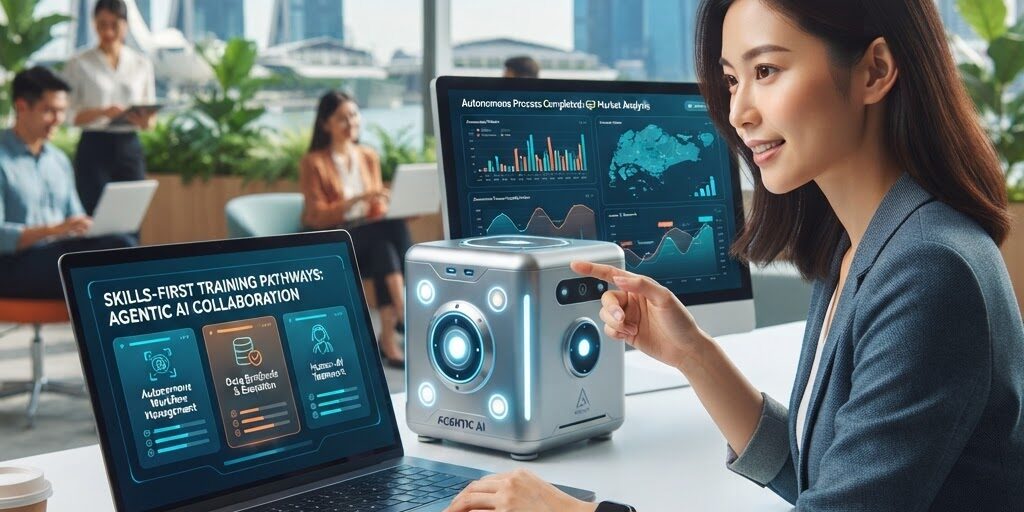
Mastering Agentic AI: A Skills-First Guide for the Singapore Workforce
The landscape of technology in 2026 is undergoing a profound transformation. While basic generative AI once served merely as a conversational tool, the emergence of Agentic AI has fundamentally altered the professional environment. In Singapore, where digital literacy and innovation are the cornerstones of economic growth, the workforce must adapt quickly to these autonomous systems. Effective AI training Singapore initiatives are no longer optional; they are essential for maintaining a competitive edge in a globalized market. Unlike previous iterations of software, Agentic AI possesses the capability to reason, plan, and execute complex workflows without constant human oversight. This shift requires a strategic move toward a skills-first approach, where professionals prioritize high-level human-AI collaboration over basic prompt engineering. By understanding how to orchestrate these autonomous agents, employees can transition from being mere task performers to strategic leaders of digital workstreams. This guide explores the foundational shift toward agent-based operations, providing actionable insights for the local workforce to navigate this new era of productivity, ethical decision-making, and specialized technical mastery within our rapidly evolving digital ecosystem.
Table of Contents
The Rise of Agentic AI
In the current technological landscape, Agentic AI represents a departure from traditional software interaction. Unlike simple assistants that wait for explicit instructions for every minor step, Agentic AI functions as a proactive collaborator. These systems analyze high-level objectives and break them down into granular, actionable tasks. For the professional in Singapore, this means that the focus must shift from repetitive execution to effective delegation. Industry experts suggest that the successful integration of these tools hinges on the professional’s ability to define clear goals and parameters for the AI. When an agent is tasked with complex project management, data analysis, or supply chain optimization, it operates with a degree of autonomy that was previously unimaginable. This shift demands a robust understanding of how AI systems evaluate information and arrive at conclusions. Training programs that focus on this transition are gaining traction, as businesses recognize that agents can handle the heavy lifting of administrative and technical workflows, allowing human staff to concentrate on strategy, relationship management, and high-stakes decision-making. The ability to manage these agents is now a core competency for any modern professional. As these systems become more deeply embedded in enterprise infrastructure, the demand for personnel who understand the underlying logic of autonomous task execution will continue to climb. Furthermore, the reliability of these agents depends on the accuracy of the foundational data provided to them, making data literacy an indispensable skill alongside technical agent management. By embracing this change, companies can realize significant gains in efficiency, reducing the time spent on manual processes and clearing the path for innovation that utilizes human ingenuity to oversee autonomous systems. This transition is not merely about learning a new tool; it is about adopting a new mindset that views AI as an active partner in the creative and operational process, effectively scaling human potential across every sector of the local economy.
Skills-First Development Frameworks
Adopting a skills-first development framework is the most effective strategy for the Singapore workforce to remain relevant in 2026. This approach shifts the focus away from specific, transient tool proficiency and toward enduring, transferable capabilities that remain valuable regardless of the underlying software versions. For those seeking comprehensive AI training Singapore professionals need to emphasize cognitive adaptability and systems thinking. In an age of Agentic AI, the most critical skills include complex problem decomposition, ethical oversight of autonomous agents, and the ability to audit the outputs generated by complex algorithms. By prioritizing these durable skills, professionals can build a foundation that is resilient to technological disruption. Our team suggests that training should focus on the intersection of technical proficiency and human-centric roles. For example, understanding the limitations of an AI model is just as important as knowing how to launch its workflows. When professionals understand the boundaries of what an agent can and cannot do, they are better equipped to intervene in the event of anomalies or errors. This is the essence of responsible AI stewardship. Organizations that foster these skills are better positioned to integrate new technologies rapidly without compromising the quality of their work or the safety of their data. Table 1 below highlights the shift from traditional skill sets to modern, agentic-focused requirements. This framework allows for a structured transition, ensuring that staff are equipped with both the theory and the practical application required to thrive in a highly automated environment. By aligning professional development with these core competencies, the workforce can ensure that they are not only keeping pace with current trends but are also actively shaping the direction of their industries. This model also encourages lifelong learning, which is a vital aspect of maintaining a resilient and adaptable national workforce, capable of overcoming the unique challenges of a digital-first economy while upholding international standards of professional excellence in every domain.
| Skill Category | Traditional Focus | Modern Agentic Focus |
|---|---|---|
| Task Execution | Manual Data Entry | System Orchestration |
| Problem Solving | Linear Logic | Autonomous Decomposition |
| AI Interaction | Prompting | Contextual Briefing |
| Oversight | Final Review | Continuous Audit |
Mastering Human-AI Collaboration
Effective human-AI collaboration is the defining characteristic of high-performing teams in the current year. As Agentic AI matures, the relationship between human and machine is becoming increasingly symbiotic. Rather than replacing the human worker, these systems amplify individual productivity, provided the human is capable of acting as an effective supervisor and strategist. In Singapore, specialized workshops are now teaching professionals how to build trust with autonomous agents by implementing iterative feedback loops. When an AI agent makes a decision, the professional reviews the logic and provides guidance to refine the output. This interaction serves to train the AI while simultaneously confirming the accuracy of the results. The key to this relationship is clear communication and precise goal setting. Humans excel at ambiguity, empathy, and moral judgment, while agents excel at speed, accuracy, and the handling of massive datasets. By combining these unique strengths, a professional can tackle tasks that were once considered impossible for a single individual or even a small team. Industry experts note that the transition to this collaborative model requires a shift in workplace culture. Managers must move away from micromanagement and toward result-oriented oversight. This requires a level of comfort with technology that allows for trust without blind reliance. Training in this area focuses on psychological readiness, understanding technical constraints, and developing the patience required to guide complex agents to the desired outcome. The goal is to create a seamless workflow where the agent handles the technical heavy lifting while the human ensures that the project remains aligned with broader corporate objectives and ethical standards. This collaboration is the bedrock of modern innovation, turning businesses into agile, responsive entities that can navigate the volatility of global markets with unprecedented speed and precision, all while keeping human oversight at the center of the operational framework.
Future-Proofing Your Career
Future-proofing a career in the current, fast-paced environment requires a proactive stance on continuous professional development. The skills required to thrive today will undoubtedly evolve as AI systems continue to advance. For those seeking advanced AI training Singapore continues to provide a robust ecosystem of resources, ranging from specialized university courses to industry-led certification programs. The core of career resilience is a commitment to understanding how agentic systems are changing the structure of various industries. Whether in finance, logistics, creative arts, or government, the ability to integrate autonomous agents into daily workflows is becoming a prerequisite for advancement. To stay ahead, professionals should actively seek opportunities to lead projects that utilize agentic frameworks. This hands-on experience is the most effective way to internalize the nuances of AI management and demonstrate value to employers. Furthermore, staying informed on current advancements in machine learning and regulatory landscapes ensures that you remain at the forefront of your field. Our team emphasizes that the future belongs to those who view learning as a perpetual process rather than a destination. By engaging with communities of practice and participating in peer-led discussions, professionals can share insights and develop a collective understanding of best practices. As we move further into the decade, the distinction between those who work with AI and those who do not will become increasingly apparent. Those who master the art of delegation to autonomous agents will find themselves with more time for strategic innovation and professional growth. This proactive approach to skill acquisition not only enhances individual performance but also strengthens the entire economic sector. By positioning yourself as a versatile, AI-literate professional, you secure your role in an increasingly competitive future, ensuring that your contributions remain indispensable in an era where human insight is the ultimate driver of technological success.
Conclusion
In conclusion, the rise of Agentic AI represents a pivotal moment for the Singapore workforce. By shifting our perspective from viewing AI as a simple tool to recognizing it as an autonomous partner, we unlock new levels of potential and creativity. The transition toward a skills-first training model is essential for those wishing to remain competitive in 2026 and beyond. By mastering the art of delegation, prioritizing cognitive adaptability, and fostering a deep, collaborative relationship with AI agents, professionals can navigate the complexities of this digital-first era with confidence. As we continue to refine our processes and embrace these emerging technologies, our focus must remain on the human elements of decision-making, ethical oversight, and strategic vision. Investing in high-quality AI training today is the most effective way to secure a prosperous and innovative future for both individuals and the nation as a whole.
Frequently Asked Questions
1. What is Agentic AI and how does it differ from traditional AI? Agentic AI can autonomously plan and execute multi-step tasks to reach a specific goal, whereas traditional AI usually requires constant human prompting for every action.
2. Why is a skills-first approach important in Singapore? It prioritizes durable, transferable human skills over temporary technical knowledge, ensuring the workforce remains resilient to rapid technological changes in the market.
3. How can I start incorporating Agentic AI into my daily work? Begin by identifying repetitive, rule-based tasks that can be delegated to an AI agent, then focus on becoming a clear, effective supervisor for those automated processes.
4. Will Agentic AI replace my current role? It is designed to augment human potential by handling complex execution, allowing professionals to shift their focus toward higher-level strategy, ethics, and creative oversight.
5. Where can I find reputable AI training in Singapore? You can seek out accredited government-supported programs, university executive education courses, or industry-recognized certifications that focus specifically on applied AI and systems integration.