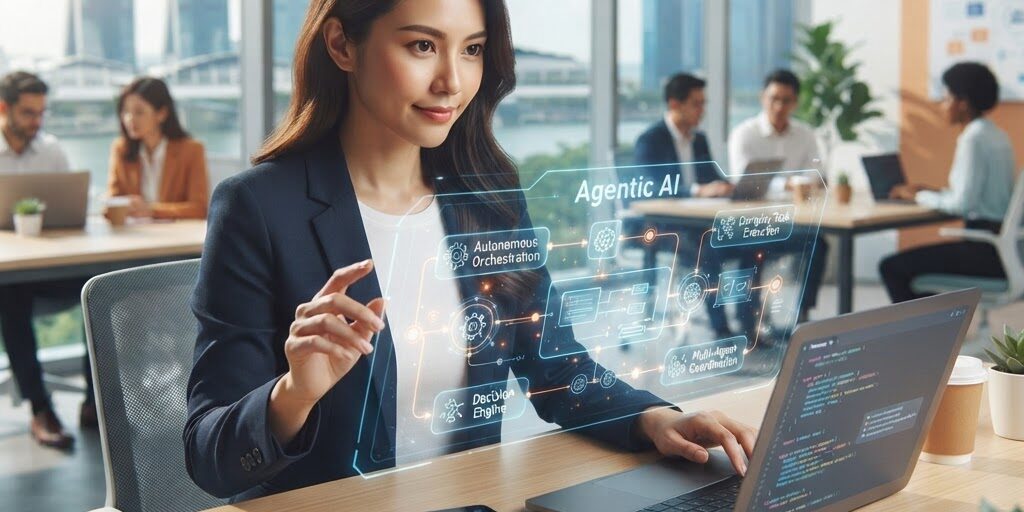
Mastering Agentic AI: The Essential Skill for Singapore’s Workforce in 2026
As the global digital economy shifts rapidly toward automated workflows, Agentic AI training Singapore has become the cornerstone of professional development for the modern workforce. By 2026, the ability to collaborate with autonomous systems—not just passive chatbots—will differentiate leaders from followers in the local job market. Unlike standard generative models, Agentic AI represents a paradigm shift where software systems transition from being simple task executors to sophisticated agents capable of complex decision-making, planning, and multi-step orchestration. For Singaporeans aiming to remain competitive, understanding the nuances of these autonomous frameworks is no longer a luxury; it is a fundamental requirement for career longevity and organizational success. This transition requires professionals to adopt new frameworks for supervision and strategy. Our comprehensive guide explores why this technology matters, how it will impact daily business operations, and the steps you must take to future-proof your skill set. By embracing this evolution, you position yourself at the forefront of the technological wave that is fundamentally reshaping the landscape of our city-state, ensuring that you remain relevant and highly valued as a critical thinker in an increasingly automated world.
Table of Contents
Understanding the Rise of Agentic Systems
The transition from traditional artificial intelligence to agentic systems marks a profound evolution in how we approach computing. Whereas previous iterations of technology functioned primarily as reactive tools—waiting for user input to generate a singular response—Agentic AI acts as an autonomous operator. These systems can break down complex business goals into actionable sub-tasks, prioritize those tasks, and execute them across multiple software environments without constant human intervention. In the context of the Singaporean digital economy, this means professionals can delegate entire workflows, such as market research, data synthesis, and procurement, to intelligent agents that learn and adapt over time. The fundamental difference lies in agency; these models possess the ability to perceive, reason, and act. Industry experts emphasize that the core benefit is not merely automation, but the orchestration of high-level operations that previously required an entire team of junior staff. By integrating these tools into daily work, a single professional can achieve the output of an entire department. However, this shift requires a new level of governance. One cannot simply deploy an autonomous agent and expect perfect results without proper oversight. Users must learn to construct effective prompts, define logical boundaries for the agent to work within, and monitor outputs for accuracy and strategic alignment. As businesses across Singapore look to optimize their operations, the demand for personnel who understand the architectural limits and capabilities of these systems is skyrocketing. This section of your professional growth journey involves learning to speak the language of autonomy, understanding the difference between deterministic scripts and probabilistic agents, and recognizing when human intuition is still the superior choice for critical decision-making processes.
Strategic Implementation in Singaporean Enterprises
Implementing Agentic AI at an enterprise level requires a systematic approach that balances innovation with operational stability. Singaporean firms are uniquely positioned to lead this adoption due to the country’s robust digital infrastructure and a workforce that is rapidly pivoting toward high-value technical roles. When integrating these agents, decision-makers must prioritize transparency and human-in-the-loop workflows. It is essential to understand that Agentic AI is most effective when it serves as a force multiplier for existing human talent rather than a direct replacement. For instance, in the legal and financial sectors, agents can scan thousands of regulatory documents to ensure compliance, flagging anomalies for human review. This drastically reduces the time spent on administrative labor. The table below outlines how traditional workflows compare to agentic workflows in a standard business environment. By shifting to an agentic model, companies can significantly reduce their overhead while increasing their agility in a volatile global market. Our analysis indicates that the most successful organizations in 2026 will be those that create internal sandboxes where employees can experiment with autonomous agents safely. This experimental culture is vital, as it allows workers to understand the edge cases and potential failure points of the technology. Leaders should focus on developing clear policy guidelines that address data privacy and security, ensuring that autonomous agents operate within the ethical frameworks established by the company. As these systems become more prevalent, the ability to manage the interface between human strategy and autonomous execution will define the next decade of corporate leadership and productivity across our island nation.
| Feature | Traditional Automation | Agentic AI Workflow |
|---|---|---|
| Task Scope | Repetitive and rigid | Dynamic and goal-oriented |
| Intervention | Frequent human input | Periodic supervisory oversight |
| Flexibility | Low adaptability | High contextual reasoning |
| Goal Setting | Hardcoded rules | Natural language objectives |
The Critical Skill Shift for Professionals
The rise of Agentic AI creates a massive demand for new, specialized skill sets that transcend basic digital literacy. In 2026, the most sought-after professionals will be those who can act as ‘Agent Architects’—individuals who possess the unique ability to design, deploy, and refine the autonomous systems running their workflows. This skill set starts with deep analytical thinking. If you cannot define a problem clearly, an agent will struggle to provide a high-quality solution. Therefore, the ability to decompose large-scale business challenges into logical sequences is now a paramount soft skill. Furthermore, proficiency in prompt engineering has matured into ‘orchestration design,’ where the focus is on how multiple agents interact with one another to produce a cohesive result. For Singaporean professionals, this shift is mirrored in the local educational focus on lifelong learning and adaptive capability. You must become comfortable with the ambiguity inherent in working with probabilistic models. Sometimes, an agent may choose a sub-optimal path, and the ability to diagnose why, pivot, and re-calibrate the agent’s parameters is what separates an expert from a novice. Additionally, understanding the ethical considerations of AI is crucial. As these agents become more integrated into our lives, questions regarding bias, privacy, and accountability will become front and center. By mastering the ability to audit an agent’s performance and maintain a human-centric oversight mechanism, you protect your organization from legal and reputational risks. This is the new standard of professional excellence: a blend of technical capability, logical rigor, and a deep, empathetic understanding of how technology serves human goals, not the other way around.
Future-Proofing Your Career in 2026
Future-proofing your career in the face of rapid technological change requires a commitment to constant evolution and a proactive stance toward learning. As we move closer to 2026, the landscape will continue to evolve, making the foundational knowledge of Agentic AI a prerequisite for almost every knowledge-based profession in Singapore. To stay ahead, prioritize continuous learning programs that offer hands-on experience with modern frameworks and development tools. It is not enough to attend webinars; you must actively engage in building, testing, and iterating upon your own agentic workflows. Focus on cross-disciplinary skills, as the true power of AI agents lies in their ability to bridge gaps between traditionally siloed departments. For example, a marketer who understands how to connect an autonomous content agent to a customer relationship management (CRM) system and a data analytics dashboard is far more valuable than one who only knows how to write copy. Furthermore, build a network of peers who are also navigating this transition. Engaging in community discussions and sharing best practices allows you to learn from the failures and successes of others, accelerating your own development. Remember that the goal is to become an indispensable partner to the AI, someone who can steer the ship while the technology handles the heavy lifting. By remaining curious and adaptable, you ensure that you are the one controlling the trajectory of your work rather than being swept away by it. The future of the Singaporean workforce is bright, but it belongs to those who view technological disruption as an opportunity to expand their personal capacity, redefine their roles, and push the boundaries of what is possible in their chosen fields.
Conclusion
Mastering Agentic AI is the defining challenge and opportunity for the Singaporean workforce in 2026. As we have explored, this technology represents more than just a software upgrade; it is a fundamental shift toward a more autonomous and efficient way of working. By understanding how to design, supervise, and refine these systems, professionals can unlock unprecedented levels of productivity. As you embark on your journey toward mastering these skills, remember that your human capacity for creativity, ethics, and strategic decision-making remains the ultimate engine of success. Start investing in your technical training today, embrace the iterative process, and position yourself to thrive in this new era of innovation. The future is built by those who are prepared to shape it, and the time for action is now.
Frequently Asked Questions
1. What is the difference between Generative AI and Agentic AI? Generative AI focuses on content creation, while Agentic AI focuses on task execution and orchestration across systems.
2. Why is Agentic AI important for the Singaporean workforce? It allows professionals to handle increasingly complex digital workloads, maintaining Singapore’s competitiveness as a high-value global talent hub.
3. Do I need coding skills to use Agentic AI? While coding is beneficial, many modern platforms now allow users to build and manage agents using natural language and low-code interfaces.
4. How can I start learning Agentic AI today? You should begin by exploring tutorials on workflow automation, agent orchestration platforms, and foundational concepts in prompt engineering and system design.
5. Is Agentic AI safe to use in corporate environments? Yes, provided that organizations implement strong governance, data privacy policies, and human-in-the-loop oversight to manage risks effectively.