Mastering Agentic AI and RAG: The Essential Skills for Singapore Professionals in 2026
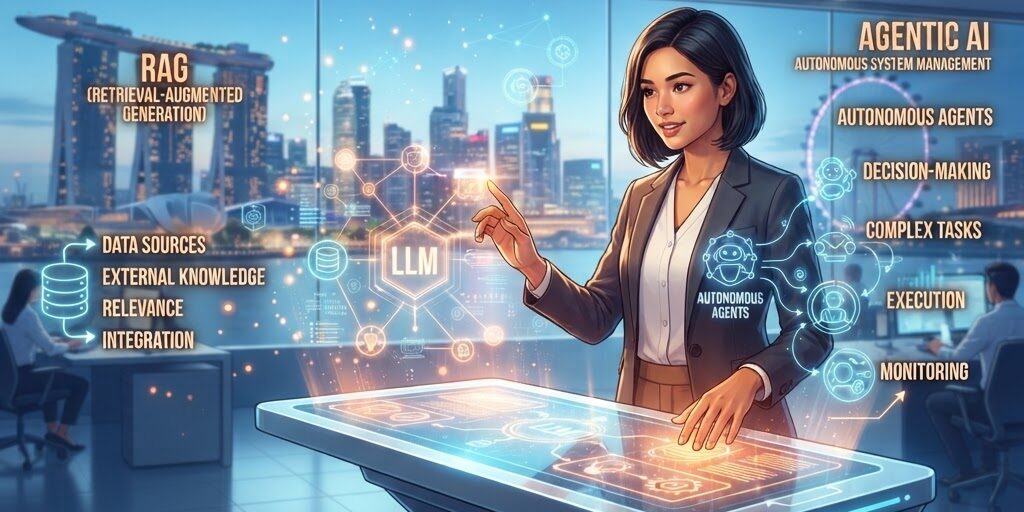
As the Singaporean economy enters a new phase of digital maturity in 2026, the demand for sophisticated technological capabilities has skyrocketed. Professionals are no longer simply using chatbots; they are now tasked with orchestrating complex autonomous systems. Understanding Agentic AI training Singapore options is now the primary differentiator for career advancement. Unlike standard generative models, Agentic AI acts with a level of autonomy, making decisions to achieve goals rather than just following prompts. Paired with Retrieval-Augmented Generation (RAG), which allows systems to access real-time, proprietary data, these skills represent the new frontier of professional competence. This article explores how to navigate this technological shift, ensuring that the local workforce remains competitive in an increasingly automated environment. Whether you are a business leader or an individual contributor, mastering these advanced workflows is essential. By integrating specialized training into your professional development plan, you position yourself at the forefront of the digital economy, ready to leverage autonomous agents to drive organizational value and innovation across various sectors within the vibrant Singaporean market landscape.
Table of Contents
Understanding the Shift to Agentic AI
Agentic AI represents a fundamental leap forward from traditional Large Language Models. While standard AI tools excel at content generation and basic analysis, Agentic AI is designed to perform tasks autonomously by creating multi-step plans, interacting with external applications, and refining its approach based on dynamic feedback. For professionals in Singapore, this means moving beyond simple prompt engineering to a deep comprehension of how agents navigate complex workflows. Industry experts define agents as systems that can observe an environment, reason about the best course of action, and execute steps to reach a specified objective. This transition is not merely technical; it requires a mindset shift from controlling output to managing autonomous processes. As organizations move toward this paradigm, the ability to architect, monitor, and troubleshoot these agents becomes a primary responsibility. Our team has observed that those who successfully master Agentic AI are better equipped to handle cross-functional tasks that were previously manual and time-intensive. Furthermore, this shift requires a robust understanding of AI safety and governance. As agents perform more tasks without human intervention, professionals must implement guardrails to ensure reliability and ethical alignment. The Singaporean workplace is currently undergoing a rapid transformation where the emphasis is on integration. Instead of having fragmented tools, Agentic AI provides a centralized engine that connects disparate systems, pulling information from customer databases, project management software, and internal documentation to perform holistic business functions. Learning to curate these agents effectively allows for unprecedented productivity levels. As more companies adopt these advanced capabilities, the gap between traditional workers and those trained in autonomous system oversight will continue to widen, making continuous learning and hands-on laboratory practice essential for long-term career growth and relevance within the competitive Southeast Asian technology corridor.
The Strategic Power of Retrieval-Augmented Generation
Retrieval-Augmented Generation, or RAG, serves as the critical backbone for effective Agentic AI implementations. By connecting models to trusted, private data sources, RAG eliminates the issues of hallucinations and outdated information that plague standard standalone models. For Singaporean professionals, RAG is the key to creating intelligent systems that understand the nuances of local regulations, corporate policies, and specific market data. Industry experts emphasize that without a robust RAG framework, AI agents are essentially guessing based on training data that may be years old. With RAG, the model becomes a subject-matter expert on your specific organization. The technical process involves creating vector databases, managing semantic search capabilities, and ensuring high-quality data retrieval. Our research suggests that the highest return on investment comes from optimizing the retrieval stage. Professionals who understand how to chunk data, index documents correctly, and rank search results effectively can significantly improve the accuracy of their AI systems. This is particularly relevant in highly regulated sectors like finance and healthcare in Singapore, where data privacy and factual accuracy are non-negotiable.
| Feature | Traditional LLM | RAG-Enabled AI |
|---|---|---|
| Data Source | Static Training Set | Dynamic, Live Documents |
| Accuracy | Risk of Hallucination | High/Fact-Based |
| Context | Limited by Training | Customized Knowledge Base |
| Reliability | General | High/Domain Specific |
Implementing RAG also demands a solid grasp of data engineering. Professionals must ensure that documents are clean, structured, and accessible to the retrieval mechanisms. This means collaborating with IT teams to create data pipelines that feed into the AI system. The synergy between high-quality data and autonomous agents creates a competitive advantage that is hard to replicate. By mastering the art of connecting agents to specialized knowledge, you become an architect of the modern enterprise, transforming raw data into actionable intelligence through seamless, high-speed automated processes that define the current state of technology.
Implementation Strategies for Singaporean Workflows
Successfully integrating Agentic AI and RAG into a professional workflow requires more than technical skill; it requires a strategic framework. Our team recommends starting with a pilot project that addresses a high-volume, low-risk process within the organization. This allows professionals to experiment with autonomous agents and RAG pipelines without disrupting critical business operations. In the Singaporean context, many organizations focus on document-heavy processes such as contract review, customer support escalation, or regulatory compliance reporting. These tasks are ideal candidates for automation because they rely on structured data and clear objective-based outcomes. When building these workflows, it is vital to focus on iterative development. Start by defining the goal for the agent, identify the data sources necessary for the RAG component, and then build the interaction loop where the agent verifies its findings. Industry experts advise that monitoring is just as important as implementation. Because agents operate autonomously, they can sometimes diverge from the desired output. Establishing human-in-the-loop checkpoints ensures that a professional can intervene, review, and adjust the agent’s logic before it completes a high-stakes task. This hybrid approach—combining machine speed with human oversight—is the gold standard for responsible AI integration. Furthermore, training must be continuous. As new models and framework updates are released, professionals need to stay updated on best practices for prompting, error handling, and security. By fostering a culture of experimentation and rigorous testing, organizations can move from ad-hoc usage to systematic, high-value AI adoption. The goal is to build a scalable architecture where agents act as reliable assistants that free up human talent to focus on creative, strategic work, thereby boosting overall efficiency and organizational agility in an increasingly fast-paced and globalized economic environment.
Future-Proofing Your Career in 2026
The job market in 2026 will heavily favor those who view AI as a team member rather than just a tool. Future-proofing your career in Singapore requires a balanced combination of technical proficiency and soft skills, such as complex problem solving and system-level thinking. While Agentic AI training Singapore programs are currently in high demand, the true value lies in how you apply these skills to create real-world impact. As autonomous systems take over routine analytical and administrative work, the role of the human shifts toward orchestrator, ethicist, and strategist. You will need to manage the lifecycle of your agents, auditing their decisions and refining their access to data. This is a profound shift from the past. Industry experts note that professionals who can explain their AI strategies to stakeholders and demonstrate measurable outcomes will be the ones leading the digital transformation projects of the future. Developing these skills now provides a significant head start. You should focus on understanding the underlying infrastructure, such as cloud-based AI environments and API integrations, while also keeping a pulse on the changing regulatory environment in Singapore regarding AI use. By participating in professional development, you are not just learning to use a specific software; you are learning how to conceptualize and manage the future of work. Stay curious, stay engaged with the community, and keep refining your workflows as the technology advances. The landscape of 2026 demands adaptability, and by investing in deep technical knowledge of RAG and agentic workflows, you ensure that you remain a vital asset to any organization navigating this new digital era, ultimately securing your place in the future workforce.
Conclusion
Mastering Agentic AI and RAG is no longer optional for professionals who wish to stay relevant in Singapore’s rapidly evolving job market. By moving past basic literacy and into the realm of autonomous systems management, you unlock new levels of efficiency and strategic capability. The combination of Retrieval-Augmented Generation to ground AI in reliable data and Agentic architectures to perform multi-step tasks marks the true arrival of useful, transformative AI in the workplace. As you refine these skills through continuous practice and learning, remember that the goal is not to replace human intellect but to amplify it. Stay focused on ethical deployment, rigorous data management, and the constant pursuit of system optimization. Your commitment to these essential 2026 skills will undoubtedly serve as the foundation for a resilient, innovative, and highly successful career path in the years to come.
Frequently Asked Questions
What makes Agentic AI different from standard LLMs?
Agentic AI goes beyond text generation by autonomously planning, executing tasks, and using tools to achieve a specific goal rather than just responding to prompts.
Why is RAG important for AI adoption in Singapore?
RAG allows organizations to feed their private, local, and proprietary data into AI models, ensuring responses are factually accurate, relevant, and secure.
How can professionals start their Agentic AI training?
Start by focusing on foundational courses, engaging in hands-on lab environments, and experimenting with building simple, goal-oriented agent workflows for daily tasks.
Is programming experience required to use these tools?
While some coding skills are beneficial, modern low-code platforms and frameworks make it increasingly accessible for non-developers to build and manage agents.
How will these AI skills impact future career growth?
Professionals skilled in orchestrating autonomous AI systems are highly sought after to lead digital transformation, offering significant advantages in productivity and strategic value.