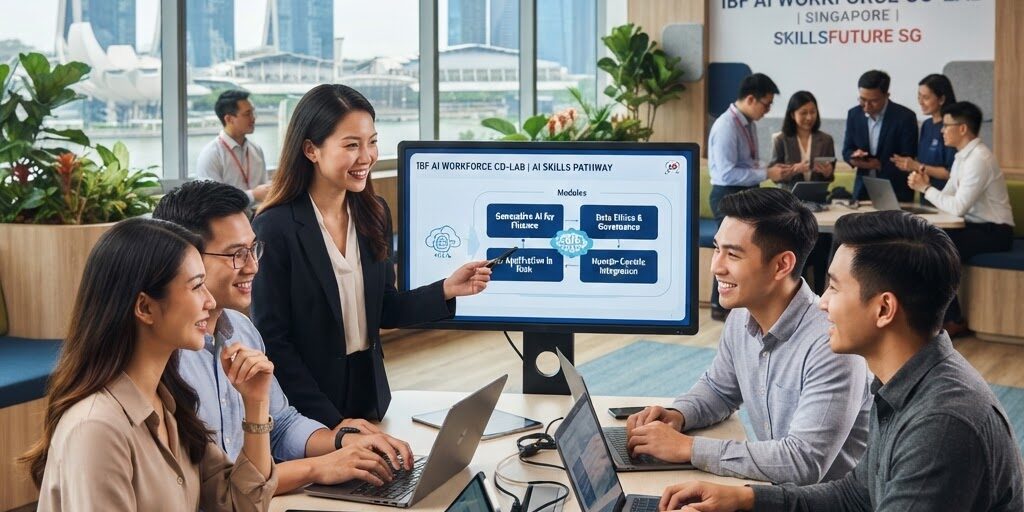
AI Workforce Training in Singapore: A Guide to National Skills Initiatives for 2027
As the global digital economy shifts rapidly, Singapore is establishing itself as a global leader in artificial intelligence readiness. Central to this transformation is the aggressive scaling of AI workforce training in Singapore, a national imperative designed to keep the nation competitive. By 2027, the focus on human-centric AI integration will determine which businesses thrive and which struggle to adapt to the new automated reality. The government, alongside key industry bodies, has launched ambitious programs like the IBF AI Workforce Co-Lab, which serves as a cornerstone for upskilling financial sector professionals. With a target to train over 80,000 employees by 2028, these initiatives provide the necessary framework for workers to pivot into higher-value roles. This guide explores the essential components of these initiatives, helping both employers and employees understand how to leverage national resources to stay ahead of the curve. Whether you are a business leader or a motivated professional, understanding the landscape of government-supported AI education is the first step toward securing your future in an increasingly intelligent and automated workforce ecosystem.
Table of Contents
The National Framework for AI Readiness
The strategic push toward an AI-ready nation is built upon a foundation of comprehensive policy support and infrastructure investment. In Singapore, AI workforce training is not merely an optional professional development path; it is a systematic requirement for maintaining economic resilience. The government has recognized that the adoption of machine learning and large language models will fundamentally alter labor demands across all sectors, from logistics to professional services. To address this, national initiatives are designed to bridge the gap between theoretical knowledge and practical application. By focusing on critical competencies such as prompt engineering, data literacy, and ethical oversight, these programs empower workers to interact with AI systems as partners rather than being replaced by them. The overarching strategy involves collaboration between the public sector, academic institutions, and private industry leaders to ensure that training content remains relevant to the current technological landscape. Industry experts suggest that the successful integration of these technologies depends heavily on a culture of continuous learning. Organizations that invest in internal reskilling initiatives while aligning them with national benchmarks are seeing higher rates of employee retention and operational efficiency. Furthermore, the government provides various funding mechanisms that lower the barrier to entry for small and medium-sized enterprises, allowing them to gain access to the same high-quality training modules as larger multinational corporations. This inclusivity is vital for ensuring that the technological divide does not widen as AI adoption accelerates. By prioritizing standardized certifications and hands-on workshops, Singapore is effectively creating a standardized baseline of digital talent that will serve as the engine for the next decade of national growth. The commitment to human-centric principles ensures that as technology evolves, the focus remains on enhancing human creativity and strategic decision-making capabilities rather than simply automating routine tasks.
The IBF AI Workforce Co-Lab and Financial Services
The financial sector is currently undergoing the most significant transformation in its history, and the IBF AI Workforce Co-Lab is at the heart of this disruption. Financial services require high levels of precision, security, and ethical compliance, making the integration of artificial intelligence both a massive opportunity and a complex challenge. The initiative to upskill 80,000 financial sector employees is a bold target that reflects the urgency of the moment. These employees are being taught how to use AI to improve risk assessment, detect financial fraud, and personalize customer experiences, all while adhering to the highest standards of regulatory transparency. The training modules are specifically tailored to the nuances of wealth management, retail banking, and corporate insurance, ensuring that the skills acquired have immediate practical value. Industry experts often point out that the human element—judgment, empathy, and ethical reasoning—is irreplaceable in finance. Therefore, the co-lab emphasizes collaborative AI, where systems act as decision-support tools. Employees are trained to interpret the outputs of algorithms, identify potential biases, and verify the accuracy of automated reports. This hybrid approach to work is becoming the new standard in the industry. Beyond technical skills, the program also covers the cultural shift required to embrace technological change, helping staff overcome apprehension toward new digital systems. Many professionals who once feared obsolescence are now leveraging these programs to transition into roles that require deep domain expertise combined with technical fluency. The collaborative nature of the program allows for the exchange of best practices across different financial institutions, fostering a collective intelligence that benefits the entire sector. By creating a shared knowledge base, the financial ecosystem in Singapore is better prepared to handle future disruptions, ensuring that local firms remain competitive on a global stage while maintaining strong public trust.
| Program Component | Primary Focus | Target Audience |
|---|---|---|
| AI Literacy Baseline | Conceptual Understanding | General Employees |
| Advanced Prompting | Technical Application | Knowledge Workers |
| Ethical AI Governance | Compliance and Safety | Management/Leaders |
| Domain-Specific AI | Sector-Specific Tools | Specialized Roles |
Strategies for Human-Centric AI Integration
Successfully embedding AI into existing operational workflows requires a shift in mindset that goes beyond simple technology adoption. Human-centric AI integration is the practice of designing, deploying, and managing automated systems with the primary goal of enhancing human capabilities and organizational value. In the context of the training initiatives being rolled out across Singapore, this means teaching the workforce to become effective supervisors of AI processes. Rather than treating an AI as an autonomous agent, workers are encouraged to act as curators who refine data inputs, monitor system performance, and provide the final qualitative judgment that algorithms currently lack. This approach significantly reduces the risks associated with “black box” decision-making, where the lack of transparency can lead to operational errors or ethical violations. Professionals participating in these programs learn how to conduct human-in-the-loop workflows where the AI provides the initial processing, and the human provides the high-level strategy and final approval. Furthermore, companies that invest in these training programs are realizing that their greatest asset is the combined power of their staff and the new software they utilize. A core component of this strategy involves continuous feedback loops, where employees are encouraged to report system limitations or biases back to the development teams. This internal communication is essential for the long-term sustainability of AI projects. When employees feel that they have a stake in the success of the tools they use, they are far more likely to engage with the training material and proactively seek out opportunities to improve their performance. The result is a more resilient organization that is capable of adapting to rapid changes in the market. By fostering a culture of curiosity and collaborative problem-solving, businesses can turn the challenge of AI implementation into a competitive advantage that defines their market position for years to come.
Future-Proofing Your Career in 2027
As we approach 2027, the definition of a “future-proof” career is changing rapidly. The days of relying on a single set of static skills are over; in the new economy, agility and the ability to learn are the most valuable assets. AI workforce training in Singapore provides a structured path for individuals to reinvent themselves in response to technological advancement. For those looking to secure their professional future, the key lies in pursuing a hybrid skill set that combines deep industry knowledge with a high degree of AI proficiency. This means that a marketing professional should not just know how to use traditional analytics but also understand how to leverage predictive modeling to anticipate consumer trends. Similarly, an HR professional should be comfortable utilizing natural language processing to improve hiring processes. The national initiatives provide the roadmap for this transition, offering various certifications that are recognized by top employers. It is highly recommended that professionals take stock of their current capabilities and identify areas where AI could augment their output. The transition phase should focus on micro-learning opportunities that fit into busy schedules, allowing for gradual skill acquisition without disrupting daily output. Furthermore, networking with peers who are going through similar training journeys can provide insights that are not available in textbooks. Engaging with communities of practice is an excellent way to stay informed about emerging trends and to gain practical advice on how to apply new skills in real-world scenarios. Ultimately, the future belongs to those who view artificial intelligence as a co-pilot rather than a competitor. By committing to these training programs, you are not just gaining technical credentials; you are developing the mindset required to navigate the complexities of the modern workplace, ensuring that you remain an essential player in the evolving landscape of 2027 and beyond.
Conclusion
The roadmap for AI workforce training in Singapore is a testament to the nation’s proactive approach to digital transformation. By focusing on mass upskilling through initiatives like the IBF AI Workforce Co-Lab, the country is ensuring that its human capital remains its greatest asset. As we look toward 2027, the emphasis on human-centric AI integration will be the defining factor in business and personal success. Whether you are a professional in the financial sector or an employee in another industry, the resources available for learning and growth have never been more accessible. Embracing these opportunities today is the best way to secure your relevance and contribute to a more efficient, innovative, and human-focused future. Start your journey toward AI proficiency now to ensure you stay at the forefront of the technological evolution.
FAQ
What is the primary goal of the IBF AI Workforce Co-Lab?
The goal is to upskill 80,000 financial sector workers by 2028 to improve productivity and ensure human-centric integration of AI.
How can small businesses benefit from these initiatives?
Government funding and modular training programs allow smaller firms to access premium education, helping them compete with larger enterprises.
Is technical programming knowledge required for these training programs?
No, most programs focus on AI literacy and application, making them suitable for professionals from various backgrounds and expertise levels.
What is meant by human-centric AI integration?
It refers to using AI as a tool to support human decision-making and creativity, rather than replacing the human worker entirely.
Where can I find information on available AI training grants?
Interested individuals and companies should check the official SkillsFuture Singapore website for the latest updates on funding and courses.