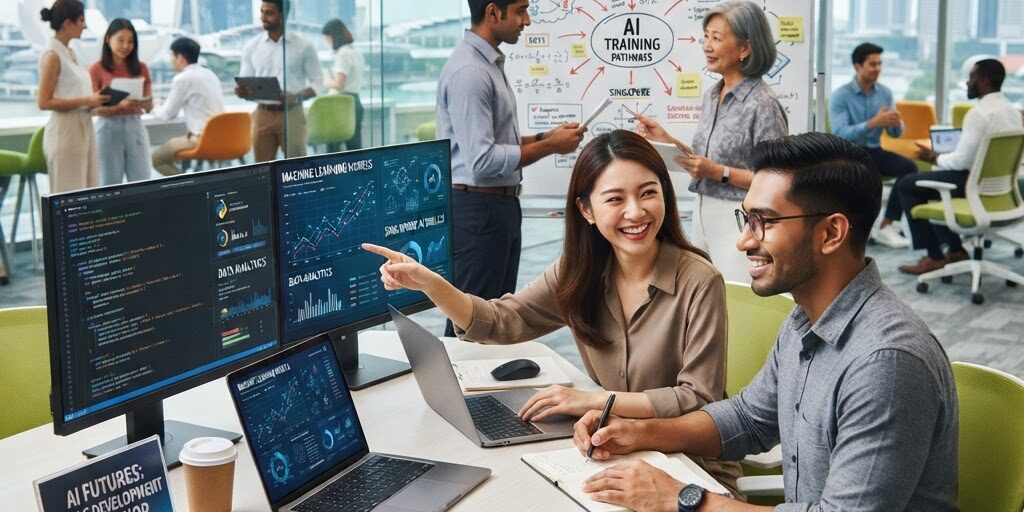
Bridging the AI Talent Gap: Essential Skills for Singapore Professionals in 2026
In the rapidly evolving landscape of the digital economy, Singapore stands at the precipice of a significant transformation. As artificial intelligence becomes the hardest-to-fill capability within the nation, professionals are increasingly seeking specialized AI training Singapore programs to bridge the talent gap and secure high-demand roles. The year 2026 marks a turning point where technical literacy in machine learning and data analytics is no longer a luxury but a fundamental requirement for career advancement. Local businesses are pivoting toward automation, necessitating a workforce that can interact with intelligent systems effectively. To remain competitive in this global hub, individual workers must proactively acquire skills that machines cannot replicate, such as strategic synthesis and complex problem-solving. By investing in reputable educational pathways now, you position yourself at the forefront of the technological wave. This guide explores the critical competencies required to thrive in Singapore’s AI-driven future, ensuring you remain relevant, employable, and capable of leading innovation within your respective industry while addressing the evolving expectations of the modern job market throughout Southeast Asia.
Table of Contents
Foundations of AI Literacy
Establishing a robust foundation in AI literacy is the first step toward navigating the complexities of the modern workplace. Many professionals often believe that AI training is strictly reserved for software developers or data engineers, but this perspective is rapidly becoming outdated. In the context of the Singaporean economy, where efficiency and productivity are the engines of growth, understanding the fundamental mechanics of generative AI, neural networks, and automated decision-making is essential for every role. Industry experts emphasize that foundational literacy involves more than just knowing what tools exist; it requires a deep conceptual understanding of how data flows through systems, how bias manifests in algorithmic outcomes, and the ethical considerations that govern responsible usage. When you undertake formal AI training Singapore workshops, you learn to demystify these black-box technologies, allowing you to ask the right questions during project planning and implementation. This literacy empowers you to transition from a passive user of software to an active architect of digital workflows. Furthermore, understanding the limitations of artificial intelligence is just as important as knowing its capabilities. Professionals who can identify where AI might fail—such as in tasks requiring high emotional intelligence, nuanced creative judgment, or complex legal interpretation—are the ones who provide the greatest value to their organizations. By cultivating this baseline knowledge, you ensure that you can effectively oversee AI integration within your department, mitigate potential risks, and act as a bridge between technical teams and non-technical management. This foundational approach ensures that your journey into advanced AI proficiency is built on logic, safety, and operational excellence, which are highly prized traits in Singapore’s competitive corporate climate during 2026.
Developing Core Technical Proficiency
Moving beyond foundational awareness requires a dedicated commitment to developing core technical proficiency. This is where specialized AI training Singapore certifications provide a tangible advantage. Whether you are aiming to master data visualization tools, gain familiarity with Python scripting, or understand the nuances of prompt engineering, the technical depth you achieve will define your professional trajectory. The demand for technical expertise in the Lion City is multifaceted, covering everything from cybersecurity to supply chain optimization. Industry experts suggest that the most successful professionals in 2026 will be those who possess a ‘T-shaped’ skill set: broad knowledge across multiple digital domains combined with deep, specialized expertise in a specific area of artificial intelligence. For instance, a financial analyst does not need to build a neural network from scratch, but they must be proficient in using AI-driven predictive modeling tools to forecast market trends with precision. Engaging in hands-on laboratories and simulation-based learning is the most effective way to internalize these complex concepts. The following table highlights the essential technical skill tiers currently in demand across Singaporean industries:
| Skill Category | Proficiency Level | Industry Application |
|---|---|---|
| Data Wrangling | Intermediate | Cleaning datasets for AI training |
| Prompt Engineering | Advanced | Optimizing large language model outputs |
| AI Ethics & Governance | Foundational | Ensuring regulatory compliance |
| Predictive Analytics | Intermediate | Market forecasting and risk assessment |
As indicated in the table, technical proficiency is not one-size-fits-all. Instead, it is a spectrum that aligns with specific organizational needs. Technical training must also be paired with a consistent effort to update your knowledge, as the shelf-life of digital tools is shrinking. By participating in professional networking groups and attending seminars, you can ensure that your technical stack remains compatible with the latest industry standards and regulatory frameworks established by local authorities, thereby securing your reputation as a high-value asset in the local workforce.
The Synergy of Soft Skills and AI
While the focus on technical expertise is intense, it is the synergy between soft skills and artificial intelligence that truly differentiates top-tier professionals. In an era where AI can generate reports, write code, and analyze spreadsheets in seconds, human-centric traits such as critical thinking, empathy, negotiation, and complex team management become the true pillars of career security. Industry experts argue that machines lack the innate ability to navigate the complex social hierarchies and cultural nuances that define the business landscape in Singapore. Therefore, the goal of effective AI training Singapore should not be to replace human decision-making, but to augment it with high-level human intuition. Consider the scenario of a manager tasked with implementing an automated HR system. While the technical side of the system might handle applicant screening, the manager must apply emotional intelligence to interpret the cultural fit, handle team resistance to change, and ensure that the process remains transparent and fair. This requires a sophisticated level of communication and leadership that cannot be automated. Furthermore, the ability to synthesize information from various sources and turn it into a compelling narrative is a skill that will remain exclusively human for the foreseeable future. By leveraging AI to perform the ‘heavy lifting’ of data collection and initial drafting, you free up your mental bandwidth to focus on strategic planning and relationship building. This dual-focus approach ensures that your professional value remains high, as you become a versatile partner who can guide teams through technological disruption while maintaining morale and organizational alignment. The most effective professionals in 2026 will be those who demonstrate that they are not just ‘AI-literate,’ but also ‘people-literate,’ using technology as a lever to enhance their interpersonal strengths rather than a crutch that limits them.
Future-Proofing Your Career Trajectory
Future-proofing your career in the face of rapid technological disruption is a journey of continuous adaptation. In Singapore, the focus of the workforce development agenda is on lifelong learning, which means that your initial education is only the starting point. To remain relevant in 2026 and beyond, you must adopt a mindset of ‘unlearning and relearning.’ This involves regularly auditing your current skills against the evolving requirements of the job market. Industry experts advise that you look for emerging trends in AI integration, such as the rise of decentralized AI architectures or the increasing integration of AI within the Internet of Things, and start developing basic familiarity with these areas long before they become industry standards. One of the best ways to future-proof is to build a personal project portfolio that demonstrates how you have applied AI tools to solve real-world problems. Whether it is a small script you wrote to automate a repetitive email task or a complex market analysis model you built to help your department make better decisions, tangible evidence of your skills speaks louder than any certificate on your resume. Furthermore, stay engaged with the wider community through specialized AI training Singapore initiatives that offer collaborative opportunities. By networking with like-minded peers, you gain insights into how other industries are tackling the same challenges you face, allowing you to cross-pollinate ideas and identify new opportunities for growth. Future-proofing is also about understanding your own cognitive flexibility; being willing to change your approach when a new tool or methodology proves more effective. By maintaining a balance between deep technical knowledge and a broad curiosity about the world of innovation, you ensure that you are not just surviving the AI transition, but actively leading the way within your organization, keeping your career trajectory upward and resilient against inevitable market shifts.
As we navigate the complexities of 2026, it is clear that the integration of artificial intelligence into the Singaporean economy is an ongoing process that demands proactive participation. We have explored the critical importance of foundational AI literacy, the development of core technical proficiency, the unique advantage of combining soft skills with machine-driven outputs, and the necessity of a lifelong learning mindset for future-proofing your career. By leveraging specialized AI training Singapore programs, you can effectively bridge the existing talent gap and secure your position as a valuable leader in the digital landscape. Remember that technology is a tool meant to enhance human capability, not diminish it. Embrace this period of transformation with confidence, knowing that your ability to think critically and adapt quickly remains your greatest professional asset in a rapidly changing world.
Frequently Asked Questions
What are the primary benefits of AI training in Singapore for my career?
AI training helps you stay competitive, increases your workplace productivity, and allows you to lead digital transformation efforts within your organization.
How do I choose the right AI course for my specific professional role?
Identify your current skill gaps and align them with courses that offer practical, industry-specific applications rather than just theoretical concepts.
Is technical knowledge mandatory for all roles involved in AI?
While deep programming isn’t always required, understanding the logic, ethics, and limitations of AI is essential for professionals across all sectors.
How can I balance soft skills with technical AI capabilities?
Focus on using AI to automate routine tasks, which frees you to concentrate on high-value human skills like leadership, empathy, and strategic thinking.
What is the most effective way to stay updated on AI trends beyond formal training?
Engage in active industry networking, follow reputable AI research publications, and consistently experiment with new software tools to maintain hands-on familiarity.