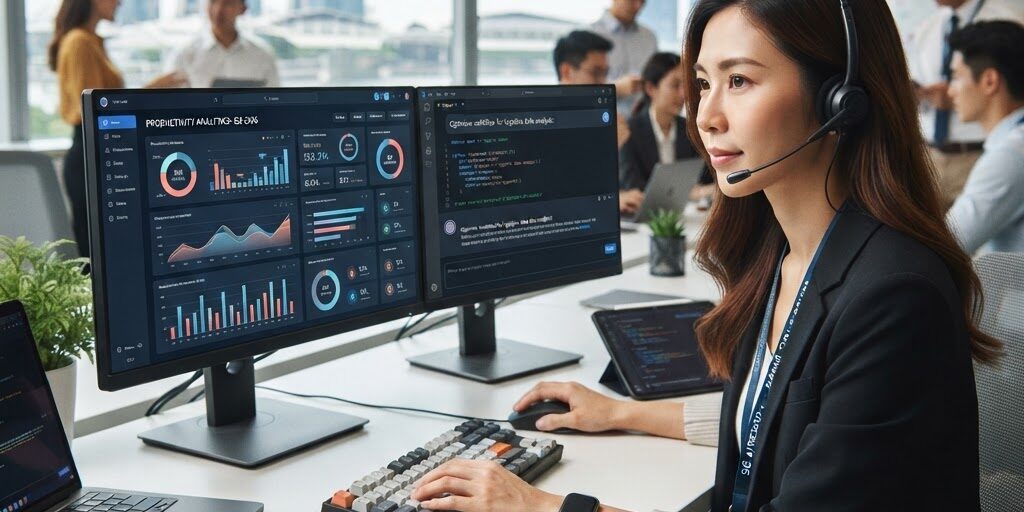
Beyond Tool Adoption: Building an AI-Ready Workforce in Singapore
In the rapidly shifting landscape of August 2026, the necessity for robust AI training Singapore initiatives has moved well beyond simple theoretical awareness. Businesses across the nation are now grappling with the transition toward becoming truly AI-bilingual, a state where employees fluently translate complex human intent into effective machine-generated output. This evolution is no longer about learning how to prompt a chatbot for general information; it is about deeply embedding generative tools into the granular, specialized workflows that define individual professional roles. As Singapore continues to solidify its status as a global hub for technological innovation, the competitive advantage for firms will be dictated by how effectively they can cultivate a workforce that views artificial intelligence not as an external utility, but as an integral collaborator. By prioritizing practical, workflow-specific integration, organizations can unlock unprecedented levels of productivity and creative output. This article explores the strategic roadmap for business leaders and human resource departments committed to transforming their human capital into an AI-driven force, ensuring that long-term digital agility remains at the heart of their corporate identity in an increasingly automated world.
Table of Contents
The Shift to AI-Bilingual Competency
The concept of AI-bilingualism represents a fundamental paradigm shift in how we approach professional skill development in the mid-2020s. Being AI-bilingual means that an employee possesses the cognitive dexterity to operate within both the traditional human sphere of strategic oversight and the digital sphere of machine logic. It is not sufficient for teams to merely understand what a large language model is; they must understand how to construct the context, constraints, and iterative feedback loops that allow these models to produce high-value, domain-specific results. As companies invest in AI training Singapore programs, the curriculum has naturally transitioned away from generic introductory workshops toward highly targeted sessions that teach employees how to audit model outputs for nuance, accuracy, and bias. This level of competency requires a deep understanding of prompt engineering, data privacy regulations unique to Singapore, and the ethical considerations involved in automated decision-making. By fostering an environment where staff members are encouraged to experiment with advanced tools under controlled circumstances, organizations help mitigate the fear of replacement and replace it with a sense of technical empowerment. This linguistic shift extends to how cross-departmental teams communicate; they are now creating new shared technical vocabularies that bridge the gap between software capability and business objectives. As industry experts note, the most successful companies are those that view this bilingual capability as a core business asset rather than a secondary skill. When employees move past the surface-level novelty of artificial intelligence, they begin to see the underlying architecture of their own tasks, identifying exactly where automation can enhance quality. Consequently, the organization achieves a level of operational harmony where the machine handles the heavy lifting of data processing while the human professional exerts the essential critical thinking and creative direction required to drive meaningful innovation within their respective sectors.
Integrating AI into Specialized Daily Workflows
Integrating generative tools into daily professional workflows is where the true promise of modern technology is realized. Rather than adopting software in a siloed fashion, forward-thinking organizations are conducting comprehensive audits of their existing internal processes to identify bottlenecks that AI can realistically alleviate. In the context of AI training Singapore, this means moving from general usage scenarios to custom-tailored modules that reflect the specific technical requirements of industries like finance, logistics, law, and healthcare. For instance, a financial analyst might learn to automate the extraction of quarterly reporting data into summary models that require human validation but remove the manual labor of data entry. This transition involves a structured approach: identifying the routine tasks, selecting the right model, implementing iterative prompt refinements, and establishing rigorous oversight protocols. The table below illustrates the typical progression of integration efficiency within modernized teams.
| Process Phase | Pre-AI Execution | Post-AI Integration | Efficiency Gain |
|---|---|---|---|
| Data Preparation | 4 Hours (Manual) | 15 Minutes (Automation) | 90% |
| Trend Analysis | 3 Days (Research) | 4 Hours (Refinement) | 85% |
| Reporting/Synthesis | 8 Hours (Writing) | 2 Hours (Auditing) | 75% |
By focusing on these specific workflow improvements, businesses in Singapore can see tangible ROI in productivity metrics. The key is to provide employees with the autonomy to build their own toolkits, rather than imposing a rigid, top-down software mandate. When staff members participate in the design of their own digital workflows, the rate of successful adoption increases dramatically. Furthermore, this workflow-centric approach encourages continuous learning. As tools improve and models become more capable, the workforce is already conditioned to audit their existing processes and adjust them accordingly. This creates a culture of perpetual optimization, where the integration of advanced technology becomes as natural as using email or project management software. It turns the daunting task of digital transformation into a manageable, incremental set of improvements that build upon one another, ensuring that the technology always serves the business goals rather than dictating them.
Cultivating Human-Centric AI Leadership
In an era of rapid technological advancement, the human element has never been more important. Effective leadership in the age of artificial intelligence requires a shift toward empathy, ethical stewardship, and the ability to foster a culture of lifelong learning. When implementing AI training Singapore initiatives, leaders must recognize that the most significant barrier to success is not technical, but psychological. Employees often worry about how automation might impact their relevance or job security. To counter this, management must clearly articulate the vision of the AI-powered workplace: one where the machine handles the repetitive, mundane tasks, freeing up the human professional to focus on high-level strategy, creative problem-solving, and relationship management. This leadership philosophy prioritizes the enhancement of human potential rather than the replacement of it. Leaders should act as mentors, encouraging curiosity and providing the necessary safe spaces for staff to make mistakes while learning new tools. The objective is to build a workforce that is comfortable with ambiguity, as the tools themselves will undoubtedly change or become obsolete in the near future. By focusing on essential human traits—emotional intelligence, complex ethical reasoning, and domain-specific intuition—organizations ensure that their teams remain indispensable, even as the landscape of work shifts beneath them. Furthermore, promoting transparency regarding why specific tools are being adopted and how they align with the company’s broader mission helps gain employee buy-in. It is essential to communicate that AI is a collaborator, a digital intern that requires supervision to reach its full potential. When leaders successfully cultivate this environment, they foster a sense of shared purpose and collective intelligence that is impossible for competitors to replicate. This human-centric approach is the bedrock of long-term sustainable innovation in the local business ecosystem.
Measuring Productivity and Future-Proofing
The ultimate test for any investment in AI training Singapore is whether it actually moves the needle on productivity and innovation. As of 2026, the metrics for success have evolved to become far more granular than simply counting hours saved. Organizations are now utilizing balanced scorecards that measure output quality, error reduction rates, employee sentiment regarding tool comfort, and the speed at which new projects move from ideation to execution. Future-proofing requires a dynamic framework that treats technology as a variable component of the corporate strategy. This means that as models change, the training programs must evolve in tandem, keeping the workforce ahead of the curve. To maintain this edge, companies must continuously monitor global research and industry best practices, integrating lessons learned from their peers while tailoring those insights to the specific regulatory and market conditions of Singapore. Periodic audits of internal AI literacy levels ensure that no department is left behind in the digital transition. By establishing these formal evaluation loops, leadership can identify high-performing teams, reward successful experimentation, and pivot resources away from underperforming initiatives. Moreover, investing in infrastructure that supports data privacy and intellectual property security is paramount to building a sustainable AI environment. As the regulatory landscape matures, firms that have established clear internal governance protocols will find themselves at a significant advantage. Ultimately, future-proofing is not about predicting exactly what the next tool will be, but about fostering a workforce that has the core capacity to learn, adapt, and integrate whatever innovation comes next with speed and confidence. This ongoing commitment to educational excellence ensures that the nation’s professional ecosystem remains robust, resilient, and ready to meet the complex global challenges that lie ahead in an increasingly digitized economic landscape.
The transition toward an AI-ready workforce is a marathon, not a sprint. By focusing on the bilingual competency of employees, integrating technology directly into established workflows, maintaining a human-centric leadership style, and employing rigorous measurement strategies, organizations can thrive. The future of work in Singapore is bright, defined by a symbiotic relationship where human expertise and artificial intelligence combine to reach unprecedented heights of productivity. As you embark on this journey, remember that the most valuable asset in any firm is the ability of its people to evolve alongside the tools they use. Embrace the change with a clear vision, invest in the right talent, and watch as your business reaches new levels of innovation and success in the coming years of technological advancement.
Frequently Asked Questions
What is the primary goal of AI training in Singapore today? The goal is to develop AI-bilingual employees who can seamlessly integrate generative tools into specialized workflows to improve productivity.
How do I measure the effectiveness of my AI training programs? Success should be measured through a combination of productivity metrics, error reduction rates, and employee comfort levels using specialized AI tools.
Is AI training only for technical staff members? No, in 2026, AI training is critical for all professional roles, as it empowers staff to focus on high-value human activities.
How can we ensure employees do not fear AI adoption? Leaders should emphasize that AI is a tool for professional augmentation, focusing on transparency, clear communication, and mentorship throughout the training process.
What is the first step in creating an AI-ready organization? The first step is conducting a thorough audit of daily workflows to identify specific tasks that can benefit from generative AI integration.