Mastering Agentic AI Workflows: A 2026 Guide for Singapore Professionals
The professional landscape in Singapore is undergoing a rapid metamorphosis as we move deep into 2026. While the initial wave of artificial intelligence centered on basic prompting, the current frontier has shifted significantly toward Agentic AI workflows. This evolution marks a transition from reactive chatbot interactions to proactive, autonomous systems capable of executing complex, multi-step tasks independently. For Singaporean professionals, adapting to this change is no longer optional but a critical career imperative. These agentic systems are designed to bridge the gap between human intent and technical execution by managing recursive logic, error correction, and iterative decision-making across disparate digital environments. Mastering these workflows requires a fundamental understanding of how to architect, supervise, and scale intelligent agents that act on behalf of the user. As organizations integrate these autonomous systems to drive productivity, the demand for human oversight, strategic flow design, and advanced logic mapping continues to soar. This guide provides a comprehensive roadmap for navigating this technical shift, ensuring that professionals remain competitive within the dynamic and fast-paced Singaporean corporate environment while leveraging the latest advancements in autonomous software and digital orchestration.
Table of Contents
Understanding the Architecture of Agentic AI
To truly grasp the power of agentic AI workflows, one must first dismantle the misconception that AI is merely a conversational interface. At its core, an agentic system is a software entity equipped with reasoning capabilities, tool-use modules, and a defined objective function. Unlike simple prompt-based models that output text, agentic agents are empowered to utilize various APIs, database queries, and web tools to complete a sequence of actions without constant human intervention. In the 2026 professional environment, this means that a single workflow can autonomously research a market trend, draft a summary report, send it to a local stakeholder, and adjust the content based on subsequent feedback loops. The architectural brilliance lies in the iterative processing of the system. By breaking down high-level objectives into actionable sub-tasks, the AI continuously monitors its own progress against a defined success metric. If a specific path fails to yield the intended result, the system automatically pivots, retries, or alerts a human controller. Professionals who understand this architectural layer are better positioned to troubleshoot complex workflows and optimize the performance of these intelligent systems. Furthermore, as infrastructure providers in Singapore continue to enhance local latency and data security, the reliance on these autonomous structures will only increase, creating a need for individuals who can bridge the gap between business objectives and technical implementation. This requires a shift in mindset: seeing the AI not as a tool for drafting, but as a dynamic engine for execution. Professionals who focus on building a deep understanding of agentic reasoning, memory management, and context windows will find themselves leading innovation initiatives within their respective industries, driving greater value through enhanced technical agency and superior operational outcomes in an increasingly digital economy.
Strategic Design Principles for Flow Mapping
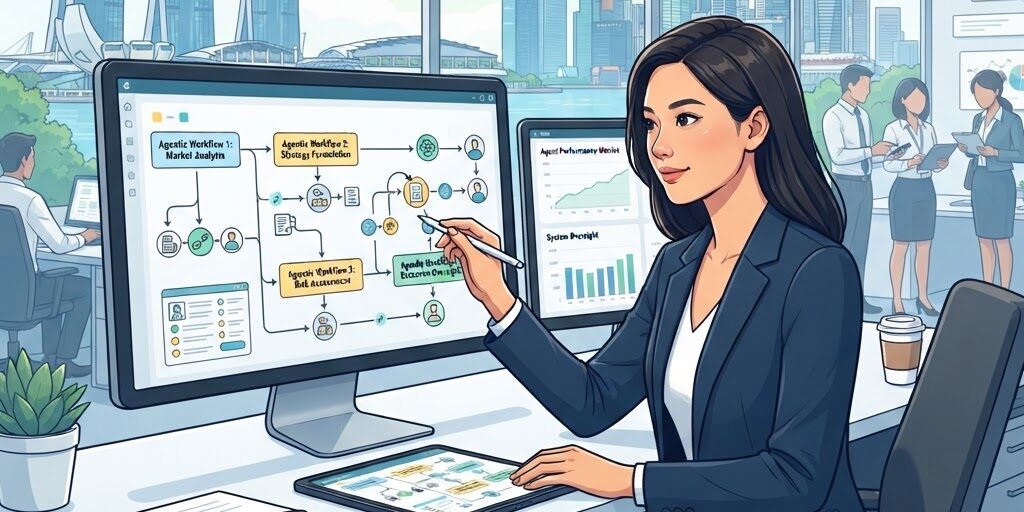
Designing an effective agentic AI workflow is less about writing perfect prompts and more about creating robust logic maps that anticipate potential failure points. In the context of 2026 business practices, industry experts suggest that the most successful workflows are built on modularity and clear constraints. A poorly mapped workflow often results in hallucinations or infinite loops, where the agent spends compute resources fruitlessly trying to satisfy an ambiguous goal. Therefore, professional training programs now prioritize the art of flowcharting before a single line of code or instruction is written. This involves defining the specific input variables, setting hard guardrails for acceptable output, and determining the exact hand-off points between the autonomous system and human stakeholders. Effective flow mapping also requires incorporating validation layers. For instance, before an agent submits a financial analysis, the workflow should trigger a verification step where the AI reviews its own math against a trusted internal data source. This self-correction mechanism is a hallmark of sophisticated agentic design. We have observed that professionals who treat workflow design as a form of logic engineering are far more successful than those who treat it as mere copywriting. Additionally, one must consider the interoperability of tools. Can the agent effectively communicate between a customer relationship management platform and a project management tool? By mapping these data flows with precision, users ensure that the agent remains in its lane while maximizing its utility. When designing these flows, it is essential to account for data privacy requirements, particularly in the Singapore context where compliance standards are exceptionally stringent. Through thoughtful planning and adherence to structural logic, professionals can construct agents that are not only highly productive but also incredibly reliable, consistently delivering high-quality results across diverse functional areas in the modern workspace.
| Feature | Traditional Automation | Agentic AI Workflow |
|---|---|---|
| Decision Making | Fixed Rules | Adaptive Reasoning |
| Flexibility | Low | High |
| Error Handling | Static Alerts | Autonomous Correction |
| Task Scope | Single Step | Complex Multi-Step |
The Critical Role of Human-in-the-Loop Oversight
As agentic AI workflows take over the heavy lifting of repetitive tasks, the role of the professional shifts from doing to overseeing. The concept of human-in-the-loop, or HITL, is central to the ethical and efficient deployment of these systems in Singapore. While an agent may be capable of executing hundreds of steps in a matter of seconds, it does not inherently possess the professional judgment, cultural context, or emotional intelligence required for high-stakes decision-making. Therefore, the goal of 2026 AI strategy is not total automation, but rather a synergistic partnership between human expertise and autonomous speed. Oversight involves monitoring the performance of agentic agents in real-time, intervening when the system enters ambiguous territory, and conducting periodic audits of the workflows to ensure alignment with organizational goals. This requires a new set of soft skills: critical analytical thinking, attention to detail, and a deep understanding of system limitations. When the agent flags an outlier or encounters an error it cannot resolve, the human supervisor must step in to guide the decision process. This ensures that the agent learns from the interaction, effectively refining its future performance. This feedback loop is vital for creating a robust system that improves over time. Furthermore, oversight is essential for safety and compliance. By keeping a human at the helm, professionals can prevent systemic bias, ensure data security, and maintain the high standard of service expected in the Singaporean corporate sector. It is important to emphasize that this oversight does not render the AI less useful; instead, it provides the necessary governance that allows the agent to function safely within a complex regulatory environment. As such, the most valued employees of 2026 will be those who can design, manage, and audit these intelligent systems, effectively acting as the bridge between raw artificial intelligence and high-level, human-driven strategy.
Scaling Operational Efficiency in Singapore
The scalability of agentic AI workflows is the final frontier for businesses looking to gain a competitive edge in Singapore. When organizations successfully transition from manual processes to agentic systems, they unlock a level of productivity previously considered impossible. However, scaling requires more than just deploying agents; it requires a cultural and technical shift within the workforce. Scaling begins with standardizing processes. Before an agent can be unleashed on a company-wide project, the underlying logic must be stable and consistent. Industry experts advocate for creating a library of modular workflows that can be reused across different departments, from human resources to supply chain management. This modular approach allows for rapid scaling because once a reliable agentic workflow is developed for one task, it can be easily adapted or integrated into others. Furthermore, scaling necessitates robust data infrastructure. In Singapore, where data integration across digital platforms is quite advanced, agents can be leveraged to draw insights from across the entire corporate ecosystem. However, this also implies that teams must prioritize data cleanliness and security. If the underlying data is flawed, the agentic output will be equally unreliable. Therefore, professional training in 2026 often focuses heavily on data management practices that support autonomous systems. As teams begin to scale their agentic operations, they must also focus on training junior staff to interact with these systems effectively. This creates a cascade effect where the entire organization becomes more proficient at working alongside intelligent machines. Ultimately, the successful scaling of these workflows will define the winners in the Singaporean economy. By building sustainable, secure, and highly efficient autonomous workflows, businesses can focus their human talent on innovation and strategy, leaving the operational complexities to the agents, thereby creating a formidable advantage in a globalized, digitally-driven commercial landscape that demands agility and precision at every single turn.
Conclusion
Mastering agentic AI workflows is a transformative process that defines the trajectory of a professional career in 2026. As we have explored, this shift requires a move toward logic-based architecture, precise flow mapping, vigilant oversight, and scalable integration strategies. By focusing on these core competencies, Singaporean professionals can harness the power of autonomous systems to achieve unprecedented levels of productivity. The era of simple prompting is fading, replaced by a more sophisticated paradigm where humans and intelligent agents act in concert to solve complex challenges. We encourage all professionals to embrace this evolution with a mindset of continuous learning and strategic inquiry. As you integrate these tools into your daily professional practice, remember that your human judgment remains the most valuable component of any system. Stay curious, stay diligent, and lead the way into this new era of digital transformation.
Frequently Asked Questions
What exactly distinguishes agentic AI from traditional AI chatbots?
Agentic AI systems can autonomously plan and execute multi-step tasks using external tools, whereas chatbots are generally limited to responding to prompts based on their training data.
How can professionals in Singapore ensure their AI workflows are compliant?
Compliance is managed by incorporating human-in-the-loop audit stages, using localized secure data environments, and ensuring that all agentic logic aligns with local regulatory frameworks.
What are the first steps to learning agentic workflow design?
Start by flowcharting your current manual processes, identify repetitive sequences, and learn to break them down into modular logic steps that an autonomous agent can follow.
Is coding required to build these sophisticated AI workflows?
While coding knowledge is beneficial for complex integrations, many modern platforms allow professionals to build agentic workflows using intuitive, drag-and-drop visual logic editors.
How will agentic AI change the job market for Singaporean employees?
It will shift roles toward strategic oversight, system governance, and architectural design, rewarding those who can successfully collaborate with autonomous systems to drive organizational goals.