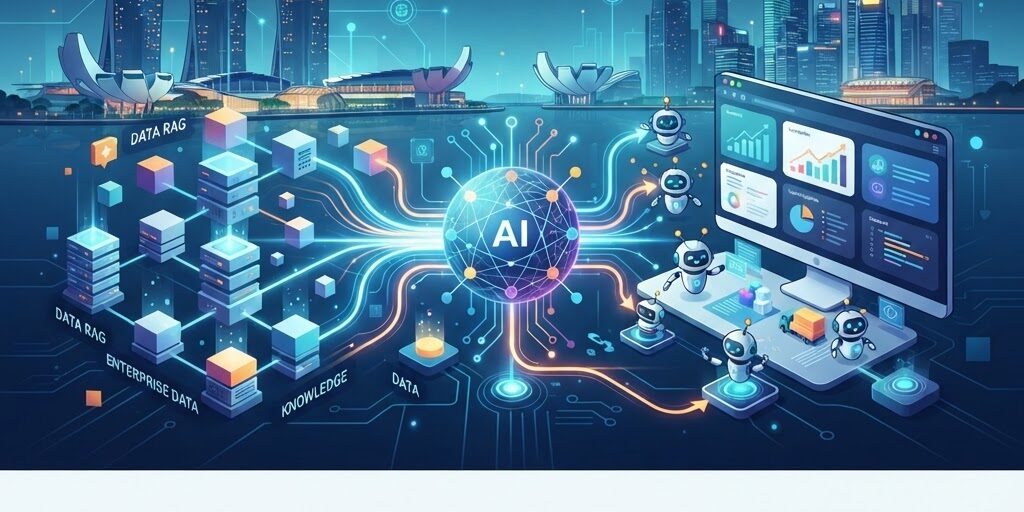
Mastering Agentic AI and RAG: Essential Skills for Singapore Professionals in 2026
As we navigate the rapidly evolving digital landscape of 2026, the demand for sophisticated technical competencies has never been higher. For forward-thinking individuals, Agentic AI training Singapore initiatives have become the primary gateway to remaining competitive in a global marketplace. We are currently witnessing a shift from passive, prompt-based interaction toward autonomous systems capable of executing complex workflows without constant human oversight. Understanding how to integrate Retrieval-Augmented Generation (RAG) with agentic architectures is no longer a niche interest; it is a core professional requirement. This guide explores why these technologies are revolutionizing productivity and how mastering them can future-proof your career. By leveraging real-time data sources and autonomous reasoning capabilities, professionals can now bridge the gap between static information and dynamic business outcomes. Whether you are in finance, healthcare, or government, adopting these advanced frameworks allows you to scale operations with unprecedented precision. Join us as we dissect the mechanics of modern artificial intelligence, the role of local training ecosystems, and the strategies necessary to lead in the era of autonomous intelligence systems.
Table of Contents
The Rise of Agentic Intelligence
Agentic AI represents a fundamental shift in how software interacts with human workflows. Unlike traditional Large Language Models that wait for a specific prompt to trigger a reaction, agentic systems are designed to operate with a degree of autonomy. These systems can plan, execute, and iterate upon tasks by evaluating their own output against defined goals. By adopting these capabilities, businesses can automate complex multi-step processes that once required manual intervention. For instance, an agentic system might be configured to monitor financial markets, synthesize regulatory updates, and draft compliance reports—all without a human needing to trigger every individual step. The complexity of these agents requires professionals to understand orchestration frameworks, memory management, and error handling within a decentralized computing environment. Mastery of these elements is a key component of effective Agentic AI training Singapore programs, where the focus shifts toward designing loops that prioritize reliability and ethical alignment. When you understand the logic behind agentic loops, you gain the ability to deploy systems that handle ambiguity better than any standard automation tool. This autonomy is not merely about speed; it is about building systems that adapt to changing data inputs in real-time. As agents become more capable, the barrier between software development and administrative tasks continues to blur, requiring professionals to think more like system architects. To excel in this environment, one must grasp how agents prioritize information, how they communicate with external APIs, and the fundamental constraints that keep them within safe operational boundaries. Developing these skills allows you to transition from a consumer of AI tools to a creator of intelligent, outcome-driven workflows that provide lasting value to your organization and industry.
RAG: The Foundation of Context
Retrieval-Augmented Generation, commonly referred to as RAG, serves as the engine that provides Agentic AI with accuracy and situational awareness. At its core, RAG is a method that allows an AI model to consult a private or dynamic database before generating a response. Without RAG, an AI relies solely on its static training data, which often leads to hallucinations or outdated information. By incorporating RAG, you ensure that your agentic systems are grounded in the latest documents, databases, and internal knowledge bases. This is particularly crucial for industries like law, medicine, and engineering, where precision is non-negotiable. Implementing RAG involves a sophisticated pipeline of vector embeddings, similarity searching, and context window optimization. When professionals undergo rigorous training, they learn to build pipelines that efficiently retrieve the most relevant pieces of information from millions of records in milliseconds. This ability to synthesize disparate data sources is what separates a generic chatbot from a high-performance decision-support engine. In the context of Agentic AI training Singapore environments, the emphasis is placed on ensuring that the retrieval process is secure, scalable, and compliant with local data privacy standards. Professionals must understand how to manage vector databases and how to refine search algorithms so that the agent only uses trustworthy sources. As the volume of data generated by modern firms grows, the efficiency of your RAG pipeline determines the overall performance of your AI agent. Mastery of RAG means you can effectively connect legacy systems to modern, generative interfaces, effectively reviving the value trapped in older digital archives. This process is essential for creating a truly data-driven culture, as it empowers every employee to ask complex questions and receive accurate, contextually relevant answers that directly influence high-stakes operational strategies every day.
Integrating AI in Singapore
Singapore’s position as a global innovation hub makes it the ideal location to master advanced AI techniques. The local professional ecosystem is rapidly shifting toward a “digital-first” mindset, where proficiency in Agentic AI and RAG is viewed as a prerequisite for senior leadership roles. Businesses across the island are investing heavily in customized training programs that prioritize practical application over theoretical knowledge. This localized approach to Agentic AI training Singapore allows professionals to address specific challenges, such as navigating regional regulatory frameworks, managing multilingual data sets, and integrating with advanced government-led digital initiatives. By engaging with local experts, you gain a perspective on how to balance innovation with compliance, a core tenet of the Singaporean business environment. The synergy between industry, academia, and government supports a unique learning culture where professionals can explore the latest advancements in machine learning while ensuring that their implementations remain robust and ethically sound. Many organizations are now implementing internal “centers of excellence” to facilitate the transfer of these critical skills across their workforce. This table outlines the comparative benefits of adopting different AI implementation strategies within an organization for better decision-making clarity:
| Implementation Type | Primary Benefit | Complexity Level | Resource Requirement |
|---|---|---|---|
| Basic Prompt Engineering | Immediate efficiency | Low | Minimal |
| Autonomous Agents | Workflow automation | High | Technical Staff |
| RAG-Enhanced Systems | Accuracy and context | Medium | Data Infrastructure |
| Hybrid AI Pipelines | Maximized performance | Very High | Full Engineering Team |
As you navigate these strategies, the local focus remains on scalability and security. By fostering a community of practice, Singaporean professionals can share best practices, troubleshoot common integration hurdles, and accelerate the adoption of transformative technologies. This collaborative spirit ensures that as AI evolves, the workforce remains agile and capable of implementing systems that respect privacy while driving significant revenue growth and operational optimization for their respective firms.
Building Your Future Roadmap
Creating a roadmap for professional development in the field of artificial intelligence requires a commitment to lifelong learning and practical experimentation. The technologies involved in Agentic AI and RAG are moving at an incredible pace, necessitating a strategy that focuses on foundational principles rather than just specific, transient software tools. Start by mastering the underlying mathematics and logic of large language models, as this knowledge will remain relevant regardless of which model or framework gains dominance in the coming years. Once you have a strong theoretical grasp, transition into hands-on development through structured Agentic AI training Singapore pathways. These programs often emphasize project-based learning, where you are tasked with building a functioning autonomous agent that solves a specific business problem. This experience is invaluable because it forces you to navigate the complexities of API integration, data cleaning, and prompt tuning in a real-world scenario. Networking with peers who are also undergoing this transition provides a support system that can help you overcome technical roadblocks. Additionally, stay informed about the ethical considerations of AI, including bias mitigation and data governance. As an architect of intelligent systems, you have a responsibility to design workflows that are transparent and accountable. This means documenting your logic, testing your agents for failure modes, and ensuring that human-in-the-loop oversight is maintained for critical decisions. By consistently iterating on your projects and seeking out feedback from industry mentors, you can build a portfolio of work that demonstrates your ability to lead complex AI initiatives. The goal is to move from being an individual contributor to becoming a systems designer who understands how to orchestrate multiple agents to achieve collective outcomes. Investing in these skills today ensures that you remain an essential asset, capable of navigating the complex, data-driven landscapes that will define the global business environment for the remainder of this decade and far beyond.
In conclusion, the mastery of Agentic AI and RAG is the defining professional challenge of 2026. By choosing high-quality Agentic AI training Singapore programs, you equip yourself with the necessary tools to navigate an era of unprecedented technological transition. We have explored how autonomous agents redefine productivity and how RAG ensures that this intelligence remains grounded in factual, relevant data. The path forward requires technical rigor, a commitment to ethical standards, and a proactive mindset toward learning. By integrating these advanced methodologies into your workflow, you do not just survive the changing landscape—you help define it. Start your journey today, build your systems with precision, and position yourself at the forefront of the autonomous revolution as it continues to reshape our world and our professional future.
Frequently Asked Questions
What is the most important skill for an AI professional in 2026? Mastery of agent orchestration and RAG data pipelines is currently the most valuable skill set for modern professionals.
Why should I choose specialized training in Singapore? Singapore offers a unique environment that balances technical innovation with rigorous data governance and local industry relevance.
How does RAG improve AI performance? RAG allows AI models to reference external, verified data sources, which significantly reduces hallucinations and increases the accuracy of outputs.
Can I start learning Agentic AI without a coding background? While technical skills help, many modern platforms allow professionals to design agent workflows using low-code tools, though deeper coding knowledge provides more control.
How long does it take to become proficient in these technologies? With intensive and focused training, most professionals can build functional, autonomous workflows within several months of dedicated practice.