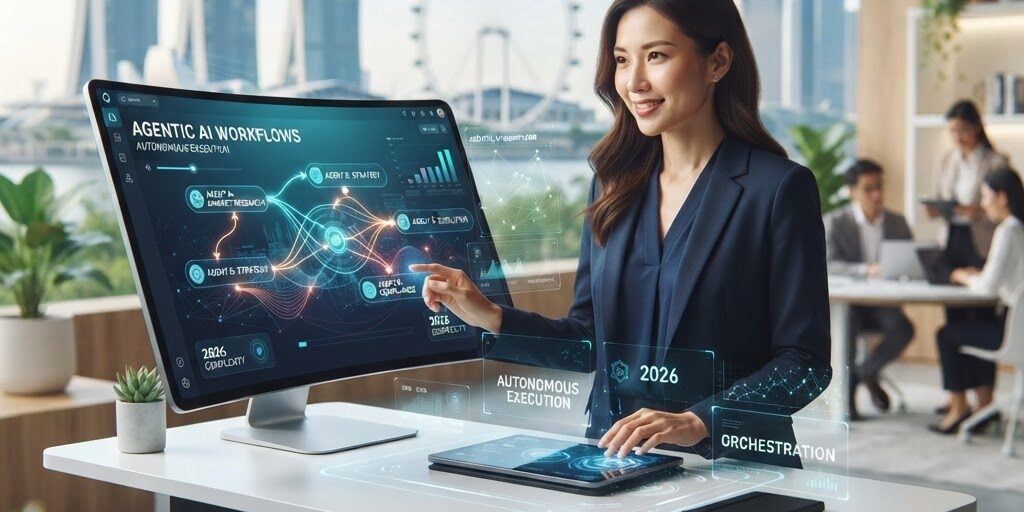
Mastering Agentic AI: The Essential Skill for Singapore’s Workforce in 2026
As we approach 2026, the landscape of professional productivity in Singapore is undergoing a radical transformation driven by the evolution of artificial intelligence. While simple prompt engineering once defined the primary way we interacted with Large Language Models, the current technological trajectory has moved toward autonomous systems. Specifically, agentic AI workflows have emerged as the defining competency for workers across every sector, from finance and logistics to healthcare and creative services. Mastering these systems is no longer an optional curiosity for tech enthusiasts but a foundational requirement for anyone looking to maintain relevance in a competitive digital economy. These autonomous agents do not merely suggest content or summarize data; they proactively plan, execute, and refine complex tasks by linking multiple tools and data streams together. This educational guide explores why these skills are critical, how they function within a business environment, and what steps professionals must take to integrate these advanced workflows into their daily operations. As Singapore continues to push forward as a global innovation hub, the ability to orchestrate these agents will determine individual success and organizational agility. By focusing on the strategic deployment of autonomous AI, the modern workforce can shift from basic administrative execution toward high-level systems design and oversight.
Table of Contents
The Rise of Agentic Systems
The transition from passive chatbots to active, goal-oriented systems marks a significant evolution in software capability. Historically, users had to provide step-by-step instructions for every machine interaction, essentially acting as manual controllers for digital tools. Today, agentic AI workflows allow these systems to evaluate an objective, determine the necessary steps to achieve it, and utilize available software tools to complete the task independently. In an environment like Singapore, where labor efficiency and productivity are paramount, this shift represents a massive opportunity. Autonomous agents can autonomously handle research, data synthesis, and communication loops, providing the human in the loop with finalized outputs rather than raw data. This is particularly significant for sectors that deal with high volumes of repetitive decision-making. By leveraging these agents, teams can reduce the cognitive burden on personnel, allowing them to focus on creative strategy rather than operational maintenance. The underlying architecture of these systems relies on iterative feedback cycles, where the model constantly self-corrects based on the success or failure of its previous actions. This ability to self-monitor is what separates modern agentic workflows from traditional automation scripts. When a script hits a roadblock, it stops; when an agent hits a roadblock, it reformulates its strategy, accesses a different tool, or provides a detailed explanation for why it requires human intervention. This resiliency turns software from a rigid machine into a collaborative partner that grows alongside the organization. Industry experts emphasize that understanding the internal logic of these agents, including their planning phases, tool-calling mechanisms, and memory retention capabilities, is now a prerequisite for professional success. Developing this technical literacy allows employees to delegate complex, multi-stage workflows to AI, freeing up precious time for deep, high-value work.
Designing Efficient Workflows
Effective implementation of agentic AI requires a fundamental shift in how we approach project management. In the past, workflows were linear, static checklists managed by individuals. In an agent-driven environment, the workflow becomes a dynamic process that the AI actively manages according to high-level goals. The secret to success lies in the design of the prompt-based directives and the careful selection of tools connected to the agent. A well-designed workflow starts with clearly defined constraints, such as specific data formats, budget limitations, or regulatory standards common in Singaporean industries. By structuring these constraints within the agent framework, workers can ensure that the AI remains within safe, productive boundaries while exploring different paths toward success. The integration of various software applications, such as CRM systems, document databases, and internal communication platforms, provides the agent with the necessary information to act. Consider the following comparison of traditional versus agent-based execution strategies.
| Metric | Traditional Workflow | Agentic AI Workflow |
|---|---|---|
| Task Scope | Single-action tasks | Complex, multi-stage objectives |
| Tool Interaction | Manual entry | Dynamic API calls |
| Adaptability | Rigid rules-based | Context-aware reasoning |
| Human Effort | Continuous oversight | Goal-based supervision |
Designing these systems effectively demands a mastery of logic and clear communication. The human operator becomes an architect, building the framework within which the agent operates. This involves identifying the right set of tools, defining the success criteria, and monitoring the agent’s performance to refine the prompts periodically. By focusing on modular design, where an agent handles a specific piece of a larger workflow, teams can build complex automated systems that are resilient and easily updated. This method of decomposition ensures that even if one part of the pipeline fails, the overall project can still recover. As workers become more adept at this, they begin to see their workflows as ecosystems of connected intelligent nodes, each contributing to a broader objective. This strategic level of thinking is exactly what the modern Singaporean job market demands. Whether managing logistics supply chains or automated financial auditing, the ability to build, maintain, and optimize these modular, agent-led pathways will determine the efficiency of your professional impact throughout 2026 and beyond.
Integrating into Singapore Sectors
Singapore stands as an ideal testing ground for the widespread adoption of agentic AI due to its high level of digital connectivity and focus on smart nation initiatives. Across industries, from the bustling financial hubs of the Central Business District to the rapidly advancing logistics parks in the west, organizations are beginning to see the value in agentic workflows. In finance, for example, agents are being deployed to monitor regulatory changes in real-time, cross-referencing internal data with external legal databases to ensure compliance. Instead of a team spending days on manual reconciliation, agents perform continuous checks, flagging only the anomalies that require human attention. In the healthcare sector, patient data management and appointment scheduling are becoming increasingly autonomous, allowing practitioners to dedicate more time to direct care. These integrations are not just about speed; they are about precision and reliability. Because agentic systems can work across different languages and platforms, they are particularly well-suited for Singapore’s diverse and multicultural business landscape. They can process inputs in English and provide outputs or actions that align with regional standards. However, the successful integration of these technologies also requires a strong foundation in data governance and security. As we move toward more autonomous operations, ensuring that the agents have access to data without compromising client privacy is a critical hurdle that requires careful planning. Industry professionals are now prioritizing cybersecurity as an integral part of the workflow design phase rather than an afterthought. This holistic approach ensures that as companies accelerate their automation, they do not create new vulnerabilities. By fostering an environment where innovation is matched with security, Singapore can lead the charge in the ethical and effective implementation of AI systems, creating a sustainable model for the rest of the world to follow. The goal is to create a seamless interplay between human expertise and machine scalability.
Future-Proofing Your Career
Looking toward the future, the value of the human worker will increasingly lie in the ability to orchestrate complexity. In a world where basic administrative and analytical tasks are handled by autonomous agents, the core skills of a successful professional will center on ethical judgment, strategic creative direction, and advanced problem-solving. Future-proofing your career in the era of agentic AI means embracing a mindset of continuous learning. It is not sufficient to simply understand how a specific tool works today, as these tools are evolving at a breakneck pace. Instead, you must focus on understanding the fundamental principles of agentic behavior—how these models reason, how they use tools, and how they manage their internal state. By mastering these concepts, you become tool-agnostic, capable of adapting to new platforms as they emerge. Furthermore, developing a strong sense of personal agency is essential. You must become a manager of agents, taking on a role that requires you to define clear outcomes and interpret the nuanced feedback these systems provide. In this new professional paradigm, the people who provide the best instructions, set the most robust objectives, and verify the outcomes with the most rigor will be the most valuable members of any organization. Think of yourself as an editor-in-chief for a team of invisible, ultra-fast researchers and implementers. Your influence grows not through the volume of work you perform manually, but through the scale of the operations you can direct. As businesses shift their investment toward those who can manage AI, the career landscape will favor those who have transitioned from being individual contributors to being systemic architects. Staying curious, experimenting with emerging agentic frameworks, and remaining committed to professional development will be your best defenses against the volatility of the labor market in the coming years.
In summary, mastering agentic AI is the defining challenge and opportunity for the workforce in 2026. By moving beyond simple prompts and into the domain of autonomous workflows, professionals in Singapore can unlock unprecedented levels of productivity and strategic insight. These systems are not merely tools; they are the new infrastructure of the modern workplace, capable of transforming how we interact with technology and how we define value. As we embrace these autonomous agents, we must also embrace the responsibility of managing them with precision, ethics, and a clear vision. The transition to agentic workflows is an exciting evolution, marking a new chapter in the digital journey of our nation. By investing in these skills today, you are securing your role in the economy of tomorrow. Start by experimenting with agent-based platforms, study the underlying logic of autonomous decision-making, and focus on your unique human contribution to the systems you design. The future belongs to those who learn to lead the machines.
Frequently Asked Questions
- What is the main difference between prompt engineering and agentic AI? Prompt engineering is about crafting specific inputs to get a single output, while agentic AI involves setting a high-level goal and letting the system plan and execute multiple steps autonomously.
- How can workers in Singapore start learning these skills? Start by exploring open-source agent frameworks and attending workshops that focus on AI orchestration rather than just basic chatbot interactions.
- Are these systems secure to use in professional settings? Security depends on your implementation; always ensure data is handled through secure APIs and that sensitive information is properly scrubbed or isolated from agent access.
- Will agentic AI replace human jobs? It will change jobs, automating routine tasks and shifting the focus to high-level oversight, strategy, and creative problem-solving, which remain human-exclusive domains.
- How do I measure the success of an agentic workflow? Success is measured by the quality of the final output, the efficiency gains in time, and the reduction in human error compared to traditional manual processes.