
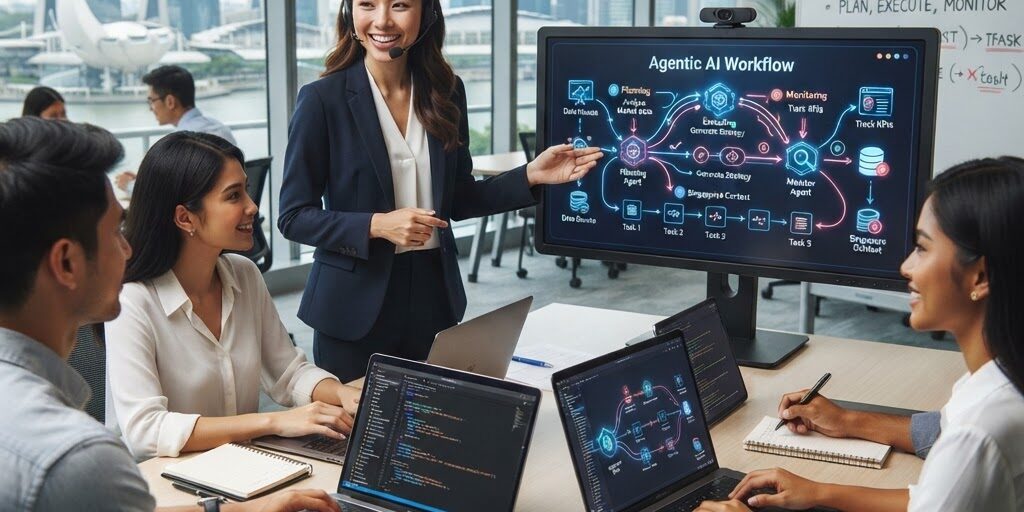
Beyond Prompting: Mastering Agentic AI Workflows for Singapore Professionals
The rapid evolution of artificial intelligence has moved beyond simple chat-based queries. As we navigate the professional landscape in August 2026, the industry is transitioning from static prompt engineering to dynamic, autonomous Agentic AI. For Singapore professionals aiming to remain competitive, understanding this shift is no longer optional; it is essential. Seeking quality agentic AI training Singapore programs is the primary step toward bridging the gap between basic automation and sophisticated, goal-oriented machine intelligence. Agentic AI is defined by its ability to break down complex business objectives into manageable sub-tasks, execute them sequentially, and iterate based on real-time feedback. Unlike traditional chatbots that require constant human hand-holding, these agents possess a degree of autonomy that allows them to perform multi-step operations independently. This transformation demands a new set of skills, focusing on orchestration, system architecture, and robust workflow integration. By mastering these autonomous frameworks, local businesses can significantly enhance productivity, reduce human error, and unlock new avenues for digital growth. This guide explores the core principles of agentic workflows and explains how you can prepare your career for this inevitable technological shift within the highly competitive Singaporean market.
Table of Contents
Understanding the Agentic Shift
The transition from Large Language Models acting as passive assistants to Agentic AI marks a monumental paradigm shift in software capabilities. Previously, professionals spent their time perfecting prompts to get a single, accurate output. Today, the focus has shifted toward building systems that reason, plan, and act. In Singapore, where efficiency and high-output environments are the standard, these agents serve as force multipliers. An autonomous agent is designed to receive a high-level goal, such as conducting a comprehensive market research report or managing a multi-channel digital marketing campaign, and then independently determine the steps required to achieve that result. This involves active web searching, data synthesis, file management, and tool interaction without constant manual intervention. Understanding this shift requires a departure from simple input-output thinking. Instead, professionals must embrace a systems-thinking approach. Industry experts emphasize that the core competency of the future is the ability to construct the environment in which these agents thrive. This includes setting clear constraints, providing access to necessary APIs, and creating rigorous verification loops to ensure quality control. By moving beyond basic prompting, you are effectively shifting your role from a task executor to an orchestrator of digital intelligence. This shift is particularly critical for Singaporean industries such as finance, logistics, and professional services, where complex, data-heavy workflows can be automated with precision. The training landscape in the region is responding to this demand by offering specialized modules that cover the nuances of agent lifecycle management, security protocols, and integration strategies. Embracing the agentic shift means accepting that your job is no longer just typing queries, but building, testing, and scaling systems that think for themselves while operating safely within the defined boundaries of your organization.
Architecting Autonomous Business Workflows
Successful implementation of agentic AI requires a deep understanding of architecture. It is not enough to simply deploy an off-the-shelf model; one must design a workflow that is resilient, scalable, and audit-ready. In a professional context, this means defining the scope of an agent, its access to proprietary data, and the triggers that cause an agent to pause for human oversight. The architecture of a modern AI workflow is best visualized as a loop of perception, reasoning, and action. First, the agent perceives the current state of a business process, such as a pending client invoice or an unclassified support ticket. Second, it uses its reasoning capabilities to plan the next logical step based on internal logic and external data. Finally, it executes the action, often interacting with other software tools through APIs. To facilitate this, professional training now includes deep dives into orchestrator frameworks that manage multiple agents working in tandem. Imagine a system where one agent researches client feedback while another drafts a personalized response, and a third conducts a sentiment analysis to ensure brand compliance. This requires a robust infrastructure to prevent conflicting actions and data silos. The table below outlines how traditional versus agentic workflows differ in daily practice for Singapore professionals. Table 1: Comparison of Operational Paradigms. Table columns include Operational Component, Traditional Prompting, and Agentic Workflow. Rows represent Task Planning, Tool Access, Execution Cycle, and Human Input. Traditional tasks are manual, static, and intermittent. Agentic tasks are autonomous, iterative, and persistent. By learning to structure these workflows properly, you ensure that your AI systems do not just execute, but also continuously improve their performance through internal feedback mechanisms and better prompt chaining strategies that lead to superior organizational efficiency.
| Operational Component | Traditional Prompting | Agentic Workflow |
|---|---|---|
| Task Planning | Human determined | Agent autonomous planning |
| Tool Access | Limited manual access | Dynamic API integration |
| Execution Cycle | Single turn | Multi-step loop |
| Human Input | Constant supervision | Strategic oversight |
Technical Mastery and Task Decomposition
Technical mastery in the age of agentic AI revolves around the ability to perform precise task decomposition. This is the process of breaking down a complex, nebulous business goal into granular, executable instructions that an AI model can parse and act upon without confusion. In many training environments across Singapore, this is taught as the cornerstone of effective agent design. Without clear decomposition, agents can experience hallucinations, drift from their objectives, or fail to complete critical steps. Mastery involves learning how to structure tasks logically so that the AI can anticipate dependencies. For instance, if an agent is tasked with financial modeling, it must first decompose the task into data acquisition, data cleansing, model selection, and reporting. The expert approach is to provide enough structure for the agent to be efficient while maintaining enough flexibility to allow it to solve novel problems that arise during the process. Furthermore, understanding the technical stack—such as vector databases for memory and RAG architectures for context—is vital. Professionals must become comfortable with the concept of long-term memory for agents, allowing them to retain information across sessions, which is a significant improvement over the stateless nature of standard chat interfaces. This technical proficiency enables you to monitor the agent’s internal thought process, debugging its reasoning path when errors occur. By understanding how the model arrives at a specific conclusion, you can adjust the constraints and parameters to prevent future failures. This level of technical oversight is highly sought after by firms looking to implement autonomous research, automated procurement, and intelligent administrative support systems. It is the bridge between amateur experimentation and enterprise-grade reliability, ensuring that agentic workflows become a staple of your organizational capabilities rather than just a fleeting pilot program with limited real-world application or long-term business impact.
Future-Proofing Your Singapore Career
As we look toward the later part of the decade, the ability to work alongside autonomous agents will become a defining trait of the high-value workforce in Singapore. Future-proofing your career requires a proactive approach to continuous learning and the willingness to pivot from content creation to system architecting. The local government and industry bodies are heavily investing in digital literacy programs that prepare workers for this automated future. By engaging in formal agentic AI training Singapore, you position yourself as a leader who can bridge the gap between technical potential and tangible business value. The goal is to move past the novelty of generative tools and start solving deep, structural inefficiencies in your workplace. Professionals who understand how to deploy agents to manage routine data entry, complex scheduling, or multi-faceted reporting will become indispensable assets. Moreover, this expertise allows you to become an internal advocate for AI safety and ethics, ensuring that your organization’s transition to autonomous systems is secure and compliant with local regulations. The shift towards agentic workflows is not just about replacing manual labor; it is about augmenting human potential to focus on high-level strategy, empathy, and creative problem-solving. This is the essence of professional development in 2026. As the technology matures, expect to see even more sophisticated integration between personal AI agents and broader organizational ecosystems. By investing in your skills now, you ensure that you remain ahead of the curve. Developing these competencies involves a commitment to understanding not just the current state of technology, but also the underlying patterns of how autonomous systems learn and adapt. This will keep you competitive, adaptable, and highly relevant as the professional environment continues to evolve toward an increasingly automated, intelligent, and agentic future for everyone.
In summary, the transition to Agentic AI represents a significant leap forward in workplace productivity. By moving beyond basic prompting and focusing on task decomposition, architectural design, and system orchestration, Singapore professionals can harness the power of autonomous agents to transform their workflows. These tools provide unparalleled efficiency, allowing you to focus on high-value, strategic work while the AI manages the complexities of execution. The future of work is not manual—it is agentic. By choosing to master these workflows today, you are future-proofing your career and contributing to the technological advancement of your industry. Whether you are an individual contributor or a leader, the capacity to orchestrate AI agents will be the most valuable skill set in the coming years. Start your training journey now to ensure you stay ahead in this dynamic landscape.
Frequently Asked Questions
What is the main difference between a chatbot and an autonomous agent? A chatbot responds to input, while an autonomous agent plans, acts, and iterates to meet a goal.
Why is agentic AI important for Singaporean businesses? It enables higher productivity, better data management, and the ability to scale complex operations with fewer manual interruptions.
Do I need coding skills for agentic AI training? While basic coding helps, modern low-code frameworks make it accessible for non-technical professionals to build sophisticated workflows.
How can I find reliable training in Singapore? Look for reputable institutions and industry-recognized certifications that focus on practical, hands-on implementation of AI systems.
Is AI training a one-time process? No, the technology evolves rapidly; professionals should expect to engage in continuous learning to stay updated with new model capabilities and safety protocols.
