Beyond Prompting: How to Master Agentic AI for Professional Workflows
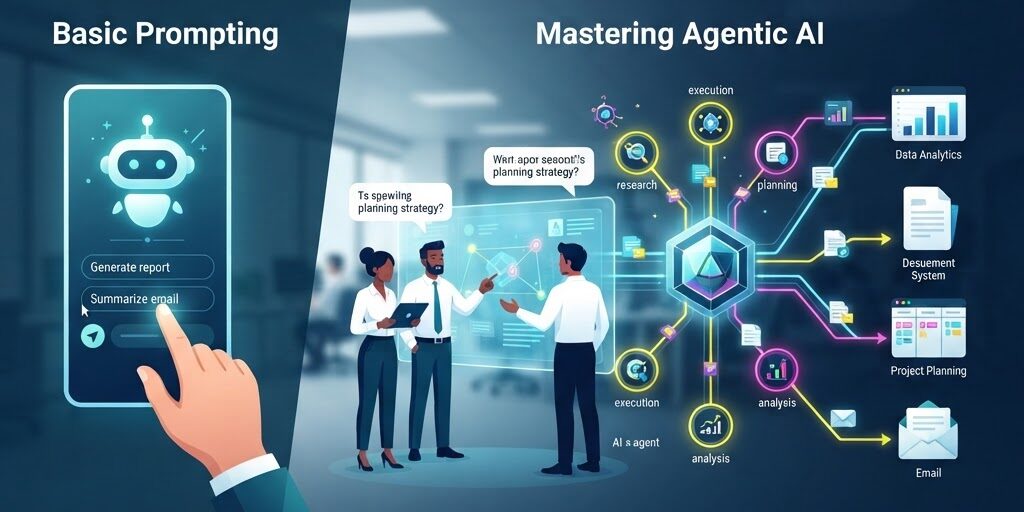
As we transition into the latter half of 2026, the landscape of artificial intelligence is undergoing a profound transformation. We are moving away from the era of simple, reactive chatbots toward a sophisticated paradigm known as agentic AI. Professionals who wish to stay relevant must now focus on agentic AI training to manage systems that do not just respond to prompts but actively plan, execute multi-step business tasks, and integrate seamlessly into complex operational workflows. Unlike the passive tools of the past, these autonomous agents operate with agency, making decisions and navigating software ecosystems independently to achieve defined organizational outcomes. This shift represents a fundamental change in how we conceptualize productivity, moving from human-in-the-loop interaction to human-as-orchestrator. By mastering these technologies, you can shift your role from tactical execution to high-level strategic oversight, effectively scaling your output through autonomous digital support. Understanding this evolution is no longer optional for forward-thinking professionals; it is the cornerstone of modern professional development in an increasingly automated and interconnected global business environment, ensuring that your workflows remain efficient, scalable, and fully optimized for long-term success.
Table of Contents
Understanding Agentic Systems
Agentic AI represents a massive leap in how software interprets intent. In traditional AI models, a user provides a prompt, and the model provides a static output based on its training data. Agentic systems, however, utilize recursive loops, memory management, and external tool usage to achieve a goal that might require ten or twenty distinct actions. Training your brain to think in terms of agentic processes requires shifting from a writer’s mindset to an architect’s mindset. When you engage with an agent, you are essentially setting the parameters for a digital employee. You define the objective, the constraints, and the success metrics, and the agent determines the necessary steps to get there. This requires a deep understanding of task decomposition. You must learn how to break down high-level business goals into logical, sequential sub-tasks that an AI can handle without error. Industry experts suggest that the most successful professionals will be those who can audit a complex workflow and identify which segments are ripe for autonomous handoff. This transition is not about learning new coding languages; it is about learning how to communicate intent clearly and structure problems so that an autonomous system can execute them effectively. By practicing iterative testing of these systems, you gain a sense of the current capabilities and, more importantly, the limitations of agentic architectures. Understanding how these systems interpret logic and handle failures is essential for any professional looking to leverage them effectively in their daily tasks. As we move forward, the ability to act as a project manager for AI agents will become a defining skill in every professional sector, bridging the gap between intent and automated execution in ways that were previously unimaginable for human workers alone.
The Strategic Implementation
Once you have grasped the fundamental nature of agentic AI, the next challenge is strategic implementation. Integrating agentic AI training into your professional workflow involves identifying the bottlenecks in your daily operations that require multi-step execution. For instance, data analysis, report generation, and lead qualification are all tasks that involve fetching data, formatting it, and distributing it—a perfect use case for autonomous agents. To implement this, you must build a framework where agents work in tandem with existing software tools. You need to create clear boundaries and verification protocols that ensure the agent’s performance aligns with organizational goals. A common pitfall is giving agents too much freedom without appropriate oversight. Professionals must implement a structure of check-ins, validation points, and human-in-the-loop overrides. The implementation process should be viewed as a phased integration. You start by assigning the agent one small, repeatable task. Once the agent demonstrates consistent performance, you gradually increase its scope of influence. Below is a comparison table that highlights the differences between manual workflows, standard AI assistance, and agentic AI integration for business environments:
| Feature | Manual Workflow | Standard AI Assistance | Agentic AI |
|---|---|---|---|
| Task Execution | Human-driven | Human-prompted | Autonomous planning |
| Tool Interaction | Direct software use | Copy-paste data | API-based interaction |
| Multi-step capacity | Sequential manual | Limited chat scope | Recursive problem solving |
| Maintenance | High effort | Moderate effort | Low oversight |
By utilizing this strategic approach, you ensure that you are not just adopting technology for the sake of novelty, but creating actual value for your organization while minimizing technical debt. The key is to document the process as you build it, allowing you to troubleshoot and optimize your agents over time as they become more refined in their output delivery and task management capabilities within your professional ecosystem.
Managing Autonomous Workflows
Managing agentic workflows requires a distinct set of operational skills focused on observability and debugging. Unlike managing a human team, you are dealing with a logical system that can encounter unexpected state changes when interacting with external APIs or software interfaces. Effective management begins with setting up robust logging and telemetry so that you can see exactly where an agent succeeded or failed in its execution path. This is vital for long-term reliability. You must also become proficient in prompt engineering at a functional level—a technique that involves shaping the behavioral environment in which the agent makes its decisions. This includes defining the toolset available to the agent and the specific constraints of the environment, such as budget, time, or data privacy requirements. Industry experts emphasize the necessity of maintaining a secure environment when agents are given autonomy, especially regarding data access. You must understand the security protocols of the systems you are connecting to your agents to prevent accidental data leaks or unauthorized executions. As your collection of agents grows, you will likely face the challenge of orchestration. This means managing multiple agents that might perform different parts of a larger project and ensuring their outputs are compatible. The process of managing these workflows is inherently iterative. You will frequently adjust the agent’s logic, improve its internal instructions, and refine the tools it can access. This creates a cycle of improvement where your professional output gets faster and more accurate with each passing week. Ultimately, managing autonomous workflows is about creating a predictable environment in an unpredictable technical space, ensuring that you maintain full control over the quality and direction of the outcomes produced by your digital assistants during your standard work hours.
Future-Proofing Your Career
The future of work is undeniably leaning toward an agentic-first model, making agentic AI training the most important investment you can make for your career growth. As corporations begin to realize the efficiency gains of deploying autonomous agents, the job market will shift toward roles that emphasize oversight, technical fluency, and complex orchestration. To future-proof your career, you must cultivate a portfolio of successful agentic deployments. Document your experiences in deploying agents to solve specific business problems and share these insights with your peers. This builds a reputation as an expert in the field of autonomous systems. It is also important to maintain a healthy skepticism and a critical eye. AI systems can hallucinate, encounter logical errors, or face API failures, and being the person in the room who can identify these issues and propose a solution is invaluable. Stay informed about the latest advancements in agentic architecture, as the field is evolving rapidly with new libraries, frameworks, and interaction patterns emerging constantly. Networking with other professionals who are actively building these workflows can provide you with early access to best practices and shared knowledge that you would otherwise have to learn the hard way. Remember, the goal is not to be replaced by an agent but to lead them. By positioning yourself as the architect and overseer of these intelligent systems, you ensure that you remain the central figure in your organization’s productivity chain. As technology continues to integrate into the fabric of daily business, your ability to blend human creativity with autonomous logic will be the distinguishing factor that keeps your career trajectory on an upward path, regardless of the broader shifts in the global job market or the continuous evolution of hardware and software platforms.
In summary, the transition to agentic AI requires a fundamental shift in mindset from manual doer to strategic architect. By embracing agentic AI training, you are learning to harness the power of autonomous systems to scale your efforts, reduce mundane workloads, and increase your focus on high-value, creative decision-making. As these technologies mature, your ability to orchestrate agents effectively will become the defining characteristic of a successful, modern professional. Start by small-scale experiments, prioritize security and observability, and always maintain your human oversight. The agents are here to support your goals, and with the right strategy, you will be well-prepared to navigate the complexities of the automated future with confidence and professional success.
Frequently Asked Questions
What is the primary difference between a chatbot and an agentic AI? Chatbots are reactive and focus on conversation, while agents are proactive and designed to execute complex, multi-step tasks independently.
Do I need to be a programmer to use agentic AI tools? No, you do not need to be a programmer, though understanding logical flow and API interactions is highly beneficial for professional results.
How can I ensure the safety of my business data when using agents? Always use authorized, secure platforms that provide clear data privacy policies and allow you to define strict access permissions for your agents.
How long does it typically take to learn agentic workflows? It depends on your current technical familiarity, but professionals can usually begin building and deploying basic agents within a few weeks of consistent training.
What is the future of agentic AI in the workplace? It is expected to evolve into a standard workplace requirement where professionals manage ‘digital departments’ of agents to handle routine administrative and analytical tasks.