
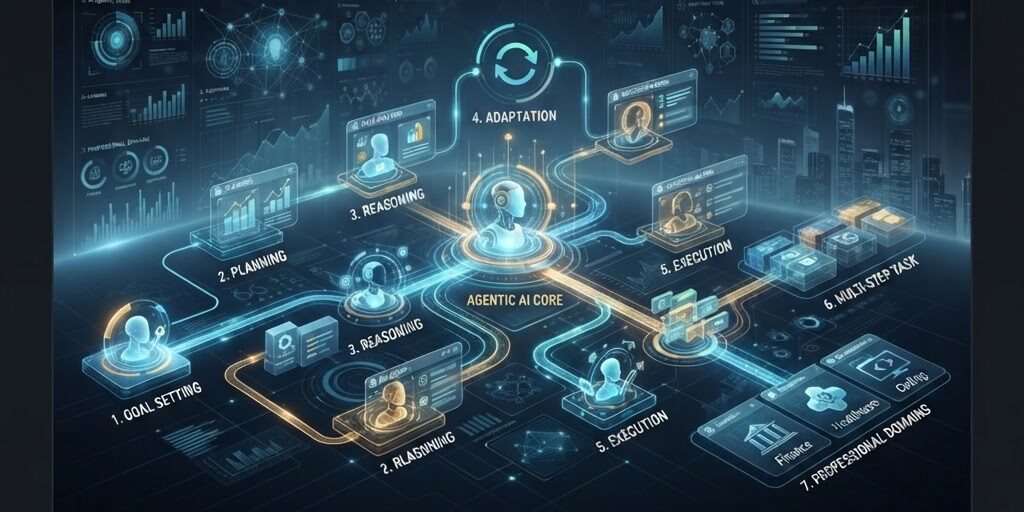
Mastering AI Agentic Workflows: A 2026 Guide to Practical AI Training
The landscape of artificial intelligence is undergoing a profound transformation as we move beyond simple chatbot interactions into the era of AI agentic workflows. By 2026, industry experts recognize that true productivity gains no longer stem from crafting perfect prompts but from orchestrating autonomous systems capable of reasoning, adapting, and executing multi-step objectives. These advanced workflows allow software to act as intelligent participants in complex professional domains, bridging the gap between intention and execution. For organizations looking to remain competitive, mastering the implementation of these autonomous frameworks is the primary objective of modern AI training initiatives. Unlike traditional automation, which relies on rigid scripts, agentic models utilize iterative feedback loops to refine their decision-making processes in real-time. This guide explores the foundational components required to design, deploy, and scale these systems, ensuring that your team is prepared to harness the full potential of goal-oriented technology. Understanding how to define task boundaries while maintaining human oversight remains critical for ethical and efficient deployment in an increasingly automated world. Let us explore the technical and strategic pillars required to build robust infrastructures that leverage the autonomous capabilities of modern artificial intelligence engines today.
Table of Contents
Architecting Autonomous Systems
Architecting autonomous systems requires a fundamental shift in how developers and operators conceptualize digital labor. In the context of AI agentic workflows, the architecture is not a static linear pipeline but a dynamic web of interconnected processes that share a common context. To build these systems, industry experts recommend focusing on modularity, where specific modules handle distinct capabilities such as data retrieval, logical analysis, or external tool execution. By compartmentalizing these tasks, the system becomes more resilient to errors, as an issue in one node does not necessarily lead to the total collapse of the entire objective. A major part of this architecture is the state machine or controller, which serves as the brain that directs the flow of operations based on the input received at each stage of the task. Modern training frameworks emphasize the importance of context windows, memory management, and persistent storage, allowing agents to retain historical data and learn from previous iterations to improve future outcomes. Furthermore, safety protocols must be hard-coded into the architecture to ensure that the agent remains within defined guardrails while pursuing its goals. This involves implementing verification checks where the agent must confirm its proposed actions with a human operator or a secondary validation layer before triggering high-impact changes. As we move through 2026, the industry is increasingly moving toward open-source frameworks that facilitate the rapid assembly of these components. By standardizing the way agents communicate with internal databases and external APIs, developers can reduce technical debt while increasing the speed of iteration. Ultimately, a well-architected autonomous system is one that balances the autonomy of the machine with the strategic direction provided by its human overseers, creating a symbiotic environment where complex, multi-step tasks are completed with unprecedented accuracy and efficiency in any given professional setting.
Designing Effective Feedback Loops
The design of effective feedback loops is perhaps the most critical element in mastering AI agentic workflows. Without robust mechanisms for evaluating performance, an agent may drift away from its intended goal, leading to inefficiency or undesirable output. Industry experts utilize iterative refinement as a core training methodology, where every stage of an agent’s task is monitored against a set of key performance indicators. When the agent completes a sub-task, the system analyzes the result against predefined quality benchmarks and then feeds this information back into the reasoning module. If the output fails to meet the criteria, the agent is programmed to self-correct, re-evaluating its previous decisions and attempting alternative pathways until success is achieved. This iterative approach mimics human critical thinking, allowing the system to learn and adapt to changing conditions in real-time. To illustrate how these loops function within a professional environment, consider the following comparison of traditional versus agentic processes:
| Feature | Traditional Automation | AI Agentic Workflow |
|---|---|---|
| Decision Making | Fixed, Rule-Based | Dynamic, Heuristic |
| Correction | Manual intervention | Automated Self-Correction |
| Flexibility | Low | High |
| Goal Orientation | Process-focused | Outcome-focused |
Implementing these feedback loops requires specialized training in prompt engineering combined with system logic design. Operators must learn how to articulate goals clearly while providing the agent with the necessary constraints to prevent hallucinations or redundant loops. By establishing clear success metrics early in the configuration phase, organizations can minimize the risk of the agent becoming caught in infinite loops or chasing incorrect variables. In 2026, the trend is moving toward reinforcement learning from human feedback, where agents are rewarded for outcomes that align with business objectives, gradually improving their performance over time. This continuous learning cycle ensures that the agent becomes increasingly adept at navigating the nuances of its assigned domain, thereby reducing the need for constant supervision and allowing human personnel to shift their focus toward higher-level strategic analysis rather than simple execution or manual error mitigation.
Integrating AI Agents Into Professional Workflows
Integrating AI agents into professional workflows requires a meticulous approach to change management and technical deployment. The primary challenge is not the intelligence of the model itself, but how well that intelligence is harnessed within the existing corporate infrastructure. Industry experts recommend starting with narrow, high-value tasks that have clearly defined inputs and outputs before expanding the agents’ scope. For instance, in data-heavy sectors like finance or logistics, an agentic workflow can be designed to monitor real-time market changes, synthesize reports, and execute low-risk hedging maneuvers autonomously. This integration strategy relies on the secure handling of APIs and internal data bridges, ensuring that the agents operate within a controlled and authenticated environment. Security and privacy are paramount when integrating these technologies; therefore, every agent should operate under the principle of least privilege, with access restricted to only the data points necessary for its specific function. Furthermore, the human-in-the-loop component is essential during the rollout phase. By maintaining a monitoring dashboard, human operators can oversee the agents’ activities in real-time, intervening if the logic deviates from the intended trajectory. This phase also involves training staff members to communicate effectively with the agents, treating them not just as tools, but as specialized teammates that require clear directives and context to perform at their best. As the organization gains confidence, the scope can be scaled up to include more complex cross-departmental operations, such as supply chain management or client relationship optimization. By emphasizing documentation and transparency during the integration process, teams can build a culture of trust and competence, ensuring that the adoption of AI agentic workflows provides a sustainable competitive advantage while minimizing operational friction and maintaining organizational compliance with industry standards and regulations.
Future Scaling Strategies for AI Operations
Scaling AI agentic workflows into the future requires an eye for sustainability and long-term infrastructure planning. As organizations move from experimental pilots to full-scale enterprise deployment, the focus must shift from individual agent performance to the efficiency of the entire agentic ecosystem. This involves deploying a multi-agent structure where specialized agents collaborate on singular, massive projects by dividing the workload according to their specific strengths. For example, one agent might be responsible for data extraction, another for sentiment analysis, and a third for final communication drafting, with a central orchestrator managing the flow of tasks between them. This division of labor not only increases throughput but also enhances system robustness, as any individual agent can be swapped or updated without affecting the entire workflow. To facilitate this, IT departments must invest in scalable cloud infrastructure that can handle the increased computational load and latency requirements associated with concurrent agentic operations. Additionally, monitoring the total cost of intelligence, or the ratio of operational expense to the value generated, becomes a vital metric for decision-makers. In 2026, industry experts emphasize the move toward decentralized intelligence, where edge computing allows agents to process data locally, reducing latency and improving privacy. By optimizing these workflows for scale, companies can transition from simple automation to a state of autonomous business intelligence. The key to successful scaling lies in establishing robust governance frameworks that ensure consistency across all departments. By documenting best practices, automating deployment pipelines, and continuously assessing the performance of the agentic workforce, organizations can create a resilient model that thrives on complexity. Looking ahead, the synergy between human creativity and autonomous execution will define the next phase of industrial evolution, making the mastery of these workflows a mandatory competency for leadership in the digital age.
Conclusion
Mastering AI agentic workflows is the defining challenge for professionals in 2026. By moving beyond rigid automation and embracing autonomous, goal-oriented systems, organizations can unlock new levels of efficiency and strategic depth. The transition involves a deep commitment to architecture, iterative feedback loops, careful integration, and future-proof scaling strategies. While the technical requirements are rigorous, the outcome is a highly responsive and capable digital workforce that allows human talent to flourish in areas requiring empathy, intuition, and high-level strategy. As we continue to refine the way humans collaborate with intelligent agents, the focus must remain on ethical implementation and the pursuit of outcomes that provide tangible value. By prioritizing training and governance today, your team will be well-positioned to lead in an environment where autonomous intelligence is no longer a luxury, but the standard for operational excellence and innovation.
Frequently Asked Questions
1. What distinguishes AI agentic workflows from traditional automation? Traditional automation relies on pre-programmed scripts that cannot adapt to change. Agentic workflows use AI to reason, learn from feedback, and make autonomous adjustments to achieve goals.
2. Why is human-in-the-loop essential for these workflows? Humans act as the strategic supervisors who define objectives, verify accuracy, and intervene in the agent’s decision-making process to ensure safety and alignment with organizational goals.
3. How do I start implementing AI agents in my organization? Begin by identifying high-value, repetitive tasks with clear success metrics. Start small with a controlled pilot before scaling to more complex, cross-departmental operations.
4. What are the main security risks with agentic systems? Risks include unauthorized data access and the potential for agents to follow unintended logic paths. Mitigate these through strict authentication, role-based access, and constant monitoring.
5. Will agentic workflows replace human roles? Rather than replacement, these workflows are designed to augment human potential by automating routine tasks, allowing professionals to focus on high-level decision-making and creative problem-solving.
