Mastering Agentic AI: The Essential Skill for Singapore’s Evolving Workforce
As the Singaporean economy reaches a pivotal point in 2026, the local workforce is experiencing a transformation unlike any previous industrial revolution. The era of basic generative AI tools that require constant human prompting is rapidly fading. In its place, the market has pivoted toward the adoption of Agentic AI. For professionals navigating this competitive landscape, mastering Agentic AI skills is no longer just an optional advantage; it has become the fundamental prerequisite for career longevity. Agentic AI refers to autonomous systems capable of reasoning, planning, and executing complex workflows without needing constant oversight. These agents can manage multi-step processes, analyze vast datasets, and iterate on solutions to meet specific business objectives. As companies across the Lion City push for deeper operational efficiency, employees who can design, monitor, and refine these autonomous workflows are finding themselves in high demand. This article explores how you can acquire the necessary expertise to thrive in this high-tech environment, focusing on practical implementation, strategic oversight, and the evolving nature of digital collaboration between human workers and sophisticated machine agents in Singapore’s fast-paced digital ecosystem.
Table of Contents
Understanding the Shift to Agentic AI
The transition from static chatbots to dynamic agents represents a massive shift in how Singaporean industries approach technology. Traditional generative AI required a human to provide a detailed prompt, receive an output, and then manually act upon that output. Agentic AI changes the paradigm entirely by allowing the software to possess agency. It defines its own sub-tasks, retrieves information from various software silos, evaluates its progress, and makes autonomous decisions to reach a designated goal. This level of sophistication is critical for local businesses that need to scale operations in an increasingly tight labor market. Industry experts observe that these agents are being deployed in departments ranging from finance and logistics to customer support and software engineering. When an agent manages a workflow, it reduces the risk of human error in repetitive tasks while freeing up human capital to focus on higher-level strategic decisions. Understanding this technology involves more than just knowing how to operate a tool; it requires a conceptual shift in how we perceive the relationship between man and machine. You must learn to act as an architect of these systems, setting the boundaries, guardrails, and desired outcomes. By shifting your perspective from being a task-executor to a workflow-manager, you align yourself with the trajectory of the modern digital economy. The capability to oversee these autonomous agents ensures that you remain relevant even as software assumes more of the tactical load. In Singapore, where productivity is the backbone of national growth, mastering the nuances of autonomous systems provides a competitive edge that is nearly impossible to replicate through traditional skill-building methods. As we move through 2026, those who view Agentic AI as a partner rather than a replacement will set the standard for future institutional success and personal professional growth across the entire local corporate landscape.
Essential Agentic AI Skills for Modern Professionals
Acquiring Agentic AI skills requires a combination of technical literacy and systemic thinking. Professionals must first learn to design clear, goal-oriented workflows that agents can follow. This involves breaking down complex business requirements into logical, sequential steps that the agent can digest. If the logic is flawed, the agent’s execution will inevitably fail, regardless of how advanced the underlying model may be. Furthermore, you need to develop proficiency in data integration. Autonomous agents are only as good as the information they can access. You will need to learn how to connect these agents to secure internal databases, cloud platforms, and external APIs to ensure they have the real-time data needed to make informed decisions. A crucial part of this skill set is prompt engineering that includes logic chains and chain-of-thought processing, which guides the agent through complex reasoning paths. You should also become familiar with basic monitoring tools that track agent performance, ensuring that these systems remain within safety guidelines and ethical frameworks. The following table illustrates the core competencies required for workers aiming to master these systems:
| Core Competency | Description | Impact on Productivity |
|---|---|---|
| Workflow Architecture | Defining sequence logic for agents | Massive reduction in manual task time |
| Data Connectivity | Linking agents to enterprise APIs | Improved decision accuracy |
| AI Monitoring | Tracking agent error rates | Enhanced operational reliability |
| Prompt Logic | Designing chain-of-thought tasks | Faster goal achievement |
Beyond technical capability, you must develop a mindset that embraces constant iterative improvement. Because Agentic AI learns from feedback loops, the ability to analyze an agent’s failure and adjust its operating parameters is highly valuable. This is the difference between an employee who simply uses tools and one who optimizes them. By fostering these abilities, you become a bridge between the technical developers who build the agents and the business leaders who need them to function perfectly. This unique position makes you an invaluable asset to any Singaporean firm looking to scale their digital transformation efforts.
Integrating Agentic AI into Existing Workflows
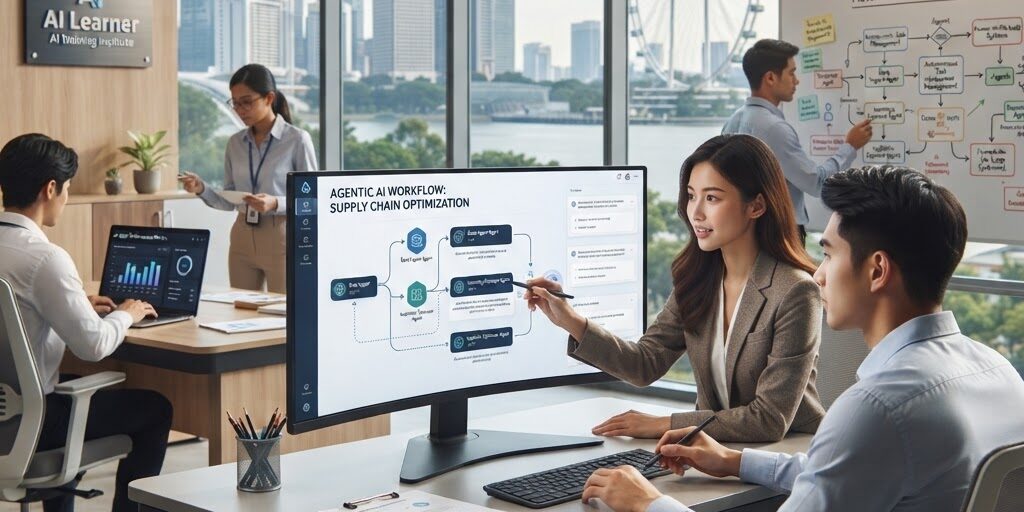
Integrating autonomous agents into the corporate environment requires a structured approach that avoids disruption while maximizing efficiency. The first step involves an audit of existing operational processes to identify which tasks are repetitive, rule-based, and data-intensive. These are the prime candidates for automation via Agentic AI. Once a task has been identified, you must map the workflow out, ensuring that all human-in-the-loop checkpoints are clearly defined. In industries like logistics and supply chain, for example, agents can be tasked with monitoring stock levels across multiple warehouses, triggering purchase orders, and alerting managers only when specific anomalies arise. This keeps the worker focused on exceptions rather than routine maintenance. Integrating these agents also means ensuring that they communicate properly with existing legacy systems. You need to understand how to bridge the gap between modern cloud-based AI agents and older, on-premise software. This requires knowledge of integration platforms and security protocols. Maintaining the integrity of corporate data is paramount in the Singaporean business environment, where regulatory compliance is strictly enforced. As you implement these workflows, always consider the impact on the broader team. Change management is just as important as technical integration. Ensure that colleagues understand that these agents are designed to handle the heavy lifting, allowing the humans to exercise creativity and empathy. Successful integration is a delicate balance of technical configuration and human-centric design. By focusing on scalability and security, you create a foundation for a truly automated workplace. Industry experts emphasize that companies failing to integrate these agents into their workflows risk falling behind in global competitiveness. Those who lead these integration efforts within their teams will find themselves in a strategic position to influence the adoption of future technology, solidifying their importance within the organizational structure for years to come.
Future-Proofing Careers in a Competitive Market
In the evolving Singaporean labor market, future-proofing your career is synonymous with cultivating a deep understanding of human-agent collaboration. The most valuable professionals of the coming decade will not be those who can do the work of a computer, but rather those who can lead teams of computers to do the work of a department. This shift requires you to constantly update your knowledge base as the capabilities of Agentic AI expand. You must stay abreast of the latest advancements in LLMs, autonomous reasoning agents, and ethical AI deployment. Continuous learning is essential in a field that changes at such a rapid pace. Participating in industry forums, attending training sessions, and engaging with peers in the Singaporean technology space will help you understand the emerging standards for agent behavior and performance metrics. Furthermore, focus on developing the soft skills that AI cannot replicate: critical thinking, ethical judgement, empathy, and high-level strategy. These are the components of your professional value proposition that will differentiate you from any autonomous system. While agents can crunch numbers and execute tasks, they lack the cultural context and emotional intelligence required for complex human leadership and high-stakes negotiation. By combining your technical proficiency in Agentic AI with your inherent human traits, you create a hybrid skill set that is highly attractive to employers. The future of work is not about machines versus humans; it is about the synergy of the two. As you refine these skills, document your successes, showing how you utilized agentic workflows to increase revenue, reduce overhead, or enhance customer satisfaction. Building a professional portfolio that demonstrates your capability to implement and manage advanced AI solutions is perhaps the best way to secure your future in an increasingly automated and complex global market. This proactive approach will allow you to stay ahead of the curve, ensuring that you are always evolving alongside the technology you oversee.
In summary, the transition toward an Agentic AI-driven workforce is an opportunity for personal and professional growth. By focusing on workflow architecture, data integration, and strategic monitoring, you can position yourself as a leader in this new era. The demands of the Singaporean market are clear: those who master these autonomous systems will dictate the pace of innovation, while those who ignore them will eventually find themselves obsolete. Stay curious, stay informed, and embrace the power of the agents at your disposal.
Frequently Asked Questions
1. What exactly makes an AI agent ‘agentic’ compared to traditional AI? An agentic system can plan and execute multi-step workflows autonomously, whereas traditional AI requires specific prompts for every single task.
2. Why is Agentic AI becoming so critical for Singaporean workers? It allows for massive productivity gains, enabling local businesses to remain competitive and cost-effective in a global, high-tech economy.
3. Do I need to be a computer programmer to learn these skills? No, while technical literacy helps, many modern agentic platforms focus on low-code or no-code interfaces designed for business professionals.
4. How can I start learning about Agentic AI workflow design? You can begin by identifying repetitive tasks in your daily job and researching AI automation tools that can handle those specific workflows.
5. Are there specific risks I should be aware of when using these agents? Yes, primary risks include data privacy concerns, potential hallucinations in agent outputs, and the need for rigorous monitoring to ensure alignment with company goals.