
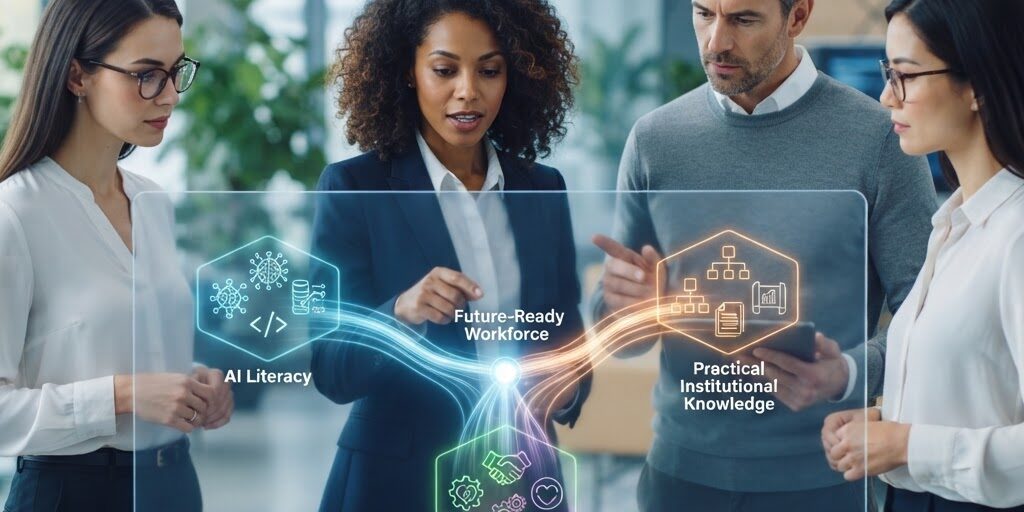
Closing the Triple Capability Gap: The Future of AI-Powered Workforce Training
The rapid integration of artificial intelligence into the modern workplace has triggered a seismic shift in how organizations prepare their personnel for the future. As businesses rush to deploy automation and machine learning, they are increasingly encountering a significant obstacle known as the triple capability gap. This phenomenon describes the urgent need for employees to simultaneously master AI literacy, sharpen durable human skills, and retain deep institutional knowledge. Successful AI workforce training is no longer just an optional investment but a foundational necessity for any competitive enterprise in the digital age. By addressing these three pillars, leaders can ensure their teams remain effective while navigating the complexities of human-machine collaboration. This guide explores the dimensions of this transition, offering a roadmap for organizations to pivot toward a sustainable, AI-empowered workforce strategy that balances technological speed with human capability. As we examine these trends, it becomes clear that the companies prioritizing holistic development will emerge as leaders in an increasingly automated economy, while those ignoring these gaps will likely face operational stagnation and talent attrition.
Table of Contents
Understanding the Triple Capability Gap
The triple capability gap represents a convergence of three distinct areas where the current workforce often lacks necessary depth. First, AI literacy is frequently misunderstood as merely knowing how to prompt a chatbot, when in reality, it involves understanding data ethics, algorithmic transparency, and the limitations of machine output. Second, durable human skills—often termed soft skills—are gaining renewed importance. Traits like critical thinking, emotional intelligence, and complex problem-solving are things AI cannot replicate. Third, institutional knowledge is the context-specific expertise that defines a company’s history and culture. When workers rely too heavily on AI tools without this internal context, they risk producing generic outputs that lack strategic alignment with company goals. Closing this gap requires a structural redesign of training programs that integrate these elements rather than treating them as silos. Most training initiatives focus on technical tutorials, yet ignoring the human-centered elements leads to disjointed workflows. Organizations must recognize that AI is a tool to amplify capability rather than a replacement for professional judgment. When employees understand the ‘why’ behind the ‘what,’ they are far better equipped to leverage AI in ways that support long-term company values. Furthermore, by addressing these three gaps in tandem, companies can foster a more resilient culture. This holistic approach ensures that technology acts as a bridge between human potential and organizational objectives. Experts suggest that the most successful training models use a blend of synchronous and asynchronous learning to address these gaps continuously, recognizing that in an AI-driven environment, the concept of a one-time training session is obsolete. The speed of AI advancement requires a culture of perpetual, iterative upskilling that evolves with the tools themselves, keeping the workforce ready to tackle unforeseen challenges.
The Foundations of AI Literacy
AI literacy is the bedrock upon which the modern workforce must be built. It is not sufficient for employees to simply have access to tools; they must understand how these systems operate, how to evaluate the accuracy of information provided, and how to maintain security protocols. Training programs should move beyond basic interface familiarity to focus on prompt engineering strategies that yield higher-quality outputs. However, the most critical aspect of this literacy is the development of a discerning mindset. Employees need to learn how to identify bias in training data, understand the risks of hallucinations in generative models, and apply proper verification steps to ensure all machine-generated output meets internal quality standards. This cognitive layer of training is often the most neglected, yet it is essential for risk mitigation. Furthermore, employees must be encouraged to treat AI as a collaborator rather than an autonomous decision-maker. Through targeted modules, staff can learn to dissect tasks into components where AI excels—such as data synthesis and pattern recognition—and areas where human intervention is mandatory, such as strategic synthesis and ethical judgment. This balanced approach protects the organization from the vulnerabilities associated with unchecked automation. The following table highlights the essential components of a robust AI training framework aimed at bridging this literacy gap across different professional levels, ensuring that everyone in the organization moves forward with shared knowledge and practical competence in a rapidly evolving digital landscape.
| Training Focus | Primary Objective | Expected Outcome |
|---|---|---|
| Data Literacy | Understanding AI inputs | Improved data quality |
| Algorithmic Ethics | Mitigating bias risks | Fair, equitable outputs |
| Prompt Engineering | Tool optimization | Greater task efficiency |
| AI Governance | Regulatory compliance | Reduced security risk |
By investing in these foundational layers, organizations create a workforce that is not only tech-savvy but also critically aware of the broader impact of the technologies they deploy daily. This creates a culture of responsible AI stewardship that empowers personnel at every level of the corporate hierarchy to contribute meaningfully to innovation while maintaining the integrity and reputation of the firm, ultimately turning potential risks into significant, scalable competitive advantages for the business.
Nurturing Durable Human Skills
In the age of AI, the human element has never been more vital. Durable human skills, sometimes referred to as soft skills, are the unique attributes that define the competitive advantage of a human-centric organization. As AI automates routine tasks, the work that remains for humans is often higher-order, requiring deep empathy, nuance, and interpersonal coordination. These skills are inherently durable, meaning they do not become obsolete as software versions change. Training initiatives that focus on emotional intelligence, negotiation, complex collaboration, and ethical leadership prepare teams to handle the ambiguity that AI often creates. For example, while an AI can draft an email or analyze a spreadsheet, it cannot navigate the sensitive team dynamics required to resolve a conflict or lead a client through a complex negotiation process. By dedicating resources to these durable skills, organizations ensure their teams can provide the human insight that is increasingly sought after by customers and partners. This training involves interactive workshops, mentorship programs, and peer-to-peer coaching sessions that emphasize active listening and cognitive flexibility. Moreover, as AI systems take over the analytical heavy lifting, employees have more bandwidth to dedicate to creative endeavors. Encouraging employees to lean into their innate curiosity and creative potential is a strategic move that turns AI adoption into a catalyst for innovation. When humans and AI work together, the AI handles the efficiency of production, while the human adds the layer of strategic intent, narrative, and contextual empathy. This synthesis of machine precision and human depth is the ultimate goal of effective training. By balancing technical AI workforce training with these durable human skills, organizations can build a workforce that is adaptable, innovative, and deeply connected to their collective mission, ensuring long-term institutional relevance and professional fulfillment for every single member of the team.
Leveraging Institutional Knowledge
The final pillar of the triple capability gap is institutional knowledge, the intangible asset that comprises a firm’s unique history, relationships, and operational nuances. AI models are excellent at processing massive datasets, but they lack the lived experience of long-term employees. Training programs must facilitate the transfer of this tacit knowledge to new hires while teaching employees how to document and structure their expertise for use by AI systems. Knowledge management platforms that are AI-enabled allow for the efficient retrieval of institutional history, but this only works if employees are trained to effectively curate and input that information. If the inputs are fragmented, the AI outputs will be equally disjointed. Therefore, organizations need a strategy for ‘knowledge codification’ that blends traditional mentorship with modern digital documentation tools. This prevents the loss of expertise when senior personnel retire or move on and allows AI to serve as a library of company wisdom. By training staff to see themselves as contributors to the organizational knowledge base, companies turn every employee into a steward of the brand’s history. This creates a feedback loop: institutional knowledge informs the AI, and the AI helps share that knowledge across the organization, accelerating the onboarding process for new talent. Crucially, this requires a cultural shift where sharing knowledge is rewarded rather than guarded. Managers play a pivotal role here by modeling the behavior of documenting processes and mentoring colleagues. When institutional knowledge is systematically integrated into the daily flow of work alongside AI tools, the organization gains an unmatched depth of insight that cannot be replicated by competitors relying solely on generic data sets or off-the-shelf AI solutions. This creates a protective moat around the organization’s specialized expertise.
To successfully navigate the future of work, organizations must view AI workforce training as a multidimensional challenge. Closing the triple capability gap requires a deliberate investment in AI literacy, durable human skills, and the active management of institutional knowledge. By focusing on these three pillars, leaders empower their employees to transcend the limitations of current technology. This is not a journey that ends with a single seminar; it is a commitment to continuous learning and adaptation. The firms that succeed will be those that foster a culture of curiosity and collaboration, ensuring that their people feel supported in their efforts to grow alongside their digital tools. Ultimately, the future of work belongs to those who view the triple capability gap as an invitation to build a more capable, resilient, and insightful workforce for the years ahead.
Frequently Asked Questions
- What is the triple capability gap in workforce training? It is the simultaneous challenge of needing AI literacy, durable human skills, and institutional knowledge to remain effective.
- Why are human skills important when AI is so powerful? Human skills like empathy and strategic judgment are unique to people and critical for complex decision-making.
- How can organizations improve their institutional knowledge management? By using AI-enabled documentation tools and creating a culture that rewards the sharing of internal expertise among peers.
- What constitutes AI literacy in a professional setting? It includes understanding AI ethics, prompt engineering, and verifying machine outputs for accuracy and bias.
- Is a one-time training session sufficient for AI readiness? No, due to the rapid speed of AI development, training must be a continuous, iterative process within the company culture.
