Mastering Agentic AI: The Essential Skill for Singapore’s 2026 Workforce
As the professional landscape of 2026 continues to evolve at an unprecedented pace, the shift from basic artificial intelligence usage to high-level mastery has become critical. For local professionals, prioritizing Agentic AI training Singapore has moved from a competitive advantage to a fundamental necessity for career longevity. Unlike standard generative models that require constant human prompting for every minor task, Agentic AI represents a leap toward autonomous, multi-step problem solving. These systems function as digital coworkers capable of executing complex workflows, making strategic decisions, and adapting to dynamic environments without constant intervention. As industries in the island nation undergo rapid digital transformation, the workforce must pivot from simply talking to chatbots to orchestrating autonomous agents. This transition is not merely technical but a complete change in how productivity is defined. By understanding how to design, deploy, and govern these intelligent agents, employees across all sectors can liberate themselves from repetitive tasks, focusing instead on high-value strategy and creative innovation. This article explores the essential skills needed to lead in this new era of automated professional excellence.
Table of Contents
Defining Agentic AI and Its Role
Agentic AI distinguishes itself from the predictive models that dominated the early 2020s by its capacity for agency, autonomy, and persistent goal-oriented behavior. While traditional AI acts as a reactive tool, responding to specific inputs with static outputs, an autonomous agent possesses the ability to plan, use external tools, and iterate on its own performance. This evolution is particularly vital in the context of professional environments in Singapore, where efficiency and precision are paramount. By engaging in comprehensive Agentic AI training Singapore, workers gain the capability to move beyond basic automation into the realm of intelligent delegation. These agents operate within specified parameters to complete complex business processes, such as auditing financial reports, managing supply chain fluctuations, or coordinating multi-departmental project timelines. The agentive model evaluates the success of its previous actions and adjusts its subsequent strategy, creating a feedback loop that mimics human analytical processes. Furthermore, these agents can interface with existing software suites, databases, and APIs, effectively becoming universal connectors across disparate digital ecosystems. By shifting the burden of execution to these systems, the human role transitions from a manual laborer of digital tasks to a curator of intelligent systems. Experts suggest that the primary challenge is no longer technical capability but the refinement of human intent—defining the objectives, ethical boundaries, and performance metrics that these agents must follow. Mastering these systems allows the professional to maintain total control over the outcome while offloading the rigorous heavy lifting of data processing and step-by-step logic. This foundational shift is what defines the next decade of workplace productivity, transforming how we view human-computer interaction in professional domains ranging from engineering and medicine to law and finance.
The Shift in Singapore’s Workforce
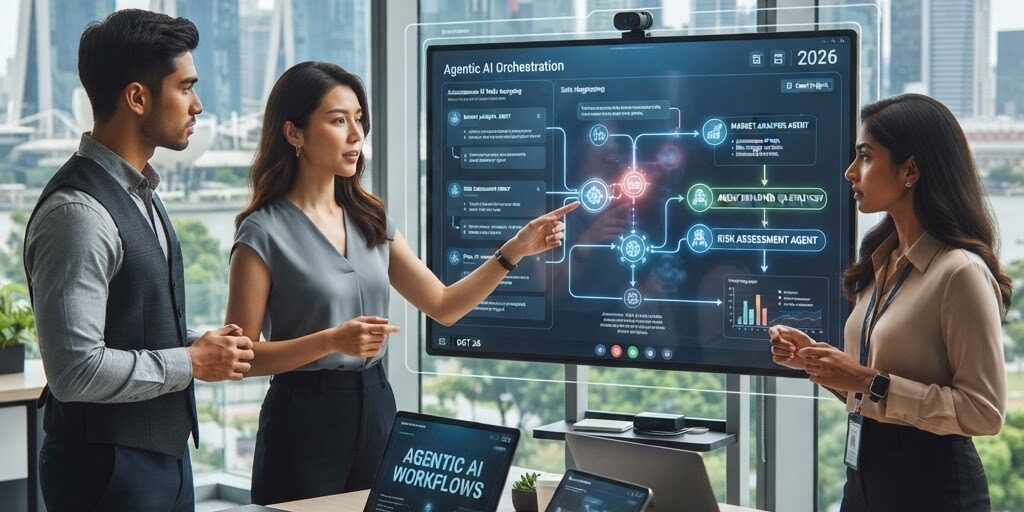
The acceleration of workplace automation has forced a major reassessment of skill sets across Singapore’s diverse industrial landscape. Historically, professional development focused on software proficiency or domain-specific technical mastery. Today, the focus has shifted toward the orchestration of Agentic AI systems. This transition is essential for maintaining the nation’s competitive stance in the global market. As businesses increasingly adopt these autonomous technologies, the workforce must acquire the ability to oversee, troubleshoot, and refine AI-driven operations. This requires a deeper understanding of how data flows through a pipeline and how different agents can collaborate to solve multifaceted problems. For example, a financial analyst might employ one agent to gather market data, a second to perform statistical regression, and a third to draft a preliminary executive report. Connecting these agents effectively requires a new kind of systematic thinking that emphasizes process architecture over simple prompt crafting. The following table highlights the distinct differences between traditional automation and modern Agentic AI workflows that every professional needs to understand to remain relevant in this evolving market.
| Metric | Traditional Automation | Agentic AI Workflow |
|---|---|---|
| Task Scope | Repetitive, linear steps | Complex, multi-step goals |
| Intervention | Constant human oversight | Periodic supervision |
| Flexibility | Rigid, static rules | Dynamic and adaptive |
| Tool Usage | Single platform focus | Cross-platform integration |
To succeed in this environment, local talent must participate in structured Agentic AI training Singapore programs that emphasize systemic design. Understanding how to build resilient pipelines that handle edge cases and data anomalies is no longer optional for senior staff or middle management. This shift creates a new hierarchy of expertise, where the ability to audit and calibrate AI decision-making becomes the most valued commodity. As the cost of intelligence drops, the value of the professional who can manage that intelligence skyrockets. Companies are actively seeking individuals who possess both the domain expertise to identify high-value problems and the technological literacy to deploy agents to solve them efficiently and safely within the corporate framework.
Implementing Autonomous Workflows
Executing autonomous workflows through Agentic AI requires a strategic approach to design and implementation that centers on reliability and security. Professionals looking to integrate these systems into their daily operations must start by breaking down their standard tasks into logical, hierarchical components. A common mistake is attempting to automate an entire department at once, which often leads to poor performance and security vulnerabilities. Instead, the focus should be on modularity—designing individual agents to handle specific micro-tasks that can be chained together. Training in Agentic AI in Singapore emphasizes the importance of ‘human-in-the-loop’ systems, where human experts intervene only when the agent hits a specific threshold of uncertainty or when critical decisions require a high level of accountability. This design philosophy preserves the essential human judgment required for high-stakes decisions while maximizing the throughput of data processing tasks. Furthermore, the selection of the right tools for orchestration is critical. Professionals need to become familiar with current frameworks that allow for the memory, reasoning, and tool-use capabilities of agents. These frameworks enable agents to persist over long durations, keeping track of history and context which is essential for ongoing projects that span days or weeks. As these systems become more capable, the primary role of the professional shifts toward robust testing and validation. Ensuring that an agent behaves according to company policy while operating in unpredictable digital environments is the hallmark of a skilled AI practitioner. This process involves rigorous unit testing of agent behaviors and constant monitoring of output quality. By adopting these methodical practices, professionals can transform their daily output from mere execution to high-level strategic orchestration, leveraging the full potential of available technology while maintaining the security standards required for the modern corporate landscape of Singapore.
Future-Proofing Your Career
In an environment as fast-paced as Singapore, future-proofing one’s career is an ongoing process of adaptation and continuous learning. With the rise of autonomous systems, the traditional linear career path is being replaced by a more fluid, skill-based model that rewards agility and technological literacy. Engaging in consistent Agentic AI training Singapore ensures that one stays at the forefront of this evolution rather than being sidelined by it. Beyond the immediate technical benefits, mastering AI agents fosters the development of critical thinking and problem-solving skills that are inherently human. Because agents function based on the parameters and goals set by their operators, the ability to clearly define problems and articulate the necessary steps to solve them becomes the most important skill an employee can possess. This is often referred to as architectural thinking—the ability to visualize a complex process as a series of connected, intelligent decisions. Furthermore, as AI agents become more prevalent, the demand for professionals who understand the ethical and regulatory dimensions of these technologies will increase. Whether it is ensuring data privacy, mitigating bias in algorithmic decision-making, or maintaining transparency in automated reporting, the ‘human-overseer’ is a role that will continue to grow in importance. By positioning oneself as a leader in AI governance, a professional ensures their value remains high regardless of how the underlying technology evolves. Success in 2026 and beyond will be defined by one’s ability to balance technical innovation with strategic human oversight. By embracing the shift toward agentic systems today, workers in Singapore can secure their professional relevance, drive efficiency within their organizations, and lead the way into a new era of digital productivity where technology and human expertise work in harmonious, autonomous synergy to achieve unprecedented business results across all sectors of the local economy.
Conclusion
Mastering Agentic AI is no longer a luxury but a fundamental requirement for the 2026 Singaporean workforce. The shift toward autonomous systems necessitates a transition from basic prompting to the orchestration of complex, multi-step workflows. By investing in dedicated Agentic AI training Singapore, professionals can ensure they remain competitive, relevant, and highly capable in a rapidly changing digital landscape. This evolution promises to enhance productivity, liberate workers from mundane tasks, and empower employees to focus on high-level strategy. As these autonomous agents become integral to business processes, the individuals who can effectively design, manage, and govern them will become the architects of the future economy. Embracing this shift today is the most effective way to secure a prosperous and resilient career, ensuring that you remain a vital contributor in an increasingly intelligent professional world.
Frequently Asked Questions
What exactly is Agentic AI? Agentic AI refers to systems capable of autonomous, goal-oriented behavior, allowing them to plan, execute multi-step workflows, and use external tools with minimal human intervention.
Why is Agentic AI training important for the Singapore workforce? As businesses automate complex processes, workers who understand how to orchestrate these agents gain a significant advantage in efficiency, strategic oversight, and career adaptability.
How does Agentic AI differ from standard ChatGPT usage? While standard AI reacts to single prompts, Agentic AI uses reasoning, memory, and iterative planning to pursue complex, long-term goals across multiple software environments.
Do I need technical programming skills to use Agentic AI? While coding knowledge is helpful, modern training focuses on orchestration and architectural design, making it accessible to professionals across various business disciplines.
What is the future of human-AI collaboration? The future is defined by humans serving as strategists and governors, while autonomous agents handle the rigorous data execution and logical processing required to complete high-level professional objectives.