Mastering Agentic AI: A Singapore Professional’s Guide to 2026 Skills
As the technological landscape evolves rapidly in 2026, the demand for sophisticated AI training Singapore professionals need is reaching an inflection point. We are moving beyond simple chatbots and basic generative models into the era of Agentic AI. These systems do not merely react to prompts; they function as autonomous units capable of multi-step task execution, decision-making, and self-correction. For Singapore’s workforce, staying ahead means mastering the orchestration of these agents. Whether you are in finance, logistics, or creative services, the shift toward autonomous task delegation is rewriting the rules of professional efficiency. Industry experts agree that the competitive advantage in the local economy now relies on understanding how to integrate these agents into existing workflows without compromising security or compliance. This guide explores the essential skills required for this transition, focusing on the dual-track framework that balances technical proficiency with domain-specific expertise. By embracing these advancements, professionals in Singapore can transition from passive technology users to active AI architects, ensuring long-term career resilience in an increasingly automated global marketplace while maintaining the high standards of excellence expected in the nation.
Table of Contents
The Evolution to Agentic AI
The transformation from passive generative tools to Agentic AI marks a significant shift in how work is conducted across various industries. Unlike earlier versions of language models that waited for human input to perform a singular task, Agentic AI systems possess the cognitive autonomy to break down complex goals into executable steps. These agents function by evaluating the objective, determining the necessary sub-tasks, querying databases, processing information, and executing actions in a sequence that mimics human problem-solving. In the context of AI training Singapore professionals are currently undertaking, the focus has shifted from prompt engineering to agent orchestration. This means learning how to define constraints, set safety boundaries, and monitor the long-term execution of agents. Professionals are now expected to curate the environment in which these agents operate, ensuring they have access to the right data without violating data privacy regulations. This is a critical development because as agents take over repetitive, complex administrative tasks, the role of the professional shifts from being a producer of work to a manager of automated processes. The ability to audit an agent’s reasoning process and intervene when performance deviates from the desired outcome is now a core competency. Furthermore, the integration of these agents into everyday business software requires a level of systems thinking that was previously reserved for technical developers. As we look at the trajectory of these tools, it becomes clear that human oversight remains the anchor of all operational efficiency. By mastering the orchestration of these autonomous entities, professionals can significantly amplify their output while focusing their energy on high-level strategy and innovation, which are the traits that differentiate high-performing individuals in a dense, competitive professional ecosystem like the one found in Singapore today.
The Dual-Track Skill Framework
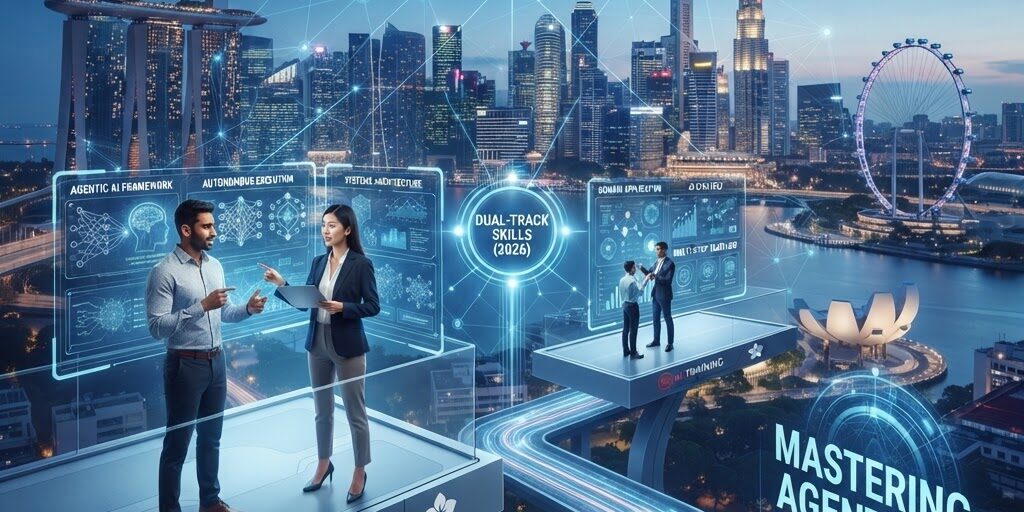
In response to the rapid adoption of new digital tools, the industry has standardized a dual-track skill framework. This model recognizes that AI training Singapore participants need is not one-size-fits-all. The first track, focused on technical specialists, emphasizes the foundational mechanics of large language models, agent frameworks, and API integrations. Specialists are taught to debug agentic loops, fine-tune model parameters for specific industry datasets, and ensure robust security protocols are in place. Conversely, the second track is designed for domain-specific non-technical professionals—such as managers, legal consultants, and medical practitioners. For this group, the objective is to understand how to leverage agentic workflows to solve specific domain challenges without needing to write code. This track emphasizes logic flows, data contextualization, and ethical oversight. The power of this framework lies in the synergy between the two groups. When a non-technical manager communicates a business requirement to a technical specialist, the collaborative output is far more effective than either party could achieve alone. The following table illustrates how these two groups interact within a corporate environment.
| Skill Category | Technical Specialist Focus | Domain Professional Focus |
|---|---|---|
| Task Architecture | Building agent loops and APIs | Designing logic workflows and parameters |
| Data Integrity | Managing vector databases | Contextualizing data for model accuracy |
| Compliance | Cybersecurity and system hardening | Regulatory and ethical oversight |
| Optimization | Token usage and cost management | Performance tracking and output quality |
By splitting the educational focus, organizations can ensure that every staff member contributes uniquely to the successful deployment of AI, fostering a culture of continuous learning that scales across all levels of the enterprise effectively.
Infrastructure and Strategic Integration
Integrating Agentic AI into a legacy corporate infrastructure is a complex undertaking that requires more than just access to software. It demands a holistic approach to data architecture and strategic foresight. For businesses in Singapore, the challenge often lies in connecting siloed data sets into a coherent fabric that an AI agent can traverse safely. This involves investing in cloud-native infrastructure that supports high-speed data retrieval and ensuring that all data inputs are cleaned, categorized, and compliant with local data protection laws. Strategic integration also involves mapping business processes to identify where agents provide the highest return on investment. Professionals undergoing AI training Singapore modules must learn to perform a gap analysis of their current workflows. This involves asking questions about where time is wasted and where human intuition provides the most value. Once these pain points are identified, the agentic systems can be deployed to handle the lower-order, high-volume tasks. However, integration is not a set-it-and-forget-it endeavor. It requires ongoing monitoring to ensure that the agents are not experiencing prompt drift or making incorrect inferences based on outdated information. The strategic professional of 2026 is someone who acts as a bridge between the technical output of the machine and the human expectations of the client. This necessitates a strong understanding of change management within an organization. By facilitating clear communication between departments, leaders can ensure that the AI infrastructure does not become a technological monolith that is too rigid to adapt. Instead, it should be a flexible foundation that allows for continuous iteration and improvement, ultimately serving the core mission of the organization while maintaining the high standards expected by clients in the professional sector.
Future-Preparedness
Preparing for the future of work requires a mindset of perpetual curiosity. As agentic systems continue to mature, the skills we value today will likely be augmented or replaced by even more advanced autonomous capabilities. The key to staying relevant is not to resist these changes, but to actively participate in the development of standards and best practices. In the Singapore professional landscape, this means participating in industry forums, engaging with local training providers, and remaining vigilant about the ethical implications of autonomous decision-making. Professionals should focus on cultivating soft skills—such as critical thinking, complex communication, and ethical judgment—which are fundamentally difficult for current agents to replicate with total accuracy. The training of the future will be less about learning to operate a specific tool and more about learning how to learn. It is about understanding the logic of systems, the nuances of human behavior, and the delicate balance between automation and accountability. As we move closer to a fully integrated agentic economy, the individuals who will thrive are those who view technology as an extension of their creative potential rather than a threat to their livelihood. This vision requires confidence, agility, and a deep commitment to maintaining the unique human element in every project delivered. Whether you are leading a team or pursuing independent professional goals, the mastery of Agentic AI is your gateway to unparalleled productivity. By investing the necessary time in rigorous education and remaining committed to professional development, you ensure that your capabilities remain at the forefront of the industry. This proactive stance is what will define success in the upcoming years of rapid technological evolution, securing your place in the future workforce of our globally connected economy.
Conclusion
Mastering Agentic AI is no longer a futuristic goal but an immediate requirement for professional success in Singapore. By adopting a dual-track approach to learning, professionals can bridge the gap between technical complexity and domain-specific utility. As these autonomous systems begin to handle the heavy lifting of multi-step task execution, the human role transitions toward that of a curator, strategist, and ethical overseer. This evolution presents immense opportunities for those who choose to upskill through comprehensive AI training Singapore programs today. By focusing on critical thinking and robust workflow orchestration, you ensure that your contributions remain indispensable. The future belongs to those who view this technological shift as an opportunity to expand their capacity, ensuring that they can lead, innovate, and excel in a digital-first global economy.
FAQ
1. What is Agentic AI? It is an advanced form of AI capable of executing multi-step tasks autonomously to reach a defined goal without constant human intervention.
2. Why is AI training in Singapore focused on this right now? To maintain global competitiveness, Singaporean professionals must leverage automation to improve efficiency and scale operational outputs effectively.
3. Do I need to learn coding for this training? No, the dual-track framework allows non-technical professionals to focus on logic and strategy while technical specialists handle the coding.
4. How do I ensure my agents remain ethical? Regular audits, setting strict operational constraints, and human-in-the-loop validation are essential for maintaining compliance and ethics.
5. Is this training suitable for all industries? Yes, the principles of agentic orchestration are highly adaptable to finance, legal, healthcare, logistics, and creative industries.