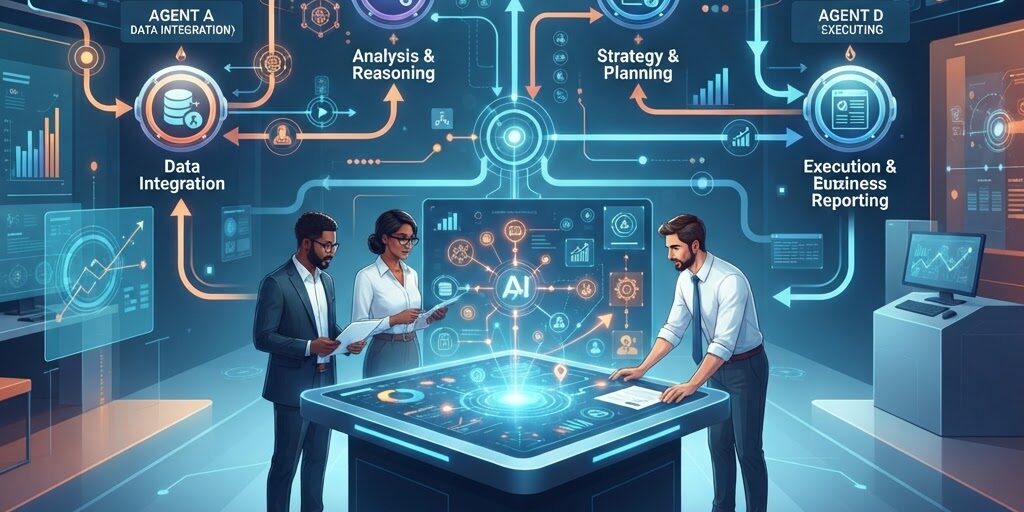
Beyond Prompting: Mastering Agentic AI Workflows for Modern Professionals
In the rapidly evolving landscape of 2026, the era of basic prompt engineering is fading. While early adopters spent years mastering the nuances of chat-based queries, the industry has fundamentally shifted toward a new paradigm: Agentic AI workflows. Unlike static chatbots that merely react to input, agentic systems act as autonomous agents, capable of reasoning, planning, and executing complex, multi-step operations to reach a specific objective. This transition represents a significant upgrade in how professionals leverage technology to solve business problems. By integrating memory, tool use, and iterative feedback loops, these workflows enable machines to navigate ambiguity, troubleshoot errors, and maintain context across extended durations. As professionals move away from single-turn commands, they must learn to orchestrate these sophisticated systems to remain competitive. Mastering the architecture of these workflows allows for unprecedented gains in productivity, as repetitive tasks are offloaded to intelligent systems that function as proactive partners rather than passive repositories of information. This comprehensive guide explores the structural elements, strategic implementation, and long-term benefits of integrating agentic intelligence into your daily professional operations today.
Table of Contents
Understanding Core Concepts of Agentic AI
The foundation of modern intelligence lies in moving from rigid automation to dynamic, agentic workflows. At their core, agentic systems are defined by their capacity for goal-directed behavior. Where traditional automation operates on linear, predefined paths, an agentic system evaluates a specific task, identifies the necessary sub-tasks, and iterates through multiple attempts to achieve success. Industry experts have identified three primary pillars that distinguish these systems: perception, reasoning, and action. Perception involves the ability of the system to digest diverse data inputs, ranging from unstructured documents to real-time market signals. Reasoning allows the agent to decompose high-level instructions into executable steps, applying logic and critical thinking to navigate potential obstacles. Action represents the final phase where the agent interacts with external tools, such as software APIs, databases, or cloud-based document editors, to modify the state of the environment. By utilizing Large Language Models as the central processor, these agents possess a semantic understanding of human intent, allowing them to adjust their strategies when initial attempts fail. This iterative loop is what separates agents from simple script-based automations. The reliance on persistent memory—the ability to remember previous states and outcomes—ensures that the system does not repeat mistakes. As professionals begin to conceptualize their tasks through the lens of agentic intelligence, they realize that the bottleneck is no longer the speed of execution, but the clarity of the objective defined for the machine. Understanding these core concepts is the first step toward moving beyond manual prompt-based interactions and building resilient systems that can function with high autonomy while maintaining alignment with organizational goals and security protocols, ultimately setting a new standard for efficient digital collaboration within any modern enterprise environment.
Designing Robust AI Agent Workflows
Architecting successful agentic AI workflows requires a rigorous approach to system design that mirrors software development lifecycle methodologies. Professionals must start by defining clear success metrics before deploying autonomous systems. The workflow begins with the specification of a goal, which is then broken down into distinct sub-tasks by the agent. One crucial design decision is the degree of human-in-the-loop (HITL) intervention required. For highly sensitive operations, such as financial transactions or data integrity updates, it is standard practice to build in approval gates. These gates require human verification before the agent executes an action that modifies a database or sends external communications. Additionally, the selection of tools is paramount. An agent is only as capable as the environment it can manipulate. By connecting agents to specialized tools—such as web browsers for research, SQL databases for data analysis, and code executors for mathematical heavy lifting—users can vastly expand the operational surface area of the system. We suggest evaluating the performance of these agents by tracking error rates, cycle time, and the number of steps required to reach a conclusion. Table 1 below illustrates a comparison between manual processes and autonomous agentic workflows.
| Metric | Manual Prompting | Agentic AI Workflow |
|---|---|---|
| Task Complexity | Simple/Single Step | High/Multi-Step |
| Error Handling | Manual Correction | Self-Correction |
| Throughput | Limited by User Input | Continuous/Asynchronous |
| Integration | None | Full Tool/API Access |
To ensure reliability, developers must focus on state management. This involves maintaining a record of what the agent has already done, what it failed to do, and what the next logical step should be. By implementing robust logging and monitoring, professionals can observe the reasoning path taken by the agent, which is invaluable for debugging performance issues. Creating a well-defined “memory” structure also allows the agent to recall previous tasks, facilitating long-term learning and optimization. When systems are designed with these principles, they become significantly more reliable, allowing professionals to trust the output generated by autonomous agents during complex, high-stakes project workflows.
Operational Integration and Best Practices
Successfully integrating agentic AI workflows into an existing professional ecosystem necessitates more than just technical configuration; it requires a cultural shift in how work is managed and distributed. The transition from active worker to orchestrator of intelligence is significant. Instead of manually writing emails or drafting reports, the professional now manages a fleet of agents, defining their parameters and auditing their performance. One of the most effective strategies for seamless integration is modular design. Rather than attempting to solve an entire enterprise-level problem with one massive agent, we recommend deploying a network of smaller, specialized agents that communicate with one another. For example, one agent might be responsible for data scraping, while another handles synthesis and formatting. This distributed approach significantly reduces the blast radius of any potential errors and makes the entire system easier to maintain. Furthermore, professionals should prioritize clear documentation and standard operating procedures (SOPs) for each agent’s role. Treating these digital entities as team members ensures that their contributions are consistent and predictable. We also recommend setting up automated monitoring dashboards that display the health of these workflows. If an agent hits a bottleneck or experiences an API timeout, the dashboard should alert the user immediately. This proactive stance on maintenance ensures that the intelligence system continues to function effectively without requiring constant manual oversight. As team members become accustomed to delegating complex tasks to these systems, they find themselves free to focus on higher-level strategy, creative problem solving, and building human relationships, which are areas where human intuition remains superior to even the most advanced algorithmic reasoning models. By fostering this symbiotic relationship between human strategy and machine efficiency, organizations can achieve a level of sustained productivity that was previously unreachable in traditional office settings.
Future Scaling and Ethical Considerations
As the adoption of agentic AI workflows accelerates, the question of scalability and ethics becomes increasingly prominent. Scaling these systems requires a transition from localized experiments to enterprise-wide infrastructure. This involves investing in secure environments where agents can operate without risk of data leakage or unauthorized access to sensitive proprietary information. We advocate for the implementation of strict role-based access control (RBAC) protocols for every agent in your fleet. An agent should never possess more privileges than are necessary to perform its assigned function. Beyond security, the ethical dimension of autonomous systems must be at the forefront of development. Ensuring that the reasoning paths of these agents remain unbiased is a responsibility that rests with the human operators. We encourage organizations to perform regular audits of their agentic logic to check for unintended biases that might have been picked up from training datasets. Furthermore, the environmental impact of running continuous, compute-heavy workflows should be considered. Efficient code and optimized model selection can significantly reduce the energy consumption of these sophisticated systems. Looking toward the future, the integration of multi-modal capabilities will allow agents to interpret images, video, and audio as efficiently as they currently process text. This expansion will open doors for autonomous video editing, complex diagnostic analysis in technical fields, and real-time project management assistance. The potential for these systems is virtually limitless, provided that the human oversight remains robust and ethical. The goal is not to replace human intellect but to augment it with a tireless, scalable, and highly capable force of autonomous agents. By adhering to transparent standards, maintaining a focus on human safety, and continuously iterating on the architecture of these systems, professionals can harness the power of modern AI while safeguarding the integrity of their work and the societies in which they operate, ultimately defining the next great leap in professional human development and technological advancement.
Mastering agentic AI workflows is no longer an optional skill set; it is a fundamental requirement for the modern professional operating in a competitive environment. By transitioning from simple prompting to the orchestration of autonomous systems, individuals and teams can unlock new levels of efficiency, accuracy, and creative freedom. These workflows represent the future of work, where human strategic oversight combines with the rapid, multi-step execution capabilities of intelligent machines to solve the most complex problems of our time. As you begin to build your own agentic architectures, remember that the most successful systems are those that prioritize clear goal setting, iterative improvement, and ethical oversight. Embrace this evolution, focus on modular design, and start small to scale effectively. The journey toward full-scale autonomous operations is complex, but the potential rewards for your professional output are truly transformative.
Frequently Asked Questions
What is the primary difference between a chatbot and an agentic workflow? A chatbot responds to single inputs, while an agentic workflow plans and executes multiple steps to achieve a goal autonomously.
Do I need to know how to code to build agentic workflows? While programming skills help with custom API integrations, many low-code tools now allow professionals to orchestrate these workflows using visual interfaces.
How can I ensure my agentic workflows are secure? Implement strict role-based access controls, perform regular security audits, and always keep a human in the loop for sensitive or destructive operations.
What is the best way to start implementing these workflows? Begin by identifying a repetitive, multi-step task and breaking it down into smaller components, then use an existing agent framework to automate the most straightforward segments.
Will agentic AI replace human professionals? No, it will augment them by handling routine tasks, allowing humans to focus on higher-level strategy, ethics, and creative decision-making.