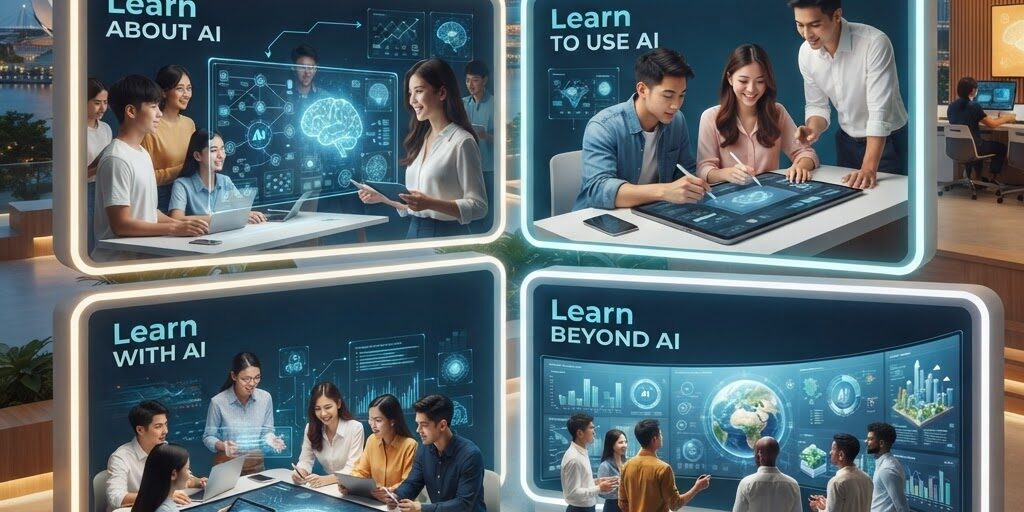
Mastering the Four Learns: A Guide to Singapore’s AI Education Framework
In an era defined by rapid technological advancement, Singapore has positioned itself at the forefront of digital transformation by prioritizing artificial intelligence within its national education system. At the heart of this initiative lies the comprehensive Four Learns AI framework, a structured approach designed to prepare learners of all ages for a future where human-machine collaboration is the norm. This strategy transcends basic digital literacy, focusing instead on developing a holistic understanding of how these powerful systems function, how to deploy them ethically, and how to utilize them as catalysts for human creativity and problem-solving. By embedding these principles into the educational pipeline, the nation ensures that students and professionals alike are not just passive consumers of software, but active architects of a technologically driven society. As global competition intensifies, mastering the Four Learns AI framework provides an essential roadmap for navigating the complexities of machine learning, neural networks, and generative models, fostering a culture of lifelong learning that is both adaptable and resilient against the shifting tides of the digital landscape.
Table of Contents
Learn About AI: Demystifying the Technology
The first pillar of the framework is fundamental: Learn About AI. To truly leverage the power of artificial intelligence, one must first understand its origins, its mechanisms, and its limitations. This stage involves moving beyond the hype to explore the mathematical and logical foundations that enable machines to process data, recognize patterns, and make predictions. Industry experts emphasize that demystifying the black box of algorithms is essential for building public trust and ensuring that users do not anthropomorphize machines. By studying the history of computation, from early logic gates to contemporary deep learning models, learners gain a clearer perspective on what AI is and, perhaps more importantly, what it is not. This educational phase includes examining how datasets influence outcomes, the importance of training data quality, and the risks of inherent bias in algorithmic decision-making. Students are encouraged to explore various types of AI, including narrow AI, which excels at specific tasks, and the theoretical concepts behind general intelligence. Furthermore, understanding the architecture of neural networks allows individuals to appreciate why certain models succeed in image recognition while others struggle with complex reasoning. This rigorous grounding ensures that learners do not view technology as magic, but rather as a tool designed by humans for specific purposes. As the national strategy emphasizes, building a foundational literacy is the prerequisite for all subsequent stages. By equipping the populace with the technical vocabulary and conceptual framework necessary to discuss artificial intelligence, the country creates a shared language that facilitates collaboration between developers, policymakers, and end-users. This stage is not merely about coding; it is about cultivating an analytical mindset that questions how input parameters influence output probability. It sets the stage for a society that demands transparency and accountability in the software products that increasingly govern our daily economic and social interactions.
Learn to Use AI: Practical Application and Prompt Engineering
Once the foundational knowledge is secured, the focus shifts to the second pillar: Learn to Use AI. This practical phase centers on mastering the tools of the trade, enabling individuals to integrate artificial intelligence into their professional workflows effectively. In the modern workplace, proficiency in prompting, tool selection, and iterative design is becoming as vital as traditional literacy. Learning to use AI involves hands-on experience with generative models, predictive analytics platforms, and automated productivity suites. It is about understanding the art of the prompt—the skill of communicating intent to a machine in a way that yields precise, accurate, and relevant results. This stage requires learners to experiment with different temperature settings, persona-based interactions, and context-setting techniques that optimize performance. Educators and trainers focus on helping users bridge the gap between human objectives and machine execution. This process is highly iterative, often requiring several refinement cycles before a user achieves the desired output. Furthermore, learning to use AI effectively means knowing which tool is appropriate for a specific problem. For example, a student might use a natural language model for brainstorming and drafting, while utilizing a data visualization tool for synthesizing numerical trends. This selective application ensures that human effort is directed toward high-value creative tasks rather than repetitive administrative work. To demonstrate the shift in skill sets, the following table compares traditional tasks with AI-enhanced workflows:
| Process | Traditional Method | AI-Enhanced Workflow |
|---|---|---|
| Data Analysis | Manual spreadsheet entry | Predictive modeling and automated insight extraction |
| Content Creation | Blank page drafting | Prompt-based brainstorming and iterative refinement |
| Language Translation | Dictionary/Thesaurus usage | Real-time neural machine translation |
| Coding | Syntax lookup and manual debugging | AI-assisted code completion and error diagnostics |
By engaging with these tools in a controlled environment, users move from novice experimentation to sophisticated mastery, learning how to troubleshoot and verify machine outputs for potential inaccuracies.
Learn With AI: Personalized Learning Pathways
The third pillar, Learn With AI, represents a paradigm shift in how education is delivered and received. Here, AI acts as an intelligent companion or tutor, adjusting to the unique pace and style of the individual learner. By leveraging adaptive learning algorithms, educational platforms can identify specific knowledge gaps, suggest tailored resources, and provide real-time feedback that traditional one-size-fits-all curricula simply cannot match. This phase is fundamentally about scaling personalized instruction, ensuring that no student is left behind due to a lack of immediate support. When a learner struggles with a concept, the system can offer alternative explanations, interactive visualizations, or scaffolded practice problems until mastery is achieved. Conversely, advanced learners are challenged with more complex material, preventing boredom and maintaining engagement. This collaborative dynamic changes the role of the teacher from a sole provider of information to a mentor who guides students through the AI-driven learning process. Moreover, learning with AI promotes a continuous feedback loop where both the machine and the human evolve. As the learner engages with the curriculum, the system learns more about their cognitive tendencies, refining its approach to maximize retention and comprehension. This symbiotic relationship fosters a higher degree of self-regulated learning, as individuals learn how to use AI to track their progress, identify areas for improvement, and stay motivated. Beyond the classroom, this approach extends to professional development, where AI assistants help workers master new skills through simulated challenges and instant coaching. By integrating AI as a learning partner, the educational framework acknowledges that cognitive offloading can actually improve human learning if managed correctly. It allows individuals to focus on deep thinking and synthesis, leaving the rote memorization and logistical navigation to the digital assistant, thereby enhancing the overall efficacy of the learning journey.
Learn Beyond AI: Ethical Stewardship and Human-Centric Innovation
The final and most critical pillar of the framework is Learn Beyond AI. This stage addresses the long-term societal implications of living and working in an automated world. Learning beyond AI involves cultivating the uniquely human traits that machines cannot replicate, such as empathy, ethical judgment, strategic vision, and complex problem-solving in ambiguous contexts. While AI can handle logic and pattern recognition, it cannot define the values by which a society chooses to live. Therefore, this pillar focuses on ethics, governance, and the philosophical implications of technological ubiquity. Learners are challenged to consider the impact of AI on privacy, labor markets, and the social contract. By examining case studies of both technological triumph and failure, individuals develop the critical capacity to act as responsible stewards of innovation. This involves understanding the legal frameworks surrounding data sovereignty and intellectual property, as well as the societal necessity for inclusive AI that benefits all members of the population. Furthermore, learning beyond AI encourages a spirit of human-centric innovation—the practice of designing systems that prioritize human well-being and environmental sustainability over raw efficiency. It requires individuals to ask not just if a technology can be built, but whether it should be built and how it affects the cultural fabric of our communities. As the nation moves toward a future where AI permeates every sector, the ability to maintain a sense of human agency is paramount. This stage fosters a mindset that views technology as an extension of our capabilities rather than a replacement for our intellect. By fostering a deep sense of social responsibility, the framework ensures that as technology advances, our moral compass remains strong, guiding the trajectory of artificial intelligence toward the common good and securing a prosperous future for all citizens in a digital-first economy.
Conclusion
Mastering the Four Learns AI framework is more than an educational initiative; it is a national strategy to ensure long-term competitiveness and human flourishing in an increasingly complex world. By systematically moving from foundational understanding to practical application, intelligent collaboration, and finally ethical stewardship, individuals are empowered to navigate the future with confidence. This framework acknowledges that the rapid evolution of technology requires a equally rapid evolution in our approach to knowledge acquisition. As we embrace these pillars, we create a society where AI serves as a powerful lever for human potential, rather than a disruption to our values. Continued investment in these four areas will undoubtedly secure a resilient future, characterized by innovation, equality, and a deeply human-centric approach to digital advancement in the years ahead.
Frequently Asked Questions
What are the Four Learns in the Singapore AI framework?
The Four Learns are learn about AI, learn to use AI, learn with AI, and learn beyond AI, providing a roadmap for comprehensive AI literacy.
Why is it important to learn about the history of AI?
Understanding the history of AI helps demystify the technology, allowing users to move beyond hype and grasp the logical foundations and limitations of modern systems.
How does the learn with AI pillar improve education?
It uses adaptive algorithms to provide personalized learning experiences, adjusting to individual needs and providing immediate feedback, which enhances overall knowledge retention.
What does it mean to learn beyond AI?
This pillar focuses on ethics, governance, and maintaining human values, ensuring that technology serves the common good and remains under responsible human stewardship.
Can the Four Learns framework be applied to professional development?
Yes, the framework is designed for lifelong learning, helping professionals integrate AI tools into workflows and adapt to the shifting demands of the modern digital economy.