The Rise of Agentic AI: Transforming Corporate Training in 2026
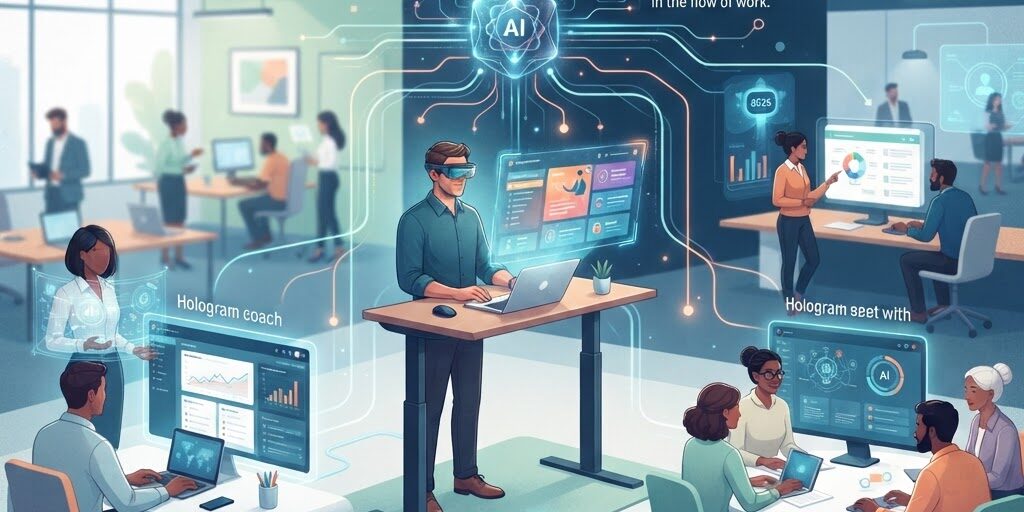
The landscape of professional development is undergoing a seismic shift as we enter 2026. Companies are rapidly moving beyond the limitations of static learning management systems and basic chatbots, embracing the powerful capabilities of agentic AI in corporate training. Unlike traditional platforms that require manual content updates and passive user participation, agentic AI functions as an autonomous digital colleague. These sophisticated systems proactively observe organizational needs, adapt curricula in real-time, and guide employees through complex tasks without constant human intervention. By integrating directly into the flow of work, this technology ensures that professional development is no longer a separate, isolated event but a continuous, dynamic loop of growth. As organizations strive for greater efficiency, adopting these autonomous agents becomes a necessity rather than a luxury. This transition marks the end of one-size-fits-all training modules and the beginning of a future where AI acts as a dedicated coach, providing personalized insights, immediate feedback, and actionable guidance, effectively bridging the gap between existing skills and future business requirements in a rapidly evolving global economy.
Table of Contents
The Evolution of Learning Systems
The journey from static manuals to interactive online platforms and finally to agentic AI represents a massive leap in how organizations handle knowledge transfer. In the early days, employees were expected to read dense procedure guides that were often outdated by the time they reached the printer. Modern learning management systems improved this by hosting digital content, but they remained passive repositories. Today, the rise of agentic AI in corporate training changes the paradigm entirely. These systems do not just store information; they possess a degree of situational awareness that allows them to interpret the context of an employee’s work environment. If a department is struggling with a new software implementation, the agent recognizes this struggle by analyzing performance gaps and workflow bottlenecks. It then automatically synthesizes relevant documentation, creates tailored micro-learning modules, and proactively offers to walk the user through the process step-by-step. This proactive capability is what distinguishes agentic AI from traditional tools. It transforms the role of the training department from content producers into architectural designers who define the parameters within which these agents operate. By leveraging natural language processing and advanced machine learning models, these systems interpret intent and sentiment, adjusting their pedagogical approach to match the user’s current stress level, technical proficiency, or time constraints. This is not merely an improvement in speed; it is an improvement in relevance. As the digital transformation continues to accelerate, the ability of AI to act independently to solve skill gaps will determine which enterprises thrive and which fall behind. Furthermore, these agents serve as a constant feedback loop for organizational leadership, providing data-driven insights into where the company is strongest and where it needs to pivot its workforce development strategies.
Hyper-Personalization in Professional Development
Hyper-personalization is the cornerstone of effective modern learning. In the past, customizing training for thousands of employees was a logistical nightmare, requiring exhaustive manual effort and significant time. However, agentic AI in corporate training makes mass-scale personalization possible for every single employee. These autonomous agents analyze individual learner profiles, historical performance data, and career aspirations to curate a learning journey that is uniquely suited to the person. Instead of forcing an employee to sit through a standardized four-hour course, the agent identifies the specific 15 minutes of material required to master a new skill relevant to their immediate task. This surgical approach to development reduces cognitive overload and improves retention rates significantly. The agentic system constantly monitors progress and adjusts the difficulty level, pacing, and modality of content delivery based on the user’s ongoing interaction. For instance, if an employee prefers video-based learning for technical troubleshooting but responds better to text-based summaries for compliance policies, the system adapts accordingly. This ensures that every engagement feels human-centered and highly intentional. Additionally, this level of personalization helps in identifying hidden talent within an organization. Agents can track how employees approach problem-solving, flagging individuals who show exceptional aptitude in specific areas, thereby informing succession planning and internal mobility efforts. By treating each employee as a unique learner rather than a number in a spreadsheet, organizations foster a culture of growth and engagement. This shift also supports diversity and inclusion, as agents can deliver content in various languages or accessibility formats without the need for additional manual development resources. The capacity to adapt in real-time ensures that employees feel supported and valued, which is crucial for talent retention in a competitive hiring environment where continuous learning is expected.
| Feature | Static Learning Systems | Agentic AI Systems |
|---|---|---|
| Content Delivery | Linear, manual scheduling | Proactive, event-driven |
| Customization | Pre-defined learning paths | Dynamic, real-time adaptation |
| Role of User | Passive consumer | Active, collaborative learner |
| Scalability | High effort required | Low effort, automated |
As illustrated in the comparison table, the shift toward agentic systems allows for a far more efficient allocation of time and resources. While static systems demand human labor for every update and adjustment, agentic systems operate autonomously. This allows for a focus on strategy rather than administration. By automating the routine aspects of training, organizations free their internal teams to focus on high-level goals like organizational culture and strategic capability building. This transformation is not just about the technology itself; it is about the new collaborative environment it fosters. As these agents become more sophisticated, they begin to serve as coaches that are available 24/7, transcending geographic and time-zone limitations. Employees no longer need to wait for a supervisor to become available or for a training window to open; they have an intelligent partner ready to provide the necessary support the moment a hurdle appears. This fosters a sense of agency and empowerment among employees, as they are provided with the tools they need to overcome challenges independently. Ultimately, hyper-personalization powered by agentic AI is about fostering an environment where growth is continuous, seamless, and deeply aligned with both the individual’s career trajectory and the broader strategic objectives of the entire company, creating a truly unified workforce that is capable of adapting to any future market pressures.
Integration and Workflow Automation
True success with agentic AI in corporate training lies in its seamless integration into the workflow. Most traditional training fails because it takes employees away from their primary responsibilities, creating a friction-heavy environment where training feels like a disruption rather than an asset. Agentic AI solves this by embedding knowledge directly into the applications employees use every day, such as CRM systems, project management tools, or communication platforms. When an agent detects a repetitive error or a failure to follow standard operating procedures, it intervenes directly within the interface to provide corrective guidance. This “in-the-moment” coaching is vastly more effective than retrospective reviews or yearly workshops. Because the AI understands the work context, its interventions are highly relevant and immediately actionable, reinforcing learning through application. This deep integration also allows for the automation of administrative tasks that previously burdened team members. For example, the agent can automatically generate documentation based on successful task completion, update skill profiles, or flag instances where manual review is strictly necessary due to compliance requirements. This automation serves two purposes: it reduces the administrative load on staff, and it provides an audit trail that can be used for continuous improvement. By closing the loop between action and feedback, the AI fosters a high-performance culture where growth is measured by actual results rather than completion certificates. Furthermore, the security and reliability of these systems are constantly improved through rigorous testing and refinement of the underlying models. Organizations can trust these agents to manage complex workflows while adhering to strict privacy and data protection standards, ensuring that sensitive information remains secure while still enabling the system to learn and improve over time. This architectural approach creates a resilient environment where the technology works for the user, not the other way around.
The Future of Human-AI Collaboration
The long-term impact of agentic AI in corporate training will be the redefinition of the human-AI partnership in the professional sphere. As these systems become more capable, the boundary between human intent and machine execution will continue to blur, leading to a new era of augmented productivity. We are already seeing the early stages of this transition, where the most successful organizations view AI not as a replacement for human intellect, but as an essential augmentative tool. This collaboration is set to redefine professional skill sets, as the ability to effectively manage and guide agentic systems will become a core competency for employees at every level. The future will belong to those who can iterate effectively alongside their AI counterparts, setting objectives and verifying outcomes while the machine handles the complex logistical execution. This shift requires a cultural evolution, one that prioritizes adaptability and critical thinking over static knowledge retention. Our team of experts believes that organizations that invest in human-centric AI governance today will be the ones that effectively navigate the challenges of tomorrow. As we look toward the later part of the decade, the integration of these technologies will only deepen, eventually becoming as ubiquitous as basic email or word processing tools. The potential for innovation is boundless, provided that companies remain focused on the goal of empowering their workforce. By fostering an environment where autonomous agents and human workers thrive in tandem, corporations can unlock new levels of creative potential and operational speed. This is not just a technological advancement; it is a fundamental shift in how we conceive of labor and professional growth. Preparing for this future requires foresight, investment, and a willingness to embrace change, but the rewards—a highly skilled, agile, and supported workforce—are well worth the effort required to get there today.
Conclusion
The rise of agentic AI in corporate training represents a pivotal shift for organizations seeking to remain competitive in 2026 and beyond. By moving from static modules to autonomous, proactive learning workflows, businesses are enabling their employees to reach their full potential with minimal friction. This transition is not merely about adopting a new tool; it is about building a sustainable culture of continuous improvement where AI serves as a powerful partner in development. As these agents become more deeply integrated into our daily workflows, the benefits of hyper-personalization, automated coaching, and real-time feedback will become standard expectations for every professional. Organizations that act now to embrace this evolution will find themselves better positioned to attract top talent and maintain an agile, high-performing workforce, effectively securing their future in an ever-changing global market.
FAQ
1. What is the primary benefit of agentic AI in corporate training? The primary benefit is the shift from passive learning to proactive, real-time coaching that integrates seamlessly into an employee’s daily workflow.
2. How does agentic AI personalize learning? It analyzes individual performance data and context to deliver specific, relevant guidance precisely when it is needed, rather than offering generic content.
3. Will agentic AI replace human instructors? No, it augments the role of instructors by automating administrative and routine coaching tasks, allowing humans to focus on complex strategy and culture.
4. Is my company’s data safe with these AI agents? Yes, modern enterprise AI solutions are designed with rigorous privacy and security frameworks to ensure sensitive data remains protected during training operations.
5. How can organizations start implementing agentic AI? Start by identifying high-frequency workflow gaps and deploying pilot autonomous agents to support those specific areas before scaling to broader organizational needs.